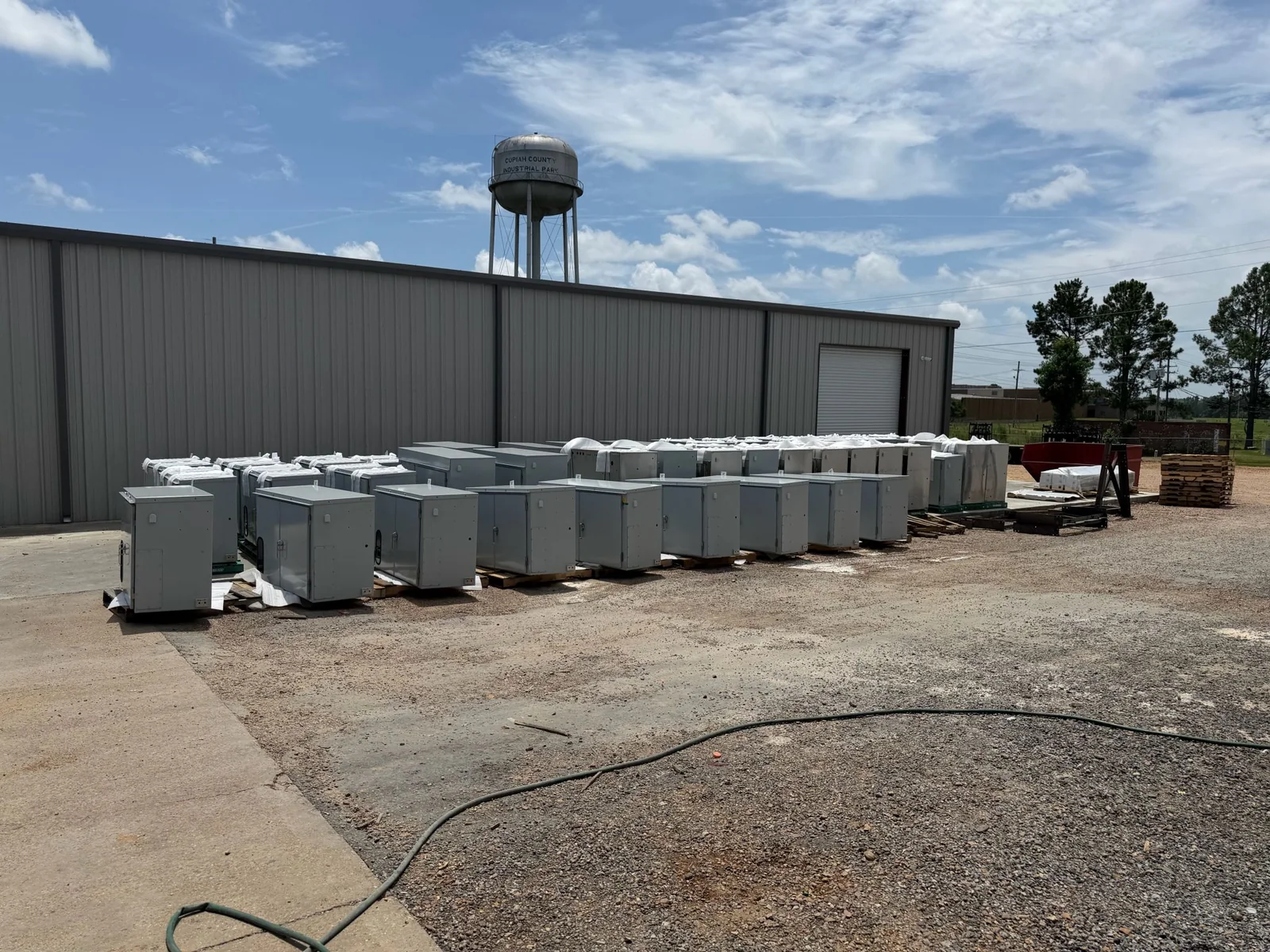
Between the campus substation and every electrical room sit transformers, and every one of them lives in a fabricated steel cabinet. Pad-mounted units in NEMA 3R cabinets at each building, dry-type units in ventilated enclosures inside, unit substations that marry a transformer to its switchgear — a single hyperscale building can carry dozens, and a campus hundreds. Transformer cabinets are the highest-volume enclosure product FabTek builds, and volume changes how they should be specified and sourced.
Have drawings for a data center build? Call 601.892.5017 or email collin.t@fabtekindustries.com — we quote to print and respond fast.
- Three cabinet families on a campus: pad-mount compartment cabinets, dry-type transformer enclosures and unit-substation transformer sections.
- Outdoor cabinets are NEMA 3R, tamper-resistant, and finished for 30 years of weather; indoor dry-type enclosures prioritize ventilation and clearances.
- Distribution transformer lead times have stretched to a year or more — cabinets are often built ahead of the transformer against the OEM’s drawings.
- At hundreds of units per month, the fabricator’s fixtures, finish line and dedicated crew matter more than any single unit’s price.
- Switchgear Enclosures for Data Centers
- Bus Duct & Busway for Data Centers
- Transformer Cabinets for Data Centers (you are here)
- Transformer Tanks for Data Centers
- Substation Steel for Data Centers
- PDU, UPS & Battery Cabinets for Data Centers
- Generator & BESS Enclosures for Data Centers
- Cable Tray Supports & Ladder Rack for Data Centers
- Equipment Skids, CDU Frames & Platforms for Data Centers
- Wiring Harnesses & Electrical Assembly for Data Centers
What a transformer cabinet is
A transformer cabinet is the fabricated steel enclosure that surrounds a transformer’s live compartments and, for outdoor units, its entire body. On a pad-mounted transformer, the cabinet is the front compartment structure: separate high-voltage and low-voltage bays with sequenced, tamper-resistant doors, a hood, sill and base that bolt to the tank or the pad. On a dry-type transformer, the cabinet is the enclosure — a ventilated housing that protects the core and coil while letting heat out. On a unit substation, the transformer section is one bay in a lineup that also houses the primary and secondary switchgear. In every case the cabinet is sheet-metal fabrication built to the transformer OEM’s print.
Where it lives in the data center
- At each building — medium-voltage feeders from the campus substation land in pad-mounted transformers or unit substations that step power down to 480 or 415 V. Two sets in a 2N design.
- In the electrical rooms — dry-type transformers in ventilated enclosures feed distribution panels, mechanical loads and house power.
- In the yard — station-service and auxiliary transformers for the substation, generators and cooling plant.
Part 2 of our first series, How a Data Center Gets Its Power, followed the voltage down from the transmission tap; the cabinets in this post are where that power arrives at the building.
What's different about data center transformer cabinets
The distinguishing factor is quantity and repetition. A transformer OEM supplying a campus program may need hundreds of identical cabinets on a monthly cadence for a year or more, and it needs each one to fit the same tank, the same bushings and the same pad without adjustment. That turns cabinet fabrication into a production-line problem: fixtures that hold the bolt pattern, a finish line that runs the same color and film thickness every shift, and a crew that knows the print. It is why we describe our transformer cabinet capability in units per month rather than in one-off terms, and why dedicated production lines with reserved capacity exist as a product.
A transformer cabinet is a simple part. Five hundred identical transformer cabinets, on time, in the same color, is a manufacturing system.
What to specify
| Cabinet type | Pad-mount compartment cabinet (single-phase or three-phase, live-front or dead-front), dry-type enclosure, unit-substation transformer section |
|---|---|
| Rating | NEMA 3R outdoors (4 or 4X for wash-down or coastal); NEMA 1/2 indoor dry-type; tamper-resistance per the utility or owner standard (recessed pentahead bolts, sequenced doors, no exposed hinges) |
| Material & gauge | Carbon steel, typically 12- or 11-gauge for doors and panels, heavier sills and bases; stainless or galvanneal for corrosive sites |
| Finish | Blast and pretreatment, powder coat to a stated color (Munsell green and ANSI 61 gray are common) and film thickness, salt-spray requirement; FabTek’s finish system is certified to IEEE 2000-hour salt spray |
| Compartment details | HV/LV barrier, door sequencing, interlocks, parking stands and bushing clearances, grounding pads, nameplate location, cable entry and pad opening |
| Ventilation (dry-type) | Louver area and screen, drip shields, clearances to core and coil, lifting provisions |
| Interfaces | Tank flange and bolt pattern, pad dimensions, bushing locations, switchgear section widths for unit substations |
| Volume & cadence | Monthly quantity, release schedule, packaging (skidded, stackable), and the transformer delivery dates cabinets must precede |
Match the enclosure rating to the environment — see How to Spec a NEMA-Rated Transformer Enclosure.
How a transformer cabinet is fabricated
Cabinets are cut on fiber laser from nested sheet, so doors, panels, hoods and sills for an entire run come off the same programs; formed on CNC press brakes with per-lot angle compensation; welded on fixtures that hold the tank bolt pattern and door alignment; blasted; and powder-coated on an in-house line that runs the customer’s color continuously. Hardware, gasketing, sequencing mechanisms and grounding pads are installed at assembly, and units are skidded for shipment in the sequence the OEM’s line needs them. Hundreds per month on a single shift is the normal cadence on FabTek’s cabinet line, with dual-shift capacity in reserve.
Common mistakes
- Treating a program like a one-off. Quoting 500 cabinets as 500 individual jobs misses the fixtures and finish-line planning that make the program work.
- Finish shortcuts. A pad-mount stands in the weather for decades; skipping pretreatment or under-specifying film thickness shows up as rust at the sill in year three.
- Ignoring tamper standards. Utility and owner standards for pentahead hardware and door sequencing are not optional on a public-facing pad-mount.
- Late color changes. Changing color mid-program costs a line changeover; settle it before release.
Lead time and sourcing
Distribution transformer lead times have stretched to a year or more, and OEMs are protecting their own floors for core, coil and tank work — which means cabinets are increasingly outsourced and often built ahead of the transformer against approved drawings. For an OEM or a program owner, the right move is a blanket agreement with monthly releases on a dedicated line, so the cabinet supply is never the reason a transformer ships late. We covered how that structure works in Long-Term Fabrication Contracts.
FabTek Industries fabricates NEMA 3R, 4 and 4X transformer cabinets, pad-mount compartment cabinets, dry-type enclosures and unit-substation sections to print for data center, EPC, electrical contractor and OEM customers — laser-cut, CNC-formed, fixture-welded, blasted and powder-coated in-house at hundreds of units per month — under an ISO 9001:2015 quality system with AWS-certified welding, from four production sites in Hazlehurst, Mississippi, shipped nationwide. Dedicated production lines with reserved monthly capacity are available for recurring volume, and our field crews handle on-site retrofit and repair. Send us your drawings or call 601.892.5017.
Frequently asked questions
What NEMA rating is a pad-mount transformer cabinet?
Outdoor pad-mount transformer cabinets are NEMA 3R as standard, with tamper-resistant construction (recessed pentahead hardware, sequenced doors, concealed hinges). NEMA 4 or 4X is specified for wash-down or corrosive environments such as coastal sites.
Why are transformer cabinets outsourced by transformer OEMs?
Transformer manufacturers are capacity-constrained on core, coil and tank work, so many outsource the sheet-metal cabinets to contract fabricators that can deliver hundreds per month to print, in the OEM's color, on a reserved production line.
What finish should a transformer cabinet have?
Blast or chemical pretreatment followed by powder coat to a specified color and film thickness, with a salt-spray performance requirement. FabTek's finish system is certified to IEEE 2000-hour salt spray.
How many transformer cabinets can FabTek produce?
FabTek's cabinet line produces hundreds of transformer cabinets per month on a single shift, with dual-shift and overflow capacity available for surge demand, from four production sites in Hazlehurst, Mississippi.