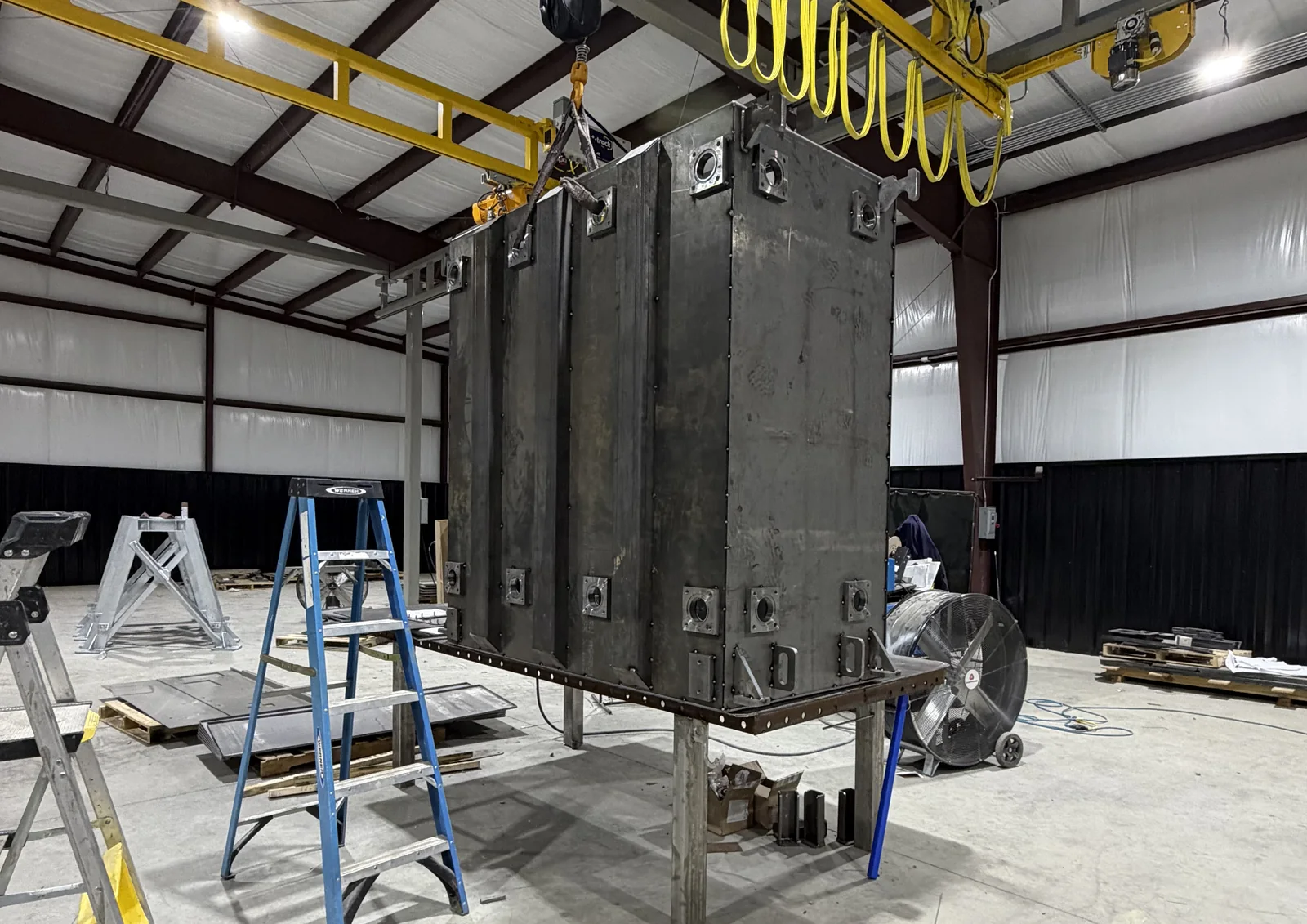
Behind the transformer shortage that sets every data center schedule is a piece of heavy fabrication most people never think about: the tank. Every liquid-filled transformer — from the 345 kV units in the campus substation to the pad-mounts at each building — lives in a welded steel vessel that holds the core, coil and insulating fluid under pressure for decades. Tank fabrication is one of the capacities transformer OEMs are shortest on, and one of the places contract fabrication is quietly adding to the supply.
Have drawings for a data center build? Call 601.892.5017 or email collin.t@fabtekindustries.com — we quote to print and respond fast.
- A transformer tank is a welded pressure-tight steel vessel that has to stay leak-free through decades of thermal cycling, vacuum filling and transport.
- Data centers use the full range: power tanks in the substation, pad-mount and corrugated-wall tanks at the buildings, conservator and sealed designs by OEM preference.
- Spec drivers are plate thickness and grade, weld procedures, pressure and leak testing, radiator and bushing interfaces, and the finish system.
- OEMs are outsourcing tank fabrication to free their floors for core and coil — a domestic tank fabricator is part of the fix for transformer lead times.
- Switchgear Enclosures for Data Centers
- Bus Duct & Busway for Data Centers
- Transformer Cabinets for Data Centers
- Transformer Tanks for Data Centers (you are here)
- Substation Steel for Data Centers
- PDU, UPS & Battery Cabinets for Data Centers
- Generator & BESS Enclosures for Data Centers
- Cable Tray Supports & Ladder Rack for Data Centers
- Equipment Skids, CDU Frames & Platforms for Data Centers
- Wiring Harnesses & Electrical Assembly for Data Centers
What a transformer tank is
A liquid-filled transformer’s core and coil are immersed in insulating fluid — mineral oil or a natural or synthetic ester — that both insulates and carries heat away. The tank is the welded steel vessel that contains all of it. It has to be pressure-tight and vacuum-tight (tanks are pulled to vacuum during oil filling), rigid enough to carry the core and coil during transport and lifting, provided with radiators or cooling tubes to shed heat, and fitted with bushings, gauges, valves and a cover that seal for the life of the unit. Structurally it is plate fabrication; functionally it is a pressure vessel, and it is inspected like one.
Where it lives in the data center
- Campus substation — large power transformers stepping transmission voltage down to 34.5 or 13.8 kV, in tanks the size of a shipping container with banks of radiators.
- Building step-down — pad-mounted and unit-substation transformers, often liquid-filled for capacity and efficiency, in pad-mount or corrugated-wall tanks.
- Yard and auxiliary — station-service transformers, generator step-up units and regulators.
Tank types
| Power transformer tank | Heavy-plate rectangular or form-fit vessel for substation-class units; detachable radiator banks, conservator or nitrogen-blanket oil preservation, jacking pads, lifting lugs, transport bracing |
|---|---|
| Pad-mount tank | Compact rectangular tank for pad-mounted distribution transformers, with the compartment cabinet bolted to the front; sealed design, cooling panels or fins |
| Corrugated-wall tank | Tank walls formed as corrugated cooling fins, eliminating separate radiators; common on distribution and small power units; demanding on forming and seam welding |
| Conservator tank | Auxiliary expansion vessel mounted above a power transformer to accommodate oil volume change; welded cylinder with breather and gauge fittings |
| Sealed / hermetic tank | Fully sealed tank designed to flex with oil expansion; no conservator or gas cushion; requires precise wall thickness and weld quality |
| Cylindrical / pole tank | Round tanks for single-phase distribution units and regulators; rolled and seam-welded |
FabTek fabricates corrugated-wall, conservator, power and pad-mount tanks to print. Welded-vs-bolted tradeoffs are covered in Welded vs. Bolted Transformer Tanks.
What to specify
- Plate and structure — steel grade and thickness for walls, base and cover; stiffeners and bracing; lifting, jacking and tie-down points rated for the filled weight.
- Welding — qualified procedures and welders (AWS D1.1 or the OEM’s standard), full-penetration seams where required, weld maps and inspection method (visual, dye penetrant, ultrasonic).
- Testing — pressure and vacuum hold tests to the OEM’s values and durations, leak test method, and documentation of each.
- Interfaces — radiator flanges and valves, bushing turrets and cover openings, tap-changer mounting, gauge and relief-device fittings, grounding pads, nameplate.
- Finish — interior cleaning and coating compatible with the insulating fluid; exterior blast, primer and topcoat to the OEM’s system and color.
- Documentation — material certs by heat number, weld records, test reports, as-built dimensions.
How a transformer tank is fabricated
Plate is cut on robotic plasma or laser depending on thickness, with cover openings, flange locations and stiffener slots placed by program. Walls and stiffeners are formed on heavy press brakes; corrugated walls are formed as continuous fin panels. Sub-assemblies are fitted on fixtures that hold squareness and flange positions, then welded by AWS-certified welders using qualified procedures, with seams inspected against the weld map. Radiator flanges, turrets and fittings are welded on and machined where a gasket face requires it. The finished tank is pressure- and vacuum-tested, blasted, primed and coated inside and out to the fluid-compatible and exterior systems specified, and shipped with test reports and material certs. It is heavy-plate work that depends on the same disciplines as the sheet-metal products in this series — program-driven cutting, fixturing, qualified welding and documented inspection — at a larger scale.
Tanks and the transformer bottleneck
The two- to four-year lead time on large power transformers has several causes — core steel supply, a thin winding workforce, a small number of OEMs — and we covered them in How the Transformer Supply Chain Works. Tank fabrication is a quieter fourth: it consumes floor space, crane time and welders that an OEM would rather spend on core and coil, and it cannot be skipped. That is why OEMs increasingly outsource tanks and cabinets to contract fabricators, and why a domestic fabricator with heavy-plate capability, qualified welders and testing capacity is genuinely part of the solution to the shortage. For data center developers, the practical implication is that the OEM you buy from is only as fast as its tank supply — a fair question to ask during procurement.
Lead time and sourcing
Tanks are built to the OEM’s design and typically purchased by the OEM, not the end user. For OEMs, the sourcing logic is a dedicated line with reserved capacity and a documented quality system that satisfies their own customers’ audits. For developers and EPCs, the leverage is indirect but real: choosing OEMs that have secured domestic tank and cabinet capacity, and building the surrounding substation steel and cabinets early so nothing waits on the tank but the tank itself.
FabTek Industries fabricates transformer tanks — corrugated-wall, conservator, power and pad-mount designs — along with the cabinets that bolt to them to print for data center, EPC, electrical contractor and OEM customers — plasma- and laser-cut plate, formed on heavy press brakes, fixture-fitted and welded to qualified procedures, pressure- and vacuum-tested, and coated inside and out to the OEM’s system — under an ISO 9001:2015 quality system with AWS-certified welding, from four production sites in Hazlehurst, Mississippi, shipped nationwide. Dedicated production lines with reserved monthly capacity are available for recurring volume, and our field crews handle on-site repair and retrofit. Send us your drawings or call 601.892.5017.
Frequently asked questions
What is a transformer tank made of?
Carbon steel plate, cut by plasma or laser, formed and welded into a pressure- and vacuum-tight vessel with stiffeners, lifting and jacking points, radiator flanges and bushing turrets. Interiors are coated with a fluid-compatible system; exteriors are blasted, primed and topcoated.
How is a transformer tank tested?
Tanks are pressure-tested and vacuum-tested to the OEM's specified values and hold times, leak-tested, and welds are inspected visually and by dye penetrant or ultrasonic methods per the weld map. Test reports and material certs ship with the tank.
What is a corrugated-wall transformer tank?
A tank whose walls are formed as continuous corrugated fins that act as the cooling surface, eliminating separate radiators. It is common on distribution and small power transformers and demands precise forming and seam welding.
Why does tank fabrication affect transformer lead times?
Tanks consume floor space, crane time and qualified welders that transformer OEMs would rather devote to core and coil work. Outsourcing tanks to domestic contract fabricators frees that capacity, which is one of the ways the industry is working to shorten transformer lead times.