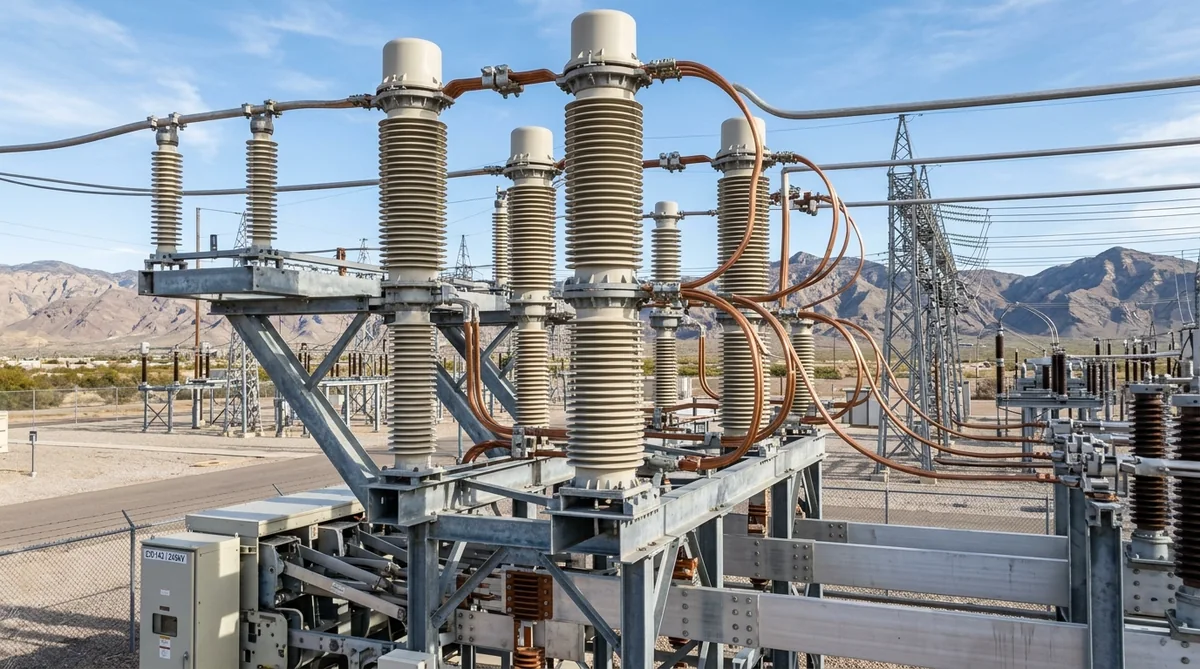
A hyperscale campus almost always has its own substation, and a substation is, physically, a field of galvanized steel with electrical equipment bolted on top. Dead-end structures terminate the incoming transmission line, bus supports carry rigid bus across the yard, equipment stands hold breakers, switches and arresters at working height, and control enclosures protect the relays. It is the most tonnage on the campus — and, unlike the transformers it supports, it can be fabricated in weeks.
Have drawings for a data center build? Call 601.892.5017 or email collin.t@fabtekindustries.com — we quote to print and respond fast.
- Substation steel is structure for equipment: dead-ends and A-frames, bus supports, equipment stands, gantries, control enclosures and miscellaneous supports.
- Nearly all of it is hot-dip galvanized for decades of outdoor life; every stand is drilled to a specific manufacturer’s bolt pattern.
- Structures are weeks, not years — order the package as soon as the layout freezes and it comes off the critical path.
- Delivery in erection sequence, match-marked with hardware kits, is worth as much as the steel; a fabricator with its own field crews removes a handoff.
- Switchgear Enclosures for Data Centers
- Bus Duct & Busway for Data Centers
- Transformer Cabinets for Data Centers
- Transformer Tanks for Data Centers
- Substation Steel for Data Centers (you are here)
- PDU, UPS & Battery Cabinets for Data Centers
- Generator & BESS Enclosures for Data Centers
- Cable Tray Supports & Ladder Rack for Data Centers
- Equipment Skids, CDU Frames & Platforms for Data Centers
- Wiring Harnesses & Electrical Assembly for Data Centers
What substation steel is
Substation steel is the family of fabricated structures that hold high-voltage equipment and conductors in position outdoors: the columns, beams, frames and stands that give every breaker, switch, transformer bushing and bus run the clearance, height and strength it needs. It is structural fabrication — wide-flange, tube, angle and plate — cut, drilled, welded and hot-dip galvanized to drawings produced from the electrical layout. Because different manufacturers’ equipment has different footprints, most of it is built to a specific project rather than from a catalog. Our general buyer’s guide is Substation Steel: A Buyer’s Guide.
Where it lives in the data center
The campus substation and, where the utility builds one, the switching station that feeds it. Also the medium-voltage yards at each building where pad-mounts and unit substations sit, the generator yard, and the behind-the-meter generation plant if the campus has one. We described how power gets to that yard in How a Data Center Gets Its Power. Because data center substations are typically built with full redundancy — two lines, two transformers, ring-bus or breaker-and-a-half schemes — they carry roughly double the structure count of a simple radial substation of the same voltage.
Structure types
| Dead-end & A-frame structures | Terminate incoming transmission conductors and carry full line tension; heavy columns and cross-arms, often A-frame or H-frame configuration |
|---|---|
| Bus-support structures | Columns and beams supporting rigid bus and insulators across the yard; sized for conductor weight, short-circuit forces, wind and ice |
| Equipment stands | Stands for circuit breakers, disconnect switches, surge arresters, CTs, PTs and CCVTs — each drilled to the equipment manufacturer’s bolt pattern and set to operating height |
| Gantry, goalpost & takeoff structures | Line entry and exit frames, often the tallest steel in the yard |
| Control enclosures & cabinets | Relay and control cabinets, junction boxes and control-house steel |
| Miscellaneous | Cable trench covers and supports, conduit racks, platforms and ladders, fencing posts, transformer firewalls and equipment screens |
What to specify
- Design basis — structural drawings with member sizes and connections, design loads (conductor tension, short-circuit, wind, ice, seismic), and the governing standard (typically ASCE 113).
- Material — steel grade (A36, A572 Gr. 50, A500 tube as applicable), plate thicknesses, anchor bolt and hardware grades.
- Equipment interfaces — manufacturer, model and mounting drawing for every piece of equipment, so each stand is drilled to the right pattern the first time.
- Coating — hot-dip galvanizing per ASTM A123 (hardware per A153), with any duplex paint-over-galvanizing for appearance or extreme corrosion; see Galvanizing vs. Paint.
- Fabrication details — weld procedures (AWS D1.1), bolt-hole tolerances, camber and straightness limits, vent and drain holes for galvanizing, match-marking.
- Delivery and erection — erection sequence and dates, hardware kits per structure, packaging, whether field erection is in scope.
The full checklist is in Substation Steel Procurement Checklist.
How substation steel is fabricated and erected
Structural members are processed on a robotic plasma system — FabTek’s Voortman V807 cuts, drills and marks beams and columns on one platform — so bolt holes land within tolerance without layout by hand. Plates and gussets are laser- or plasma-cut, fit on fixtures and welded to AWS D1.1 by certified welders, with weld inspection recorded. Assemblies are detailed with vent and drain holes and sent for hot-dip galvanizing, then inspected for coating thickness and appearance, match-marked, bundled by structure with hardware kits, and loaded in erection sequence. Where the owner wants it, FabTek’s own crews perform field erection, which removes the handoff between fabricator and erector entirely.
The steel package is the one line on a data center power schedule that a buyer can actually pull forward. Everything else is waiting on someone else’s factory.
Common mistakes
- Ordering steel off the transformer date. Steel is short-lead only if it’s ordered early. Waiting for the transformer ship date turns weeks into a scramble.
- Missing equipment drawings. A stand drilled to a generic pattern is a field-drilling job on galvanized steel — which also damages the coating.
- Galvanizing details left off. Closed sections without vents can rupture in the kettle; overlapping plates without weep holes trap acid. Detail for the process.
- No erection sequence. Steel that arrives out of order sits in the yard while the crane waits for the pieces it needs.
Lead time and sourcing
Fabrication plus galvanizing is a matter of weeks once approved drawings and equipment mounting details are in hand. The sourcing move for a developer or EPC is to engage the fabricator at layout, release the package as soon as the equipment list freezes, and align delivery to the erection plan — not to the transformer. Domestic fabrication keeps freight short and galvanizing coordinated, and a fabricator with field crews can absorb the inevitable late change. FabTek supplies turnkey substation steel packages to EPCs across the Southeast and the eastern grid.
FabTek Industries fabricates substation structures and support steel — dead-ends, A-frames, bus supports, equipment stands, gantries, control enclosures and miscellaneous steel to print for data center, EPC, electrical contractor and OEM customers — robotic-plasma processed, laser-cut, AWS D1.1 welded, hot-dip galvanized to ASTM A123, match-marked and delivered in erection sequence — under an ISO 9001:2015 quality system with AWS-certified welding, from four production sites in Hazlehurst, Mississippi, shipped nationwide. Dedicated production lines with reserved monthly capacity are available for recurring volume, and our field crews handle on-site erection. Send us your drawings or call 601.892.5017.
Frequently asked questions
What structures are in a data center substation?
Dead-end and A-frame structures that terminate the incoming transmission lines, bus-support structures carrying rigid bus, equipment stands for breakers, switches, arresters and instrument transformers, gantry and takeoff structures, control enclosures, and miscellaneous supports such as cable trench covers and conduit racks — nearly all hot-dip galvanized.
How long does substation steel take to fabricate?
Fabrication and hot-dip galvanizing typically take weeks once approved drawings and equipment mounting details are released, which is why substation steel should be ordered as soon as the layout freezes rather than off the transformer delivery date.
Why is substation steel galvanized rather than painted?
Hot-dip galvanizing to ASTM A123 gives decades of outdoor corrosion protection with no maintenance, including inside closed sections and at cut edges. Paint is used over galvanizing (duplex) only where appearance or extreme environments require it.
Does FabTek erect substation steel on site?
Yes. FabTek's field crews perform on-site substation and switchyard steel erection, so the fabricated structures and the installation come from one source with one schedule.