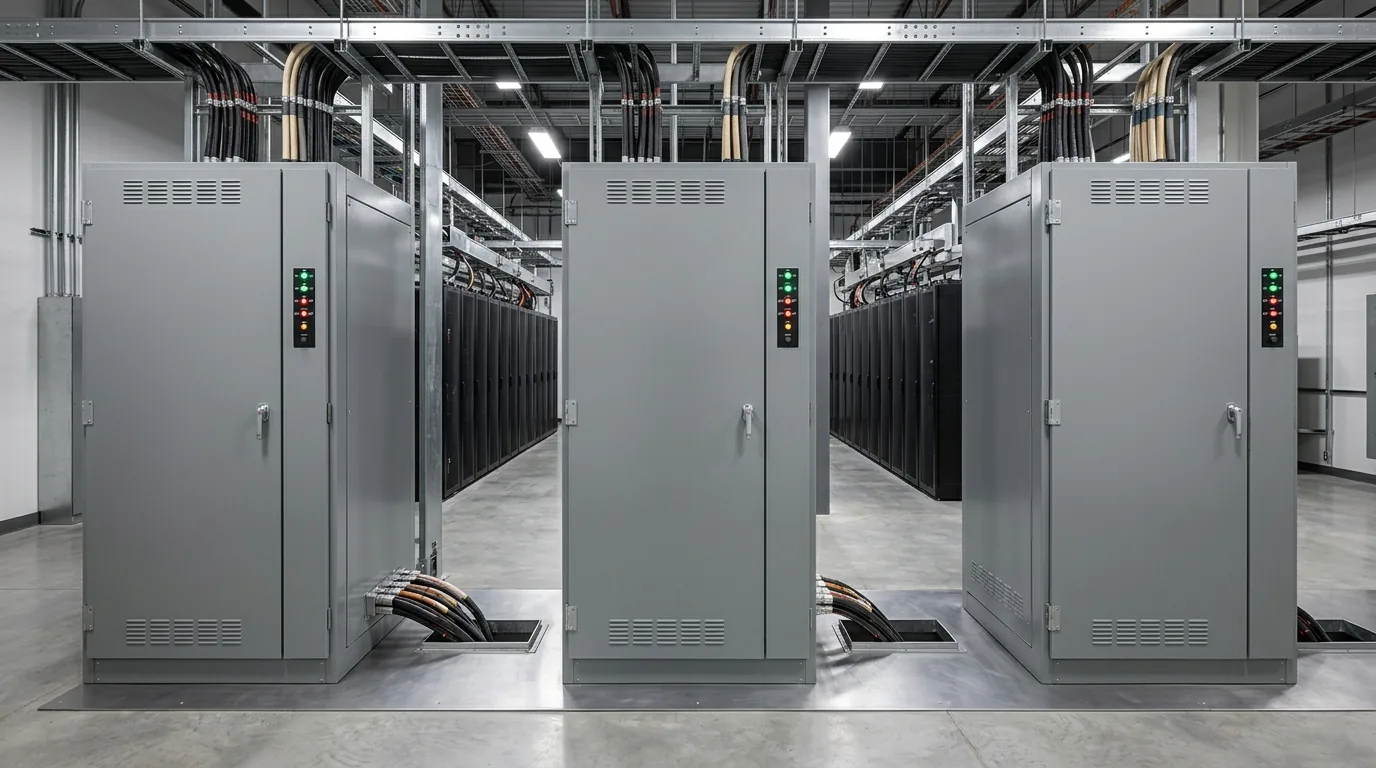
Every megawatt entering a data center passes through switchgear, and every lineup of switchgear is delivered inside a fabricated steel enclosure. On a hyperscale campus that is dozens of enclosures per building — medium-voltage walk-ins in the yard, low-voltage sections in the electrical rooms, paralleling gear beside the generators. This first post in our data center fabrication series covers what a switchgear enclosure has to do, what to put on the drawing, and how to get them built and delivered in step with gear that has been on order for two years.
Have drawings for a data center build? Call 601.892.5017 or email collin.t@fabtekindustries.com — we quote to print and respond fast.
- Switchgear enclosures fall into three families on a campus: outdoor walk-in NEMA 3R houses, indoor free-standing sections, and generator paralleling-gear enclosures.
- A 2N design roughly doubles the enclosure count; standardizing the design across buildings is what lets a fabricator run them as a product line.
- The spec items that decide 20-year performance: NEMA rating, gauge, weld quality, gasketing, finish system and door hardware — plus arc-resistant details where required.
- Enclosures are short-lead in isolation; the risk is sequencing. Order them against the switchgear delivery date, not after it.
- Switchgear Enclosures for Data Centers (you are here)
- Bus Duct & Busway for Data Centers
- Transformer Cabinets for Data Centers
- Transformer Tanks for Data Centers
- Substation Steel for Data Centers
- PDU, UPS & Battery Cabinets for Data Centers
- Generator & BESS Enclosures for Data Centers
- Cable Tray Supports & Ladder Rack for Data Centers
- Equipment Skids, CDU Frames & Platforms for Data Centers
- Wiring Harnesses & Electrical Assembly for Data Centers
What a switchgear enclosure is
Switchgear is the assembly of circuit breakers, bus, relays and instrument transformers that receives, protects and switches power. The enclosure is the fabricated steel structure that houses it: the sections, doors, roof, base, barriers and mounting provisions that keep the electrical components aligned, protected from weather and contact, and serviceable. For outdoor gear, the enclosure becomes a small building — a walk-in house with an aisle, lighting, heating, ventilation and cable entry — delivered with the gear installed. For indoor gear, it is the free-standing steel sections the OEM populates with breakers and bus.
In either case, the enclosure is the part of the product most often outsourced by the switchgear OEM or bought directly by the EPC, which is why it belongs in a series about data center metal fabrication.
Where it lives in the data center
- Campus substation and yard — medium-voltage (13.8 or 34.5 kV) metal-clad switchgear in outdoor walk-in NEMA 3R enclosures, receiving the feeds from the step-down transformers.
- Main electrical rooms — medium- and low-voltage switchgear and switchboards in indoor free-standing sections, two complete lineups per building in a 2N design.
- Generator yard — paralleling switchgear that combines the output of the standby generators, usually in its own outdoor enclosure next to the units.
- Behind-the-meter generation — where a campus adds gas turbines, engines or battery storage, each block brings its own switchgear and enclosure.
We walked the full chain from utility feed to rack in Inside the Data Center Electrical Room; this post zooms in on the metal.
What's different about data center switchgear enclosures
Three things. Volume — a single hyperscale building can need more lineups than a mid-size industrial plant, and a campus multiplies that by the building count. Repetition — operators standardize the electrical room, so the same enclosure design repeats across sites; a fabricator that builds it as a product line, with fixtures and a dedicated crew, delivers more consistently than one treating each as a custom job. Schedule coupling — the enclosure has to be complete when the gear is ready to be installed or set, and the gear's date is fixed by an OEM backlog. The enclosure cannot be late, but it also should not be built before the OEM's final drawings freeze, because a late change to bus geometry or breaker frame ripples into cutouts and mounting.
The gear has a two-year lead time. The enclosure has a six-week lead time. The enclosure is still the one that shows up late if nobody owns the sequence.
What to specify
| Enclosure type | Outdoor walk-in (aisle, non-walk-in), indoor free-standing sections, paralleling-gear house; single or dual-aisle |
|---|---|
| NEMA / environment | NEMA 3R is standard outdoors; NEMA 4 for wash-down or splash; 4X for coastal or corrosive sites. Indoor sections typically NEMA 1 or 12. See NEMA 3R vs. 4 vs. 4X |
| Material & gauge | Carbon steel, 12- or 11-gauge panels and doors; heavier structural members for base, roof and lifting; galvanneal or stainless where specified |
| Finish | Blast, pretreatment and powder coat to a stated color and film thickness; ANSI 61 gray common; salt-spray requirement (FabTek’s system is certified to IEEE 2000-hour salt spray); galvanized base channel outdoors |
| Hardware & sealing | Three-point latching, padlockable handles, stainless hinges, door stops, closed-cell gasketing, drip shields over doors, screened and filtered ventilation |
| Arc-resistant details | Where the gear is arc-rated: pressure-relief flaps or plenum, reinforced doors and hinges, sealed seams — built to the OEM’s tested design |
| Interfaces | OEM section widths and depths, breaker cutout dimensions, bus penetration locations, floor-channel and anchor bolt pattern, cable entry (bottom, top, side), transformer throat flange location |
| Building services (walk-ins) | Lighting, receptacles, heaters and thermostats, exhaust fans, door interlocks, roof drainage, removable roof sections for maintenance, lifting lugs and shipping splits |
| Documentation | Material certs, weld inspection records, finish reports, as-built drawings, ISO 9001 and AWS certificates |
Representative spec items. Arc-resistant construction must follow the switchgear OEM’s tested configuration.
How a switchgear enclosure is fabricated
At FabTek the sequence is: fiber-laser cutting of sheet and plate with every cutout, vent and hole placed by program; CNC press-brake forming of panels, doors and channels to tight, repeatable angles; robotic plasma processing of heavier structural members; AWS-certified MIG and TIG welding of frames, bases and roofs; blast-room surface prep; powder coat on our in-house line; then assembly — doors hung, hardware and gasketing installed, and, where the customer wants it, back panels mounted and wired before shipment. Fixtures hold section dimensions so that a forty-section campus order stays interchangeable. We covered the hyperscale-specific requirements in Switchgear Enclosures for Hyperscale Builds.
Common mistakes
- Over-specifying the rating. 4X stainless where 3R carbon steel is all the environment needs adds cost and lead time without benefit.
- Under-specifying the finish. “Painted gray” is not a spec. Call out pretreatment, film thickness and a salt-spray requirement.
- Freezing the enclosure before the gear. A late breaker-frame change means recut panels. Tie the enclosure release to the OEM’s approved drawings.
- Ignoring shipping splits and lifting. A walk-in that can’t be trucked or set with the crane on site is a redesign at the worst time.
- Separating metal and wiring. Two vendors, two schedules, one fit-up problem. Buy the wired enclosure from one shop where you can.
Lead time and sourcing
A switchgear enclosure is weeks of fabrication, not years — if the fabricator has floor space when your drawings release. The shops that do this well are busy, so engage at preliminary design, get the enclosure on a reserved production line if the volume repeats, and give the fabricator the switchgear delivery date so the enclosure lands the week before. Domestic sourcing matters here more than almost anywhere else: an imported walk-in that arrives dented, mis-drilled or late has no rush replacement, and a change order takes months. From Hazlehurst, most Southeastern and Gulf sites are a day’s truck ride. We laid out the broader argument in Where Data Center Builds Get Stuck.
FabTek Industries fabricates NEMA-rated switchgear enclosures, walk-in houses, control cabinets and panel housings to print for data center, EPC, electrical contractor and OEM customers — laser-cut, CNC-formed, AWS-welded, blasted and powder-coated in-house, with optional integrated wire-out — under an ISO 9001:2015 quality system with AWS-certified welding, from four production sites in Hazlehurst, Mississippi, shipped nationwide. Dedicated production lines with reserved monthly capacity are available for recurring volume, and our field crews handle on-site setting and retrofit work. Send us your drawings or call 601.892.5017.
Frequently asked questions
What NEMA rating do outdoor data center switchgear enclosures need?
NEMA 3R is the standard for outdoor walk-in switchgear houses and paralleling-gear enclosures. NEMA 4 is specified where hose-down or splash exposure exists, and NEMA 4X where corrosion resistance is required, such as coastal sites. Indoor sections are typically NEMA 1 or 12.
What gauge steel is used for switchgear enclosures?
Panels and doors are commonly 12- or 11-gauge carbon steel, with heavier structural members for the base, roof and lifting points. The switchgear OEM's tested design governs where arc-resistant construction is required.
How long does it take to fabricate a switchgear enclosure?
Fabrication is typically measured in weeks once approved drawings are released and floor capacity is reserved. The schedule risk is sequencing: the enclosure must be complete when the switchgear is ready to install, so it should be ordered against the gear's delivery date.
Can a fabricator wire the enclosure before shipping?
Yes. FabTek mounts back panels, components and terminal blocks and completes point-to-point wiring in-house, so the enclosure ships as a single tested unit and the electrical contractor lands feeders rather than building panels on site.