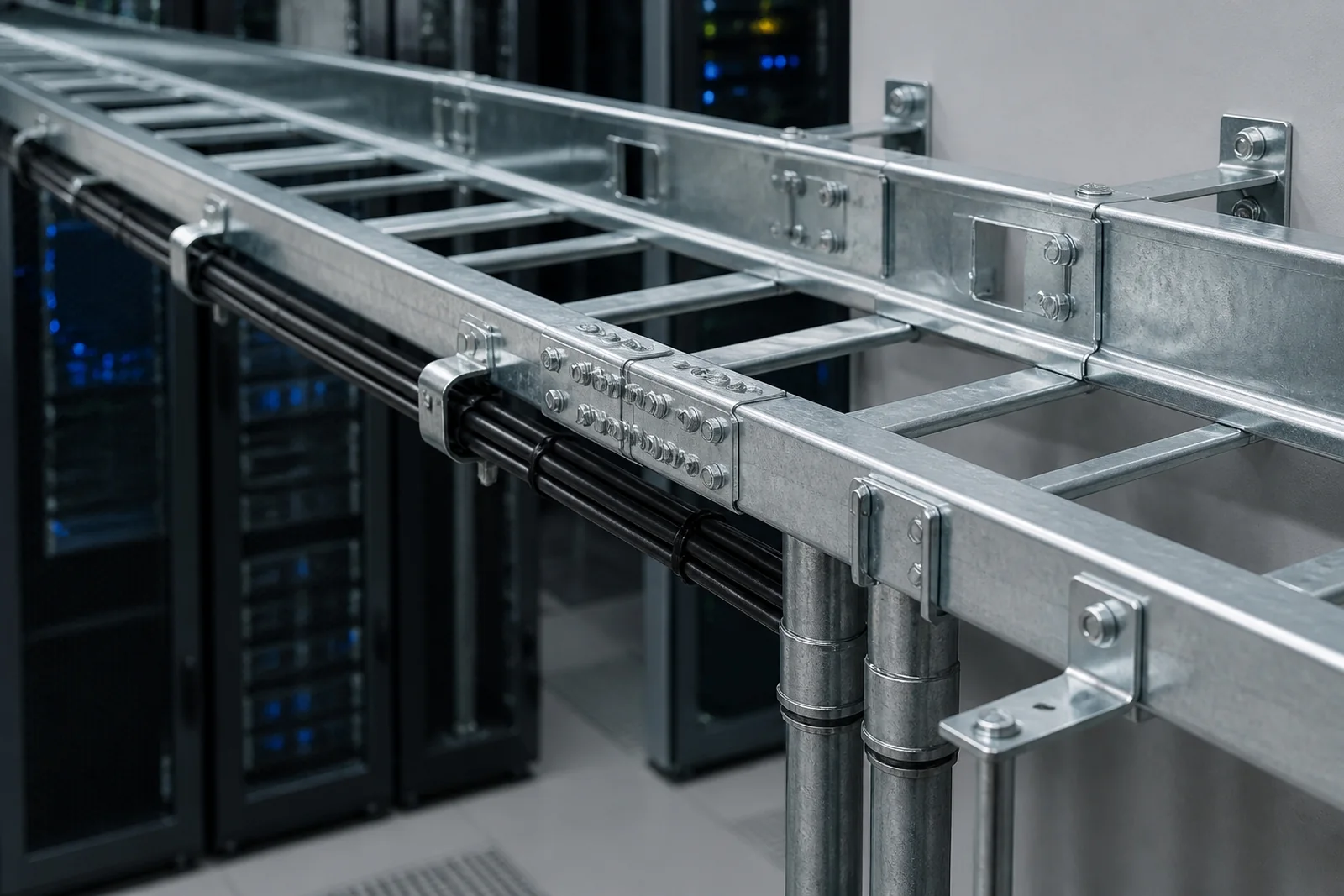
A data center is threaded with miles of cable tray, ladder rack, conduit and overhead busway — power and fiber to every rack, control wiring to every device — and none of it holds itself up. Trapeze hangers, wall brackets, conduit racks, busway hangers and overhead support frames are the fabricated steel that carries it all. Individually they are simple parts. Collectively they arrive in thousands, and a project that gets them late or out of sequence watches its electricians stand around.
Have drawings for a data center build? Call 601.892.5017 or email collin.t@fabtekindustries.com — we quote to print and respond fast.
- Support steel includes trapeze hangers, cantilever brackets, conduit racks, ladder rack supports, busway hangers and mezzanine-level support frames.
- Data center specifics: heavy overhead loads (busway, dense tray), seismic bracing, coordinated multi-tier routing, and volume in the thousands of pieces.
- Specify materials, coating, load ratings, attachment details and quantities by zone, and give the fabricator the install sequence.
- The sourcing win is kitting and sequencing: parts delivered by area, labeled, in the order the trades will hang them.
- Switchgear Enclosures for Data Centers
- Bus Duct & Busway for Data Centers
- Transformer Cabinets for Data Centers
- Transformer Tanks for Data Centers
- Substation Steel for Data Centers
- PDU, UPS & Battery Cabinets for Data Centers
- Generator & BESS Enclosures for Data Centers
- Cable Tray Supports & Ladder Rack for Data Centers (you are here)
- Equipment Skids, CDU Frames & Platforms for Data Centers
- Wiring Harnesses & Electrical Assembly for Data Centers
What support steel is
Everything overhead in a data center — cable tray, ladder rack, conduit banks, busway, piping — hangs from structure through fabricated steel intermediaries. Trapeze hangers carry tray and conduit on threaded rod from the deck; cantilever brackets hold tray off walls and columns; conduit racks carry banks of conduit in the yard and along building perimeters; busway hangers set the plug-in runs at the right height and spacing over the racks; and at mezzanine and gallery levels, purpose-built support frames carry the heaviest concentrations. Some of this is catalog strut; a great deal of it, especially the heavier and more specific pieces, is fabricated to the electrical contractor’s or engineer’s drawings.
Where it lives in the data center
Overhead in the data hall (busway and tray over the rack rows), in the electrical rooms and galleries (feeder tray and conduit between switchgear, UPS and PDUs), in the substation and yard (cable trench supports, conduit racks between transformers, generators and buildings), and on rooftops and mezzanines where mechanical and electrical distribution runs. FabTek also builds the related substation-yard items — cable trench covers, conduit racks, platforms and ladders — as part of substation steel packages.
What's different about data center support steel
Loads and coordination. Overhead busway and fully loaded tray are heavier than typical commercial runs, and AI halls stack power, fiber and liquid-cooling manifolds in multiple tiers over each row, so hangers are engineered rather than picked from a catalog. Seismic bracing is common. And the volume is enormous: a single building can consume thousands of hangers and brackets across dozens of zones, each with its own install date. The fabricator’s job is as much logistics as fabrication.
What to specify
| Part types & quantities | Schedule of hangers, brackets, racks, frames and busway hangers by type, with quantities by zone or area |
|---|---|
| Loads | Design load per support (tray fill, busway weight, conduit bank), safety factor, seismic category and bracing requirement |
| Material | Carbon steel angle, channel, tube and plate; A36 / A572; strut and hardware grades where mixed with catalog product |
| Coating | Hot-dip galvanized (ASTM A123) for yard and damp locations; pre-galvanized or powder coat indoors; stainless where specified |
| Attachment | Anchor and insert types, rod sizes, beam-clamp compatibility, slotted holes for field adjustment, attachment to PEMB purlins or concrete deck |
| Fabrication detail | Weld vs. bolt assembly, hole patterns, edge preparation (no sharp edges near cable), labeling and match-marking |
| Delivery | Kitting by zone, labeling standard, packaging, delivery sequence tied to the install schedule |
How it's fabricated
This is high-mix, high-volume structural and sheet-metal work. Angle, channel and tube are processed on robotic plasma for cutting, drilling and marking in one pass; plates and brackets are laser-cut in nests; parts are formed on CNC press brakes where required, welded to AWS D1.1 on simple fixtures, deburred so no edge can damage cable jacket, and finished — hot-dip galvanized for outdoor or damp service, powder-coated or pre-galvanized indoors. The differentiator is the back end: parts are labeled, kitted by zone with hardware, and staged to ship in the order the electrical contractor will hang them. It is the same discipline FabTek applies to substation support steel, scaled to thousands of small pieces.
Common mistakes
- Bulk delivery. Ten thousand hangers on pallets with no zone labeling is a sorting project the site didn’t staff for.
- Catalog hangers for engineered loads. Multi-tier busway and coolant manifolds over AI rows exceed what generic strut trapezes are rated for.
- Sharp edges. Support steel near cable must be deburred; a nicked jacket is a fault waiting to happen.
- Wrong coating for the location. Powder coat in a wet cable trench or pre-galv in a coastal yard fails early.
Lead time and sourcing
Support steel is fast to fabricate and easy to under-plan. The right approach is a schedule of parts by zone released with the electrical contractor’s rough-in plan, a blanket order so the fabricator can buy material and run the plasma line in efficient batches, and deliveries kitted to the sequence. Domestic fabrication a day’s haul from the site makes the inevitable adds and changes a phone call rather than a delay.
FabTek Industries fabricates cable tray supports, ladder rack supports, conduit racks, busway hangers and overhead support frames, along with substation-yard trench covers, platforms and ladders to print for data center, EPC, electrical contractor and OEM customers — robotic-plasma processed, laser-cut, AWS-welded, deburred for cable safety, hot-dip galvanized or powder-coated, and kitted by zone — under an ISO 9001:2015 quality system with AWS-certified welding, from four production sites in Hazlehurst, Mississippi, shipped nationwide. Dedicated production lines with reserved monthly capacity are available for recurring volume, and our field crews handle on-site installation. Send us your drawings or call 601.892.5017.
Frequently asked questions
What supports cable tray and busway in a data center?
Trapeze hangers on threaded rod from the deck, cantilever brackets on walls and columns, conduit racks, busway hangers set to the rack-row layout, and engineered support frames at mezzanine and gallery levels — much of it fabricated to the project's drawings rather than taken from a catalog.
Should data center cable tray supports be galvanized?
Hot-dip galvanized (ASTM A123) is standard for yard, trench and damp locations; pre-galvanized or powder-coated steel is common indoors. The coating should match the location, since powder coat fails early in wet trenches and pre-galvanized steel is inadequate in coastal yards.
Why do overhead supports in AI data halls need engineering?
AI rack rows stack three or four overhead tiers — busway, power tray, fiber and liquid-cooling manifolds — with loads that exceed generic strut trapeze ratings, and often require seismic bracing, so supports are engineered and fabricated to the design load.
How should support steel be delivered to a data center site?
Kitted by zone or area with hardware, labeled to the drawing, and shipped in the order the electrical contractor will install it, so the site is never sorting pallets or waiting on the next area's parts.