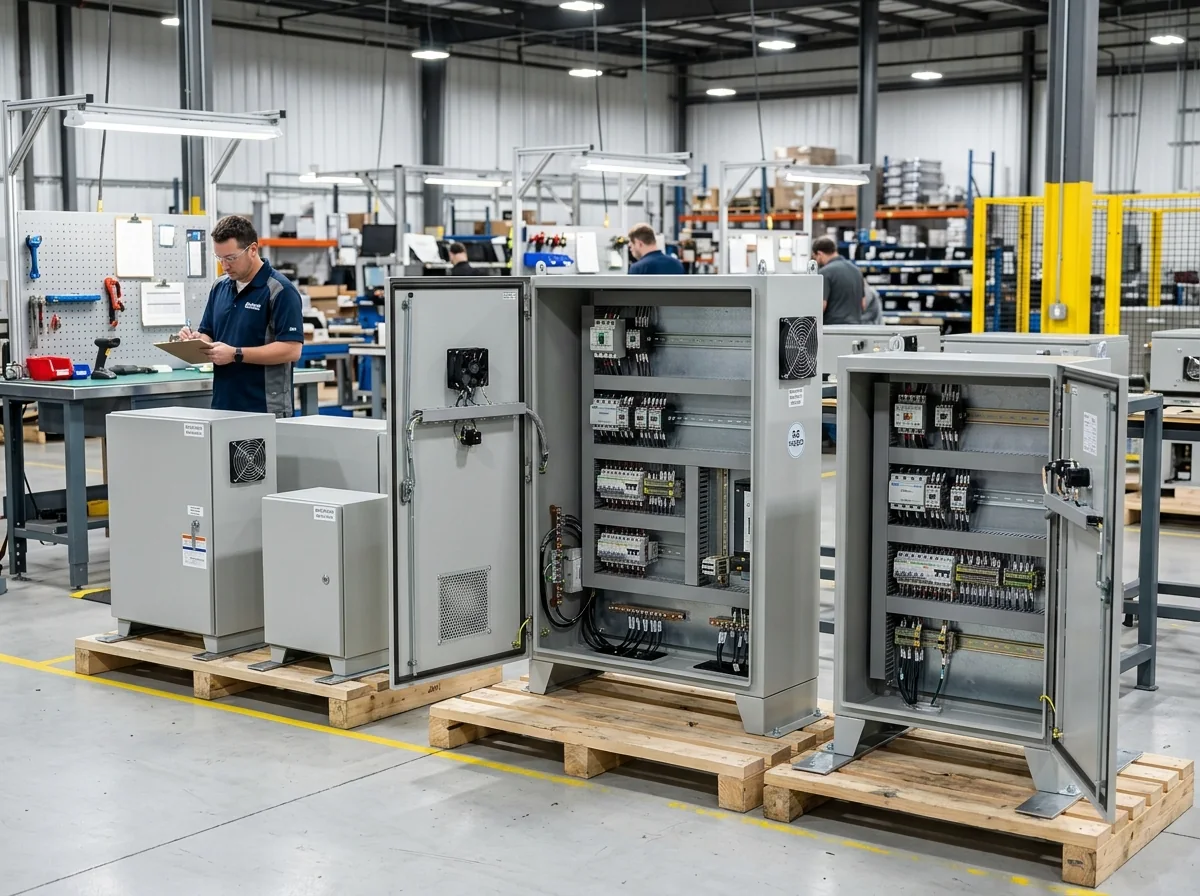
Between the switchgear and the server rack sits a layer of electrical cabinets most people never see: power distribution units, remote power panels, UPS modules, battery cabinets and the control panels that run the building. None of them is glamorous, all of them are fabricated sheet metal, and a hyperscale building needs hundreds. This post covers what each cabinet does, what to put on the drawing, and why buying them already wired is one of the few ways to recover labor hours on a data center site.
Have drawings for a data center build? Call 601.892.5017 or email collin.t@fabtekindustries.com — we quote to print and respond fast.
- The cabinet layer: PDUs and RPPs split power to racks; UPS modules and battery cabinets carry the load through an outage; control panels run mechanical and building systems.
- Spec drivers are gauge, ventilation, seismic anchorage, component clearances, cable entry and finish — plus battery-specific containment and thermal requirements.
- A cabinet delivered with the back panel mounted and point-to-point wired saves a week of scarce electrician time per unit.
- These are high-volume, repeating parts — the right sourcing model is a dedicated line with reserved capacity, not a series of RFQs.
- Switchgear Enclosures for Data Centers
- Bus Duct & Busway for Data Centers
- Transformer Cabinets for Data Centers
- Transformer Tanks for Data Centers
- Substation Steel for Data Centers
- PDU, UPS & Battery Cabinets for Data Centers (you are here)
- Generator & BESS Enclosures for Data Centers
- Cable Tray Supports & Ladder Rack for Data Centers
- Equipment Skids, CDU Frames & Platforms for Data Centers
- Wiring Harnesses & Electrical Assembly for Data Centers
What these cabinets are
- Power distribution units (PDUs) — floor-standing cabinets, often with an integral transformer, that take a feeder from the UPS output and split it into dozens of branch circuits for the racks. Houses breakers, monitoring, and sometimes a static switch.
- Remote power panels (RPPs) — smaller distribution cabinets placed at the end of rack rows, fed from a PDU, bringing breakers closer to the load.
- UPS modules — the rectifier, inverter and control electronics of the uninterruptible power supply, in modular cabinets that line up into a UPS plant.
- Battery cabinets — house the battery strings (increasingly lithium-ion) that carry the load while generators start; require ventilation, thermal management, containment and monitoring provisions.
- Control cabinets and panel housings — the enclosures for building management, mechanical controls, generator controls, fire and life-safety panels and instrumentation.
FabTek builds these as control cabinets and electrical panel housings and, increasingly, as wired assemblies for OEMs and contractors.
Where they live in the data center
PDUs and RPPs sit in the data hall or the adjacent electrical galleries, close to the racks they feed. UPS modules and battery cabinets occupy dedicated UPS and battery rooms in the gray space, two complete plants per building in a 2N design. Control panels are everywhere: mechanical rooms, generator yard, electrical rooms, the building management office. For the full picture of the space they occupy, see What’s Inside a Data Center?
What's different about data center cabinets
Density and repetition, again. A large AI hall may need a PDU or RPP every few rack rows on each of two redundant paths, and a UPS plant is a lineup of dozens of identical modules and battery cabinets. Operators standardize these designs across sites. That makes the cabinet a product-line problem for the fabricator — fixtures, nested cutting programs, a finish line running one color — and it makes wire-out a schedule lever, because the same panel layout repeats hundreds of times. Battery cabinets add their own requirements: thermal-event containment, ventilation to the fire code, seismic anchorage for heavy strings, and monitoring penetrations.
What to specify
| Cabinet type & form | PDU / RPP / UPS module / battery cabinet / control panel; floor-standing, wall-mount or lineup; front-, rear- or dual-access |
|---|---|
| Material & gauge | Carbon steel, 14- to 11-gauge by size and load; galvanneal or stainless where specified; heavier base for transformer-equipped PDUs and battery strings |
| Rating | Typically NEMA 1 or 12 indoors; gasketed doors where dust control matters; NEMA 3R for any yard-mounted control panel |
| Ventilation & thermal | Louver area and filtration, fan mounting, heat-load path; battery cabinets: code-required ventilation, thermal-event containment provisions, temperature-sensor penetrations |
| Structural | Seismic anchorage detail, floor-loading and casters or leveling feet, lifting provisions, shipping splits for lineups |
| Interior | Back-panel dimensions and mounting, DIN rail and component layout, breaker cutouts, busbar supports, grounding pads, cable entry (top/bottom/side) and gland plates |
| Finish | Powder coat to stated color and film thickness; textured finishes common; interior white for visibility |
| Wire-out scope | Bill of materials, wiring diagrams, labeling standard, test procedure, and whether components are customer- or fabricator-supplied |
Where a cabinet is part of a listed assembly, the OEM’s certified design governs construction.
How they're fabricated
Cabinet bodies, doors and back panels are laser-cut from nested sheet with every cutout, knockout and mounting hole placed by program; formed on CNC press brakes; welded or PEM-fastened depending on the design; blasted; powder-coated; and assembled with hardware and gasketing. For wired assemblies, the back panel then moves to the electrical assembly floor where components are mounted to the layout drawing, point-to-point wiring is run and labeled to the diagram, and the finished panel is installed in the cabinet, inspected and bench-tested before it ships. The metal and the wiring never leave the building, which is the whole point.
Why buy them wired
The scarcest resource on a data center site is a licensed electrician’s hour — we made the case in The Field Crew Labor Bottleneck. A cabinet that arrives with the back panel mounted, components installed and wiring landed and labeled turns days of site work into hours of landing feeders and terminating field wiring. It also removes the two-vendor handoff — a metal shop and a panel shop, two schedules, two sets of tolerances — that most often causes a cabinet to fit wrong or ship late. The math is in Integrated Wiring Assemblies.
Lead time and sourcing
These are repeating parts, and the sourcing model should match: a blanket agreement or dedicated production line with monthly releases, drawings frozen per design revision, components either consigned or sourced through the fabricator, and delivery sequenced to the electrical rooms as they come available. Individual cabinets are days of fabrication; a campus program is a year of steady output. Domestic sourcing keeps a design revision from becoming a container-ship delay.
FabTek Industries fabricates PDU, RPP, UPS, battery and control cabinets and electrical panel housings, wired or unwired to print for data center, EPC, electrical contractor and OEM customers — laser-cut, CNC-formed, powder-coated and, on request, fully wired and bench-tested on our electrical assembly floor — under an ISO 9001:2015 quality system with AWS-certified welding, from four production sites in Hazlehurst, Mississippi, shipped nationwide. Dedicated production lines with reserved monthly capacity are available for recurring volume, and our field crews handle on-site installation and retrofit. Send us your drawings or call 601.892.5017.
Frequently asked questions
What is a PDU cabinet in a data center?
A power distribution unit is a floor-standing electrical cabinet, often with an integral transformer, that takes a feeder from the UPS output and divides it into dozens of branch circuits for server racks. Remote power panels (RPPs) are smaller distribution cabinets placed at the end of rack rows.
What gauge steel is used for electrical cabinets?
Data center electrical cabinets are typically 14- to 11-gauge carbon steel depending on size and load, with heavier bases for transformer-equipped PDUs and battery cabinets. Galvanneal or stainless is used where the environment requires it.
What are the special requirements for battery cabinets?
Battery cabinets need code-required ventilation, thermal-event containment provisions, seismic anchorage for heavy strings, temperature and monitoring penetrations, and structural design for the string weight — in addition to standard electrical cabinet requirements.
Can FabTek supply electrical cabinets already wired?
Yes. FabTek fabricates the cabinet and completes component mounting, point-to-point wiring, labeling and bench testing in-house, so the unit ships as a single tested assembly and site electricians only land feeders and field wiring.