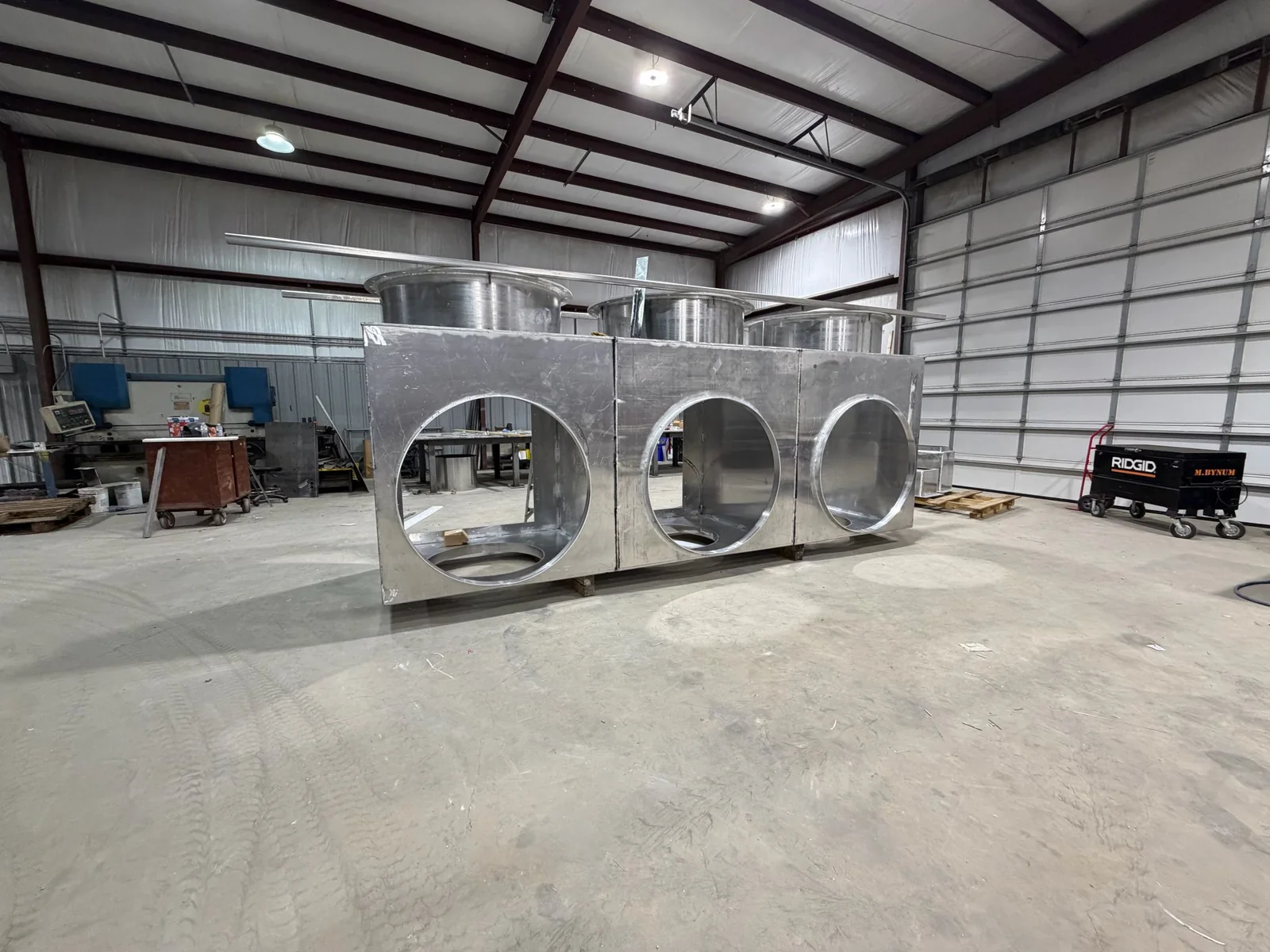
At a few hundred amps, power moves in cable. At the thousands of amps a data center electrical room handles, cable stops making sense — and rigid bus duct takes over. Bus duct and busway are the most data-center-specific fabricated products on this list: nearly every new hall is designed around them, and they are the least forgiving to build, because a run of sections has to align to a fraction of an inch and mate to an OEM bus stack exactly.
Have drawings for a data center build? Call 601.892.5017 or email collin.t@fabtekindustries.com — we quote to print and respond fast.
- Two jobs, two products: feeder bus duct (1,600–6,000+ A) connects transformers, switchgear and distribution; overhead busway (400–1,200+ A) runs down each rack row with plug-in tap-offs.
- Phase configuration — non-segregated, segregated or isolated-phase — drives the housing design and cost.
- The fabricated content is the housing, tap boxes, elbows, offsets, expansion sections and supports; the bus bar itself comes from the OEM or is supplied with the housing.
- Accuracy across a long run is the whole game — specify straightness, joint geometry and packaging, and buy from a shop with a dedicated bus duct line.
- Switchgear Enclosures for Data Centers
- Bus Duct & Busway for Data Centers (you are here)
- Transformer Cabinets for Data Centers
- Transformer Tanks for Data Centers
- Substation Steel for Data Centers
- PDU, UPS & Battery Cabinets for Data Centers
- Generator & BESS Enclosures for Data Centers
- Cable Tray Supports & Ladder Rack for Data Centers
- Equipment Skids, CDU Frames & Platforms for Data Centers
- Wiring Harnesses & Electrical Assembly for Data Centers
What bus duct is
Bus duct (or busway) is a factory-built power distribution system: rigid copper or aluminum bus bars, insulated and supported inside a fabricated metal housing, shipped in sections that bolt together on site. It replaces bundles of parallel cable at high currents, moving the same power in a fraction of the footprint with fewer terminations, predictable impedance and a clean overhead routing. The housing — the fabricated part — carries the bars, provides the enclosure rating, and defines where sections join, turn, penetrate walls and tap off.
Where it lives in the data center
Feeder bus duct connects the unit substation transformers to the low-voltage switchgear, switchgear to distribution switchboards, and UPS output to the distribution boards — often running through walls, up risers and across mezzanines with fabricated elbows, offsets and expansion sections. Overhead busway then runs down each row of the data hall with plug-in tap-off points every few feet, so a new rack can be powered by attaching a tap box rather than pulling a new circuit. In a 2N design, both exist twice: two feeder risers and two busways down every row, on physically separated paths. We explained why in Inside the Data Center Electrical Room.
Types and ratings
- Non-segregated phase bus (non-seg) — all three phases in one housing, bars insulated and supported together. The workhorse for low- and medium-voltage feeder duct; the most common data center type. See our Datacenter Bus Ducts buyer’s guide.
- Segregated phase bus — phases in one housing but separated by grounded metal barriers, for higher fault levels.
- Isolated-phase bus (iso-phase) — each phase in its own housing, used at generator and very high-current connections; heavier fabrication, larger housings.
- Plug-in busway — low-voltage overhead busway with continuous or spaced tap-off openings for rack power; aluminum or steel housings with a defined hanger interval.
- Bus bar housings, tap boxes and transitions — the fabricated boxes at each end and each tap: transformer throat connections, switchgear entry flanges, wall flanges, end closures.
Ratings are set by the bus bar (material, cross-section, temperature rise) and the housing (ventilation, spacing, enclosure type). Indoor housings are typically NEMA 1 or 12; outdoor runs between a yard transformer and an electrical building are NEMA 3R with drains and weather seals.
What to specify
| Electrical | Ampacity, voltage class, phase configuration (non-seg / seg / iso-phase), conductor material, neutral and ground provisions, short-circuit rating |
|---|---|
| Scope | Complete bus duct, or housings and tap boxes for the OEM’s bus stack — state who supplies bar, insulators and joints |
| Routing | Dimensioned routing drawings with every straight section length, elbow, offset, wall/floor penetration, expansion joint, tap-box location and end connection |
| Housing | Material (carbon steel, galvanneal, aluminum, stainless), gauge, welded vs. bolted construction, ventilation openings, enclosure rating, finish system |
| Interfaces | OEM joint geometry and bolt pattern, transformer throat and switchgear flange dimensions, hanger and support interval, seismic bracing requirements |
| Accuracy | Straightness and squareness tolerance per section, cumulative tolerance across the run, match-marking scheme |
| Packaging | Section-by-section crating, protection of machined joint faces, delivery sequence tied to installation order |
| Documentation | Material certs, weld records, dimensional inspection reports, finish reports |
Bus bar ratings and joint designs are the busway OEM’s; the housing must be built to those tested configurations.
How housings and tap boxes are fabricated
Bus duct housing is precision sheet-metal work at structural scale. Flat patterns are laser-cut with every ventilation slot, joint hole and tap opening placed by program, so section-to-section repeatability comes from the file rather than the operator. Panels are formed on CNC press brakes with angle compensation dialed in per material lot, then welded on fixtures that hold length, squareness and flange alignment across the whole order. Interior surfaces are cleaned so nothing sheds into live bus; exteriors are blasted and powder-coated, or left mill-finish aluminum or stainless as specified. Tap boxes and transitions are built as sub-assemblies and trial-fit to the mating section before shipment. FabTek runs this on a dedicated bus duct line stood up specifically for data center demand.
Common mistakes
- Buying housings without the OEM joint drawing. A joint that is off by a bolt-hole’s width at section 1 is off by a section at section 30.
- Specifying length, not cumulative tolerance. Each section can be in spec and the run can still miss the switchgear flange.
- Forgetting expansion. A 300-foot copper run grows measurably between a cold start and full load; expansion sections and slotted hangers belong on the drawing.
- Shipping unprotected joint faces. A dinged flange in a crate is a field-machining exercise on a live schedule.
- Ordering busway last. It is the last thing installed before racks, and the first thing blamed when the hall is late.
Lead time and sourcing
Busway OEMs are backlogged along with the rest of the electrical supply chain, which is exactly why they outsource housings and tap boxes to contract fabricators — and why a fabricator with a dedicated line and open capacity effectively adds to the OEM’s output. Whether you are an OEM, an electrical contractor or an owner standardizing a program, the moves are the same: release routing drawings early, reserve capacity for the whole campus rather than one hall, and source domestically so a late routing change can be turned around in days. We laid out the broader context in Datacenter Power Demand and Lead Times.
FabTek Industries fabricates bus duct and busway housings, tap boxes, transitions and complete non-segregated, segregated and isolated-phase bus duct to print for data center, EPC, electrical contractor and OEM customers — laser-cut and CNC-formed for repeatability, fixture-welded for alignment across long runs, powder-coated or left in aluminum or stainless as specified, on a dedicated datacenter bus duct line — under an ISO 9001:2015 quality system with AWS-certified welding, from four production sites in Hazlehurst, Mississippi, shipped nationwide. Dedicated production lines with reserved monthly capacity are available for recurring volume, and our field crews handle on-site installation and retrofit of bus duct systems. Send us your drawings or call 601.892.5017.
Frequently asked questions
What is the difference between bus duct and busway?
The terms are often used interchangeably. In data centers, 'bus duct' usually refers to high-ampacity feeder duct (1,600–6,000+ A) connecting transformers, switchgear and distribution, while 'busway' refers to the lower-ampacity plug-in overhead runs (400–1,200+ A) that power rack rows through tap-off boxes.
Why do data centers use bus duct instead of cable?
At thousands of amps, cable requires many parallel conductors, large conduit banks and slow terminations. Bus duct moves the same current in a compact fabricated housing with fewer connections, and plug-in busway lets racks be added by attaching tap boxes rather than pulling new circuits.
What is non-segregated phase bus duct?
Non-segregated (non-seg) phase bus places all three phase conductors in one housing, insulated and supported together. It is the most common type for low- and medium-voltage feeder duct in data centers. Segregated bus adds grounded barriers between phases; isolated-phase bus gives each phase its own housing.
What tolerance does bus duct housing need?
Individual sections are typically held to roughly plus or minus an eighth of an inch on length and squareness, but the critical specification is cumulative tolerance across the run and exact conformance to the OEM's joint geometry, so a 30-section run still meets the switchgear flange.