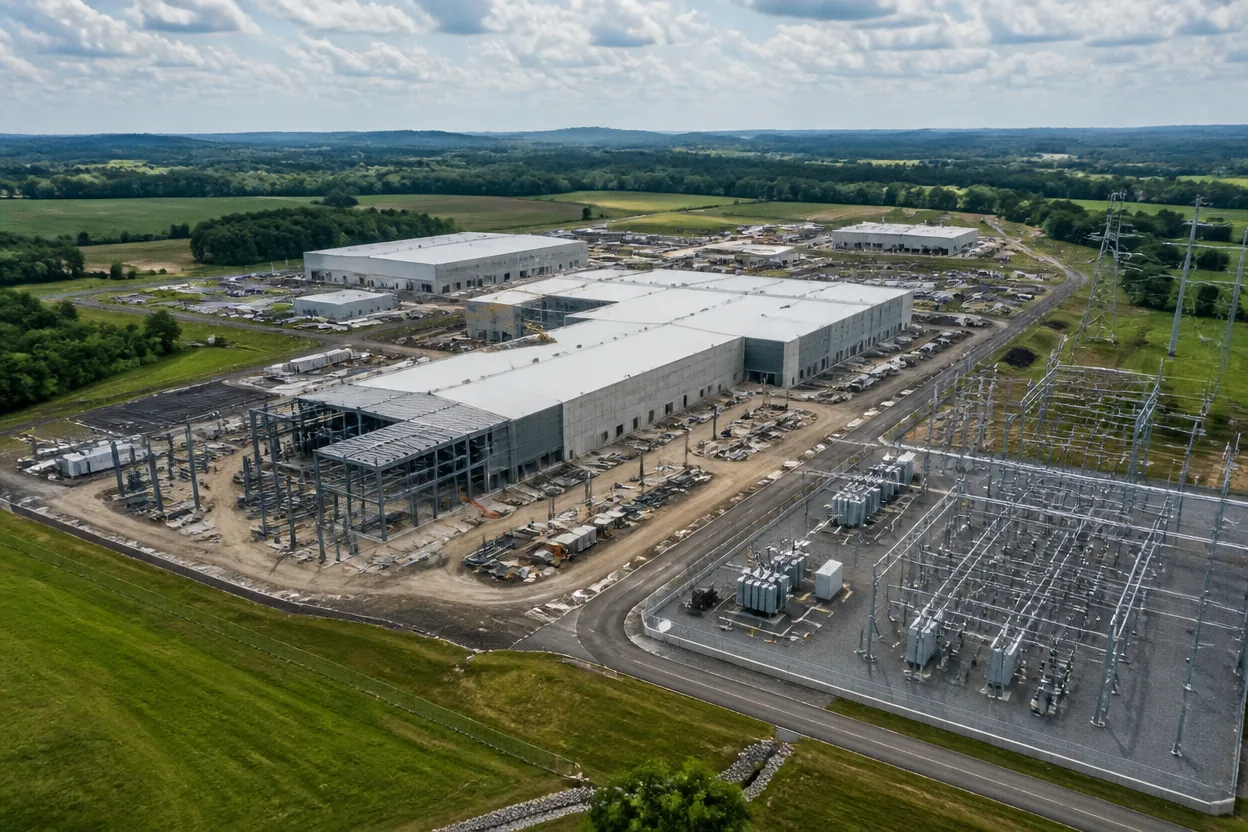
A hyperscale building carries enough diesel generation to run itself indefinitely, and increasingly some battery storage alongside. Both live outdoors in fabricated steel: sound-attenuated generator enclosures on structural bases with fuel tanks and containment, paralleling-gear houses beside them, and weatherproof, thermally managed enclosures for battery energy storage systems. With engine lead times at two years and beyond, this is the steel that gets built long before the equipment it protects.
Have drawings for a data center build? Call 601.892.5017 or email collin.t@fabtekindustries.com — we quote to print and respond fast.
- Generator yards need sound-attenuated weatherproof enclosures, structural bases and sub-base fuel tanks, containment, and paralleling switchgear houses.
- BESS enclosures add thermal management, fire-code ventilation and deflagration provisions, and heavy floor loading to the standard outdoor enclosure spec.
- Engine and battery lead times run 18–30 months; the enclosures are fabricated against the OEM’s drawings and staged ahead.
- This is build-to-print custom fabrication — heavy-gauge, large-format, with acoustic and airflow engineering baked into the drawing.
- Switchgear Enclosures for Data Centers
- Bus Duct & Busway for Data Centers
- Transformer Cabinets for Data Centers
- Transformer Tanks for Data Centers
- Substation Steel for Data Centers
- PDU, UPS & Battery Cabinets for Data Centers
- Generator & BESS Enclosures for Data Centers (you are here)
- Cable Tray Supports & Ladder Rack for Data Centers
- Equipment Skids, CDU Frames & Platforms for Data Centers
- Wiring Harnesses & Electrical Assembly for Data Centers
What these enclosures are
- Generator enclosures — weatherproof steel housings around a standby generator set, lined with acoustic material and fitted with intake and discharge silencers to hold noise at the property line to code. Doors for service access, removable roof or end panels for engine removal, exhaust penetrations, louvers and fans sized for combustion and cooling air.
- Structural bases and sub-base fuel tanks — the skid the generator sits on, often integrating a double-wall fuel tank with day-tank capacity and secondary containment, plus lifting and anchor points.
- Paralleling switchgear houses — walk-in NEMA 3R enclosures for the gear that synchronizes and combines generator output (covered in Part 1).
- BESS enclosures — outdoor cabinets or containers housing battery racks, inverters and controls for battery energy storage, with HVAC or liquid thermal management, fire-code ventilation and detection provisions, and structural design for the battery mass.
Where they live in the data center
The generator yard, usually along one side of each building, in 2N or N+1 quantities — a large building can have dozens of 2–3 MW units in a row. BESS blocks sit near the substation or the generator yard, used for grid services, peak shaving or bridging while the utility connection is completed. Where a campus adds on-site gas turbines or engines as primary generation, the same enclosure families multiply. We described the yard in What’s Inside a Data Center?
What's different about data center generator and BESS enclosures
Scale and duty. Data center generators are large (2–3 MW class), numerous, and expected to run for extended periods rather than a few hours a year, so enclosures are engineered for continuous cooling airflow, serviceability and a long life in the weather. Noise limits are strict because campuses are built near communities, which drives heavier acoustic construction. BESS is newer and code-driven: fire and building codes for stationary storage set ventilation, deflagration venting, spacing and detection requirements that shape the enclosure. Both are large-format, heavy-gauge build-to-print fabrication rather than catalog product.
Nothing in the generator yard ships on the generator’s schedule except the generator. The enclosure, the base and the switchgear house should already be on the pad.
What to specify
| Enclosure type | Generator: weather-protective or sound-attenuated (state dB(A) at distance); drop-over or walk-in; roof-mounted or in-line silencers. BESS: cabinet or container format, module count, inverter/controls integration |
|---|---|
| Material & gauge | 12- to 10-gauge carbon steel skins; heavy structural frame; galvanneal or aluminum skins where specified; stainless hardware |
| Rating & environment | NEMA 3R equivalent weather protection; wind and snow loads per site; seismic anchorage; corrosion class for coastal sites |
| Acoustic | Target sound level, lining material and thickness, intake/discharge silencer geometry, door and panel sealing |
| Airflow & thermal | Combustion and cooling airflow (CFM), louver free area, fan and damper provisions, exhaust routing and penetrations; BESS: HVAC or liquid cooling integration, temperature limits |
| Fuel & containment | Sub-base tank capacity, double-wall construction, secondary containment volume, fill/vent/level provisions, spill containment |
| Fire & code (BESS) | Ventilation and deflagration provisions, detection and suppression penetrations, spacing and access per applicable stationary storage codes |
| Structural & access | Base frame, lifting and anchor points, floor loading (battery mass), service doors, removable roof or end panels, cable and conduit entry |
| Finish | Blast, pretreatment and powder coat or industrial coating system to color and film thickness; salt-spray requirement |
Acoustic and fire-code requirements are project-specific and belong on the engineer’s drawing; the fabricator builds to them.
How they're fabricated
These are large weldments. Structural frames and bases are cut on robotic plasma and welded to AWS D1.1 by certified welders; skins, doors and louver panels are laser-cut and CNC-formed; acoustic lining is installed in panelized sections; silencers, fan housings and damper frames are built as sub-assemblies. Fuel-tank bases are welded to the tank standard specified and leak-tested. Everything is blasted and finished on the powder-coat line or with the industrial coating system called for, then trial-assembled to check fit before shipping in sections sized for the truck and the crane. For enclosures FabTek also installs on site, our field crews handle setting, assembly and the inevitable interface adjustments.
Common mistakes
- Acoustic spec without a location. “Quiet” is not a spec; a dB(A) target at a stated distance is.
- Undersized airflow. A generator that derates in July because the louvers are too small is a fabrication problem that started on the drawing.
- No engine-removal path. Removable roofs and end panels are cheap on the print and expensive after the fact.
- Treating BESS like a switchgear house. Stationary storage codes drive requirements that a standard outdoor enclosure does not meet.
Lead time and sourcing
With engines at 18–30 months and battery systems not far behind, enclosures, bases and switchgear houses are ordered against the OEM’s approved drawings and staged well ahead of the equipment. Because these are large and heavy, freight distance is real money and real risk; a domestic fabricator within a day’s haul, with crews that can set and adjust on site, is the sensible default. We covered the bottleneck logic in Where Data Center Builds Get Stuck.
FabTek Industries fabricates generator enclosures, structural bases and fuel-tank containment, paralleling-gear houses and BESS enclosures as build-to-print custom fabrication to print for data center, EPC, electrical contractor and OEM customers — robotic-plasma and laser-cut, AWS D1.1 welded, acoustic-lined where specified, blasted and finished in-house, and trial-assembled before shipment — under an ISO 9001:2015 quality system with AWS-certified welding, from four production sites in Hazlehurst, Mississippi, shipped nationwide. Dedicated production lines with reserved monthly capacity are available for recurring volume, and our field crews handle on-site setting, assembly and retrofit. Send us your drawings or call 601.892.5017.
Frequently asked questions
What is a sound-attenuated generator enclosure?
A weatherproof steel housing around a generator set, lined with acoustic material and fitted with intake and discharge silencers to reduce noise to a specified level — stated as dB(A) at a given distance — while providing the combustion and cooling airflow the engine needs and service access for maintenance.
What is a BESS enclosure?
A battery energy storage system enclosure is an outdoor cabinet or container that houses battery racks, inverters and controls, with thermal management, fire-code ventilation and deflagration provisions, detection penetrations, and structural design for the battery mass.
How far ahead of the generator should the enclosure be fabricated?
Enclosures, structural bases and paralleling-gear houses are typically fabricated against the OEM's approved drawings and staged on the pad well before the generator ships, since engine lead times run 18 to 30 months while the enclosure takes weeks.
Does FabTek build generator enclosures?
Yes, as build-to-print custom fabrication: structural bases and sub-base fuel tanks, weatherproof and sound-attenuated enclosures, paralleling switchgear houses and BESS enclosures, fabricated in Hazlehurst, Mississippi with field crews available for on-site setting.