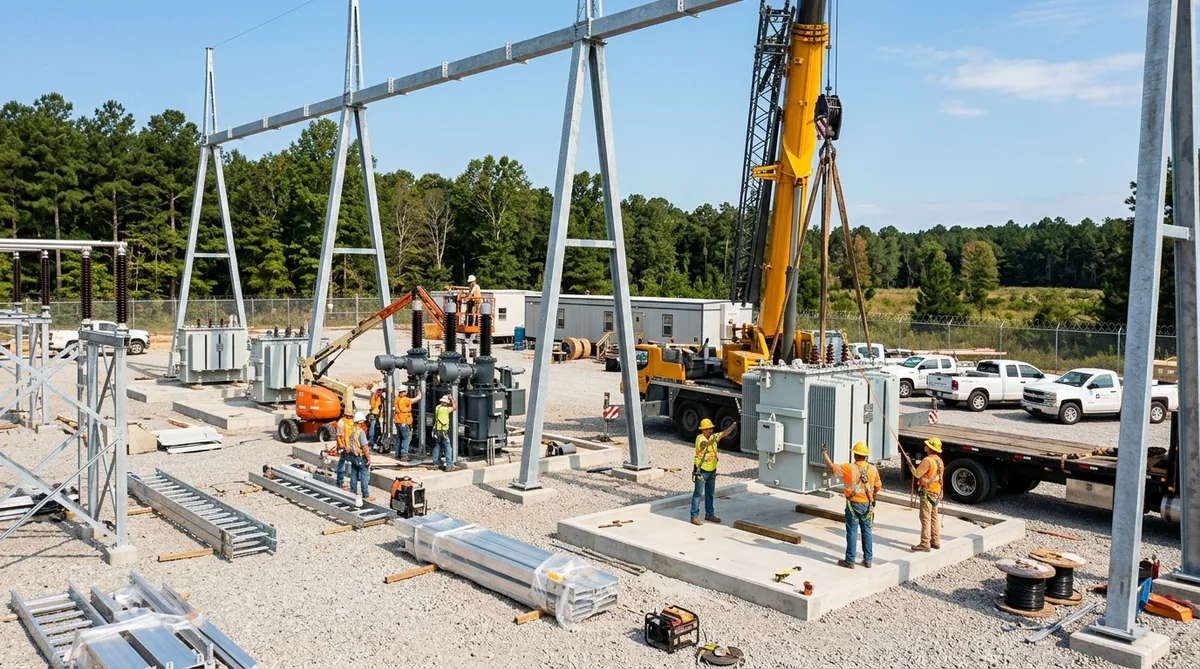
Once the layout exists, a substation project becomes a procurement exercise, and the procurement is dominated by a handful of components whose lead times are measured in years. Part 2 of this series is about that equipment — what it is, why it takes so long, how utilities and EPCs are ordering around it, and what the equipment’s mounting drawings mean for the steel that has to hold it up.
Have a substation steel package to quote? Call 601.892.5017 or email collin.t@fabtekindustries.com — send the layout and equipment list and we’ll turn it around fast.
- Power transformers (2–4 years), circuit breakers and metal-clad switchgear (12–24+ months) set the critical path of nearly every substation project.
- Lead times reflect a few OEMs, scarce electrical steel and winders, and demand from utilities and data centers competing for the same slots.
- Buyers respond with early orders on preliminary specs, standardized equipment, strategic inventory and framework agreements.
- Every long-lead item arrives with a mounting drawing — the bolt pattern the steel is drilled to — so releasing those drawings early is how the structures get off the critical path.
- From Load Request to Layout: How a Substation Project Starts
- The Long-Lead Equipment Order (you are here)
- The Structures Package: Detailing Steel to Equipment
- Fabrication and Galvanizing: How Substation Steel Is Made
- Delivery Sequencing and Site Logistics
- Field Erection: How Substation Steel Goes Up
- Energization and Commissioning
- The Change Order: Managing Late Design Changes
Equipment sets the critical path
A substation’s foundations can be poured in weeks, its steel fabricated and galvanized in weeks, its bus and wiring installed in weeks. Its transformer cannot be had for years. That asymmetry means the project schedule is built backward from equipment delivery dates, and everything else — design releases, site work, steel, erection — is sequenced to be ready when the equipment arrives. We described the same dynamic on the data center side in Where Data Center Builds Get Stuck; on a utility substation the equipment list is longer and the coupling to the steel is tighter.
The long-lead list
| Power transformers | The pacing item. 69 kV and above units commonly quote 2–4 years; distribution-class units a year or more. Arrive on heavy-haul, need a pad, oil containment, and radiators and bushings installed on site. |
|---|---|
| Circuit breakers | Dead-tank SF₆ and increasingly SF₆-free designs at 69–345 kV; 12–24 months typical. Each sits on a fabricated stand drilled to its base. |
| Metal-clad switchgear | Medium-voltage lineups in a control building or outdoor walk-in enclosure; 12–24 months and longer for arc-resistant designs. See Switchgear Enclosures. |
| Disconnect switches | Group-operated air-break switches; several months to a year. Mounted on stands or structure beams, operating mechanisms at working height. |
| Instrument transformers & arresters | CTs, PTs, CCVTs, surge arresters; months, occasionally longer. Each on a stand or on the breaker. |
| Protection & control | Relays, RTUs, panels, and the control house itself (often a prefabricated building); relay panels are increasingly the long pole in P&C. |
| Bus & insulators | Rigid aluminum bus, fittings, station-post insulators; months, sensitive to aluminum supply. |
| Structures | Weeks for fabrication and galvanizing — the exception on this list, and the reason it can be scheduled around everything else. |
Lead times are indicative of the current market and vary by OEM, voltage class and specification.
Why lead times are where they are
Three causes stack. A small number of manufacturers for each equipment class, several of them foreign-owned with global order books. Material and labor constraints inside those plants — grain-oriented electrical steel and skilled coil winders for transformers, as we described in How the Transformer Supply Chain Works. And demand collision: utilities rebuilding aging systems, developers energizing campuses, and renewable and storage interconnections all ordering the same equipment at once. OEMs are adding plants and shifts, and they are outsourcing the metal around their products to contract fabricators to free capacity (Why Transformer OEMs Outsource), but the queues will take years to clear.
Ordering strategies
- Order early on preliminary specs. Transformers are ordered from the one-line and a preliminary rating, with the detailed spec finalized during the OEM’s engineering window. The cost of a change is smaller than the cost of a year.
- Standardize. Utilities that use a few standard transformer and breaker designs can order ahead of specific projects and deploy units where needed; standard equipment also means standard stands, which a fabricator can build repeatedly.
- Carry inventory. Spare and strategic-stock transformers and breakers, sometimes pooled across utilities, to protect in-service dates and outage recovery.
- Framework agreements. Multi-year agreements with OEMs for reserved slots, and with fabricators for reserved steel capacity, so neither the equipment nor the structures join a queue.
- Dual-source and qualify alternates. Approving a second breaker or switch manufacturer widens the window, at the cost of a second set of mounting drawings.
Mounting drawings and the steel
Every piece of equipment arrives with a mounting drawing: the base footprint, anchor or bolt pattern, hole sizes, weight, center of gravity and terminal heights. Those drawings are what the structural engineer detail equipment stands to, and what the fabricator drills. Until they exist, a stand can be designed for load and height but not finalized for holes. The practical consequence is that the equipment order and the steel package are linked by paper, not by delivery: the day the OEM issues approved mounting drawings, the stands can be detailed, fabricated, galvanized and stored — a year or more before the equipment itself ships. Buyers who ask OEMs for mounting drawings early in the order, and pass them straight to the fabricator, take the stands off the critical path entirely. Part 3 covers detailing in depth.
Ask the OEM for the mounting drawing before you ask about the ship date. One of them you can build to now.
What to build while you wait
With equipment years out, the project has time to spend, and the well-run ones spend it: foundations and grounding grid; the control house; cable trench and conduit; fence and gates; and the entire structures package — dead-ends, A-frames, bus supports, gantries, and every equipment stand whose mounting drawing is approved — fabricated, galvanized, delivered and erected so the yard is a finished steel skeleton waiting for equipment. Bus can be cut and fitted to the structures; only the final connections wait. When the transformer arrives on its lowboy, the crane sets it once, the connections are made, and commissioning starts. That is the difference between a substation that energizes the month the transformer arrives and one that energizes a season later. Part 4 is about building that steel.
FabTek Industries fabricates substation structures, transformer tanks and switchgear enclosures for utilities, EPCs and data center developers — fabricated from approved mounting drawings while the equipment is still in the OEM’s queue, and staged or erected ahead of delivery — under an ISO 9001:2015 quality system with AWS D1.1-certified welding, from four production sites in Hazlehurst, Mississippi, and our own crews handle field erection. See how we work with EPCs, with utilities, or send us the layout.
Frequently asked questions
What are the long-lead items on a substation project?
Power transformers (two to four years for transmission-class units), high-voltage circuit breakers and metal-clad switchgear (12 to 24 months or more), disconnect switches, instrument transformers and arresters (months), protection and control panels, and the control house. Fabricated structures are the exception at weeks.
Why do power transformers take so long to get?
A small number of manufacturers with global order books, shortages of grain-oriented electrical steel and skilled coil winders, and simultaneous demand from utilities, data center developers and renewable interconnections competing for the same production slots.
What is an equipment mounting drawing and why does it matter?
The OEM's drawing of a piece of equipment's base footprint, bolt pattern, weight and terminal heights. Equipment stands are detailed and drilled to it, so obtaining approved mounting drawings early lets the structures be fabricated and galvanized a year or more before the equipment ships.
What can be built on a substation site while waiting for the transformer?
Foundations and grounding, the control house, cable trench and conduit, fence, and the complete structures package — dead-ends, bus supports, gantries and equipment stands with approved mounting drawings — erected as a finished steel skeleton with bus fitted, so the transformer is set once and connected.