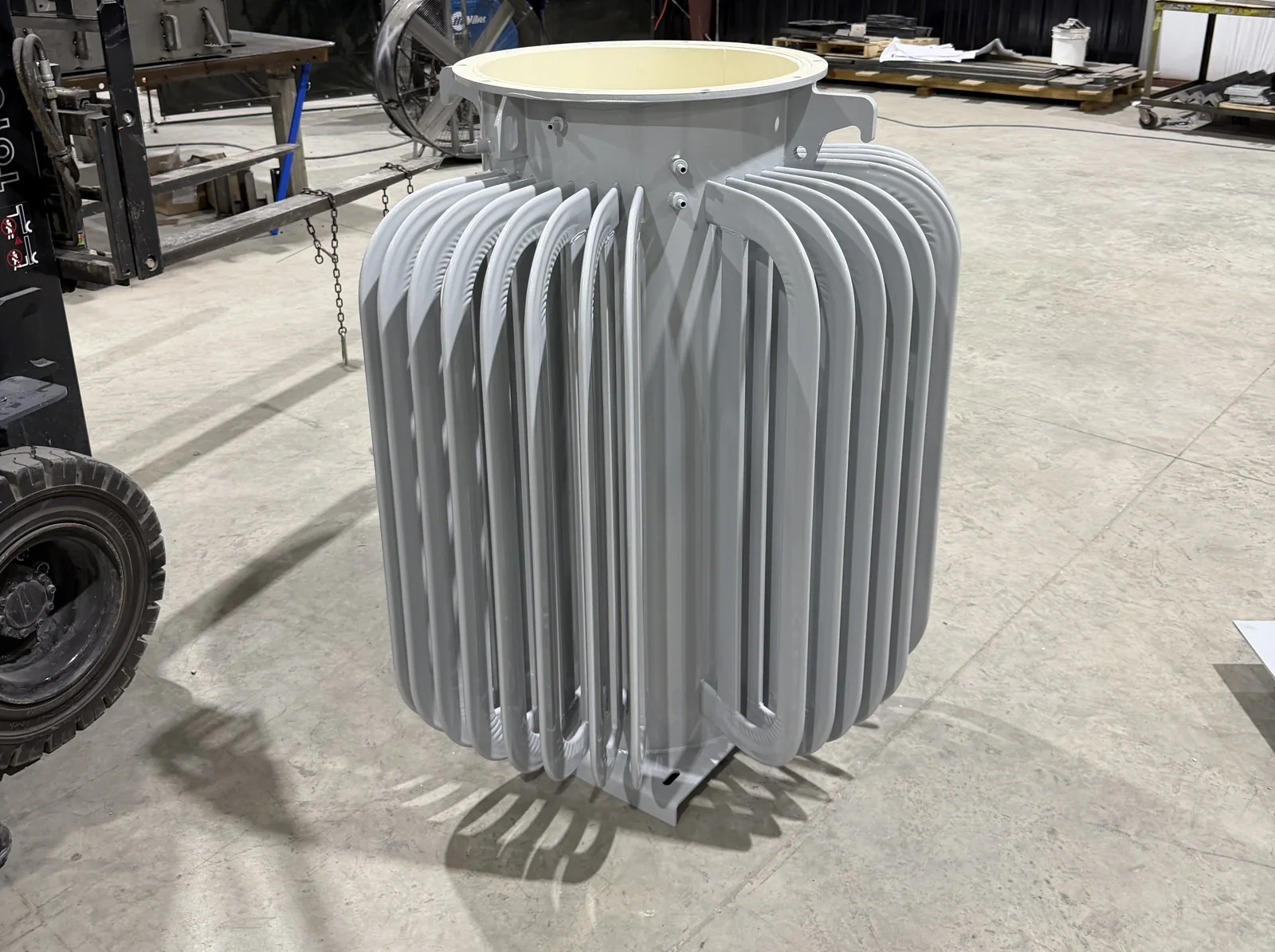
Every transformer manufacturer in North America has the same problem in 2026: more orders than floor. Lead times on large power units are quoted in years, distribution units in a year or more, and the constraint is not demand — it is the square footage, crane time and skilled welders needed to build each unit. This series is about one of the few levers an OEM can pull quickly: outsourcing the metal around the transformer — tanks, cabinets, enclosures, covers and conservators — to a contract fabricator. Part 1 explains why it works.
Transformer OEM looking for tank, cabinet or coil capacity? Call 601.892.5017 or email collin.t@fabtekindustries.com — send a print and a monthly quantity and we’ll quote it.
- Tank and cabinet fabrication consumes floor space, crane time and welders that an OEM would rather spend on core, coil and test — the work only the OEM can do.
- Outsourcing the metal is capacity without capex: output rises without a building, a press brake or a hiring campaign the OEM can’t staff.
- For mid-market OEMs, remanufacturers and repair shops, it is often the difference between taking a program and turning it down.
- Keep the electrical core competency in-house; outsource the build-to-print metal to a shop with a quality system your customers will accept.
- Why Transformer OEMs Outsource Tanks, Cabinets and Enclosures (you are here)
- How to Qualify a Contract Transformer Tank Fabricator
- Contract Coil Winding: When It Makes Sense to Outsource
- Conservators, Covers and Tank Accessories
- Running an OEM–Fabricator Program
- The Cost of a Stalled Line vs. Reserved Capacity
The OEM's constraint
A transformer plant is organized around a small number of processes that define the product: core stacking, coil winding, core-and-coil assembly, tanking and oil processing, and test. Those are the steps that require the OEM’s engineering, the OEM’s specialized equipment and the OEM’s hardest-to-hire people — the winders whose shortage we described in Winding Labor Is the Real Bottleneck. Everything else in the building is there to support them. When the order book doubles, the OEM cannot double its winders or its test bay overnight, so every square foot and every welder-hour spent on something other than the core competency is output the plant is not producing.
What the metal costs an OEM
Look at where a tank actually gets built inside a transformer plant. Plate arrives and is stored; it is cut on a plasma table or sent out; walls are formed on a press brake large enough for tank sides; stiffeners, cover, base and fittings are fit and welded — often on the same floor and under the same crane as tanking; the tank is pressure-tested, blasted and painted in a booth the plant maintains; then it waits for its core and coil. A cabinet program does the same thing at smaller scale, in sheet metal, with a powder line or a paint booth behind it. Add it up and a typical distribution or small power plant is spending a meaningful share of its floor, its crane hours and its welding headcount on metal fabrication that has nothing to do with what makes the product a transformer.
What gets outsourced
- Tanks — pad-mount, corrugated-wall, small and medium power, regulator and specialty tanks, built to the OEM’s print, pressure- and vacuum-tested, coated inside and out. See Transformer Tanks.
- Cabinets and compartments — pad-mount HV/LV compartment cabinets, hoods, sills, dry-type enclosures and unit-substation sections, powder-coated in the OEM’s color. See Transformer Cabinets.
- Covers, conservators and accessories — tank covers with turrets, conservators, radiator supports, cable boxes, bases, lifting and jacking hardware. Covered in Part 4.
- Coil and winding sub-assemblies — for OEMs whose bottleneck is winding capacity rather than metal, preformed and tape-wrapped windings and core-and-coil sub-assemblies. Covered in Part 3.
- Control cabinets and wired assemblies — control and monitoring cabinets delivered wired and tested. See Electrical Assembly.
What it frees up
When the tank arrives finished, the OEM’s tank line becomes a second tanking or assembly bay. The crane hours go to units that ship. The certified welders move to cover seals, bushing turrets and repair — work that requires them to be in the transformer plant. Plate inventory and the working capital tied up in it leave the balance sheet. The paint booth either shrinks or handles only touch-up. And the plant’s output ceiling moves from “how many tanks can we weld” to “how many cores can we wind and test,” which is the ceiling the OEM actually wants to be managing. We described the downstream effect on the industry in Transformer Tanks for Data Centers: contract tank capacity is one of the quiet ways the transformer shortage is being worked.
An OEM’s customers are not paying for its welding. They are paying for a transformer that tests and ships. Every hour of welding that can leave the building is an hour of transformer that stays.
The mid-market case
The largest OEMs have always outsourced some metal; what has changed is that mid-market manufacturers, remanufacturers and repair shops now face the same choice, at a scale where it decides whether they grow. A shop producing a few thousand distribution units a year and asked to double by a utility or a data center program has three options: build a tank and cabinet line (capital, a building, hiring in a market with no welders), turn down the program, or buy the metal. For most, the third is the only one that fits the customer’s schedule. Remanufacturers and repair shops have an additional reason: their work is variable, so a fabricator that quotes one-off tanks and cabinets to print, quickly, is more useful than a line that only pays off on volume. FabTek works with OEMs across this range; the transformer OEM page describes the model.
What to keep in-house
Outsourcing works when the line is drawn in the right place. Core, coil, assembly, oil processing and test define the product and its warranty — they stay. Final tanking (setting the core and coil in the tank and sealing the cover) usually stays, because it is coupled to processing and test. Engineering and drawings stay: the OEM owns the design, and the fabricator builds to it. What goes out is build-to-print metal with a clear drawing, a clear test requirement and a clear acceptance criterion — the work a good fabricator does better and cheaper because it is all that fabricator does.
The risks, and how to manage them
- Quality risk — a leaking tank or a mis-drilled cabinet stops the line. Manage it by qualifying the fabricator’s quality system, weld procedures and test capability before the first order; Part 2 is the checklist.
- Schedule risk — the fabricator has to deliver in step with core-and-coil completion. Manage it with a reserved line and a release schedule tied to the OEM’s build plan; Part 5 covers program mechanics.
- Dependency risk — one supplier for a critical input. Manage it with a documented print package the fabricator doesn’t own, and a supplier financially and physically able to grow with you; Part 6 is the cost comparison.
- Audit risk — the OEM’s utility and data center customers will audit its suppliers. Manage it by choosing a fabricator whose documentation is already what those customers expect — the records we describe in ISO 9001 and AWS-Certified Welds.
FabTek Industries builds transformer tanks, cabinets and compartments, covers, conservators, control cabinets and coil and winding sub-assemblies to print for transformer OEMs, remanufacturers and repair shops — plasma- and laser-cut, CNC-formed, fixture-welded to qualified procedures, pressure-tested, blasted and finished in-house in the OEM’s color — under an ISO 9001:2015 quality system with AWS-certified welding, from four production sites in Hazlehurst, Mississippi. Dedicated production lines with reserved monthly capacity are how most of our OEM programs run. See how we work with transformer OEMs, or send us a print.
Frequently asked questions
Why do transformer manufacturers outsource tank fabrication?
Tank and cabinet fabrication consumes floor space, crane time and certified welders that a transformer plant needs for core, coil, assembly and test — the work only the OEM can do. Outsourcing the metal raises output without building a fabrication line or hiring welders in a market where they are scarce.
What parts of a transformer are typically outsourced?
Tanks (pad-mount, corrugated-wall, small and medium power), compartment cabinets and hoods, dry-type enclosures, tank covers and conservators, cable boxes and bases, control cabinets, and in some cases coil and winding sub-assemblies. Core, coil assembly, oil processing, final tanking and test usually stay in-house.
Can small transformer manufacturers and repair shops outsource fabrication?
Yes — and increasingly they must. A mid-market OEM or remanufacturer asked to double output cannot build a tank line on the customer's schedule, so contract fabrication is often the only way to take the program. Repair shops benefit from a fabricator that quotes one-off tanks and cabinets to print quickly.
What are the risks of outsourcing transformer tanks?
Quality (a leaking tank stops the line), schedule (deliveries must match core-and-coil completion), dependency on one supplier, and supplier audits by the OEM's own customers. Each is managed by qualifying the fabricator's quality system and test capability, reserving capacity with a release schedule, keeping the print package in the OEM's control, and choosing a fabricator with audit-ready documentation.