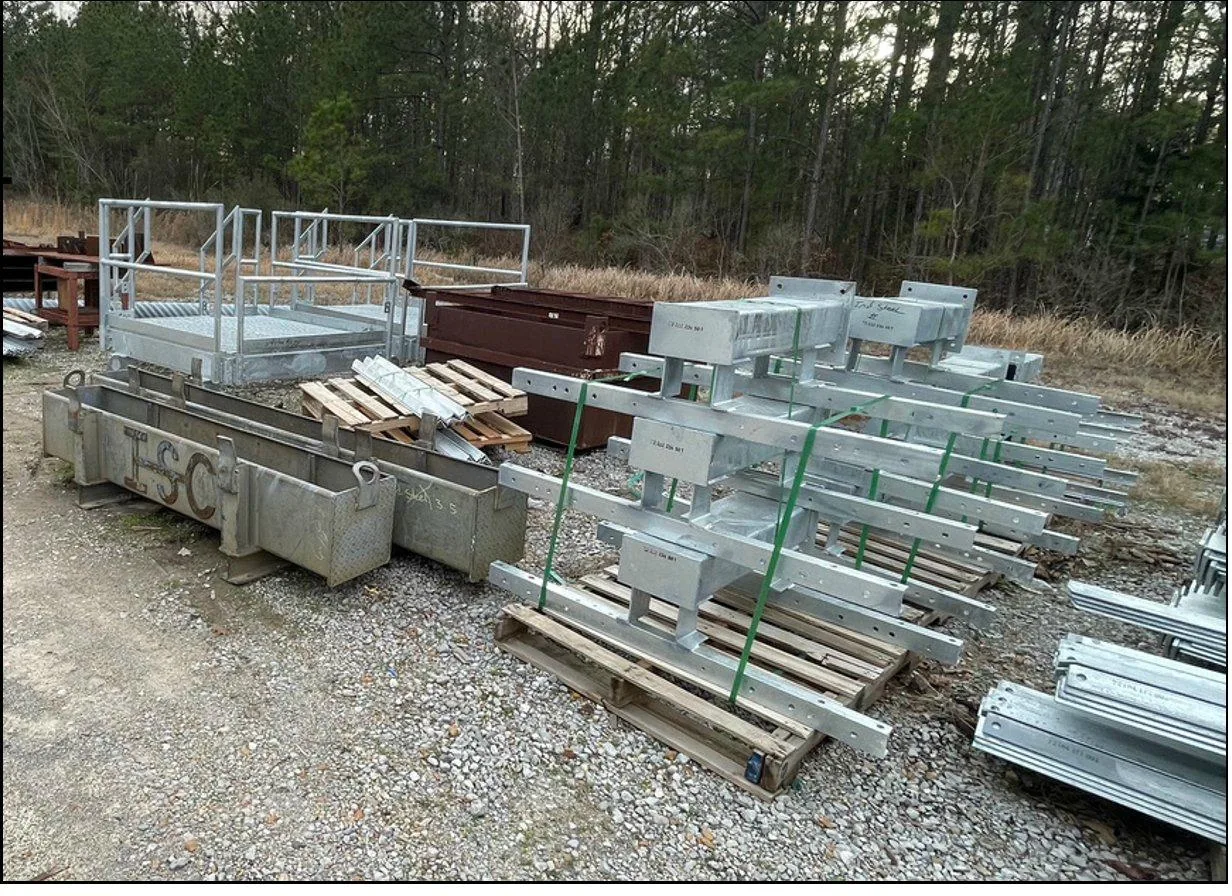
The structures package leaves the detailer as drawings and arrives on site as galvanized steel that has to bolt together on the first try. Part 4 of this series is everything in between: how substation steel is received, processed, fitted, welded, inspected, galvanized and checked — and where each step can go wrong if the fabricator skips it.
Have a substation steel package to quote? Call 601.892.5017 or email collin.t@fabtekindustries.com — send the layout and equipment list and we’ll turn it around fast.
- Fabrication starts with material traceability — certs to heat number, carried through cutting to the finished piece mark.
- Robotic beam processing cuts, copes, drills and marks structural shapes from the model in one pass, which is why bolt holes land within tolerance.
- Welding is to AWS D1.1 by certified welders on fixtures, with visual and NDE inspection recorded against a weld map.
- Hot-dip galvanizing to ASTM A123 is a chemical process the steel has to be prepared for; coating inspection and A780 repair close it out.
- From Load Request to Layout: How a Substation Project Starts
- The Long-Lead Equipment Order
- The Structures Package: Detailing Steel to Equipment
- Fabrication and Galvanizing: How Substation Steel Is Made (you are here)
- Delivery Sequencing and Site Logistics
- Field Erection: How Substation Steel Goes Up
- Energization and Commissioning
- The Change Order: Managing Late Design Changes
Material and traceability
Substation steel is ordered to the design — typically ASTM A36 and A572 Grade 50 shapes and plate, A500 tube, F1554 anchor bolts — and received with mill test reports. The fabricator’s receiving inspection verifies grade, dimensions and cert against the PO, and marks material so its heat number follows it: onto the nest, onto each cut piece, onto the finished piece mark. When a utility’s inspector asks for the cert on a dead-end column ten years later, this is the step that answers. We covered the materials themselves in The Materials of Metal Fabrication.
Robotic beam processing
Columns, beams, cross-arms and braces run through a robotic structural processor — at FabTek, a Voortman V807 — that takes the shop drawing’s model directly and, in one pass, cuts the member to length, cuts copes and miters, drills every bolt hole to size and location, and marks the piece with its identification. There is no layout by hand and no magnetic drill. Hole location accuracy comes from the machine and the file, so a stand’s top plate matches the breaker’s bolt pattern and a splice matches its mate across the yard. This step is the single biggest reason modern substation steel fits up better than steel did twenty years ago.
Plate, gussets and stands
Base plates, top plates, insulator attachment plates, gussets and stiffeners are cut from plate on plasma or fiber laser with holes and features placed by program. Equipment-stand top plates are cut with their bolt pattern in the same operation that cuts the outline, so pattern-to-edge relationships are exact. Plates that will carry insulators or equipment are checked for flatness before fit-up; a plate that warps in welding is corrected before galvanizing, because it cannot be corrected after.
Fit-up and welding
Members and plates are assembled on fixtures that hold squareness, plumb and plate position; a stand is fixtured so its top plate is level and its bolt pattern is oriented to the erection drawing. Welding is by AWS-certified welders to qualified procedures — AWS D1.1 for structural steel — with MIG for production and flux-cored or stick where thickness or position calls for it. Weld sequence is planned to control distortion on long members and thin plates. The welds themselves are detailed with the galvanizer in mind: consistent size, no undercut or porosity that will show through zinc, and no sealed pockets.
Weld inspection
Each structure design has a weld map; each weld is inspected visually against the acceptance criteria of D1.1, and welds the engineer designates — typically full-penetration welds at dead-end attachment plates and base-plate connections — receive non-destructive examination (magnetic particle or ultrasonic) by qualified inspectors. Records are kept by piece mark. Dimensional inspection follows: overall length, plumb and square, bolt-pattern location and hole size, plate flatness — checked before the steel goes to the kettle, because galvanizing adds coating and removes the chance to fix anything cheaply.
Preparation for the kettle
Galvanizing is chemistry, and it only works on clean steel. At the galvanizer the steel is degreased in a caustic bath to remove oil and marking paint, pickled in dilute acid to remove mill scale and rust, rinsed, and dipped in a flux solution that prevents oxidation before the zinc bath. Anything that blocks these steps — weld spatter, heavy paint marks, oil from a cutting operation — produces bare spots. The fabricator’s job before shipment to the galvanizer is to send steel with clean surfaces, vents and drains open, hanging points accessible, and pieces bundled so the galvanizer can rack them for the dip. FabTek coordinates galvanizing with qualified plants and inspects the steel both before and after the trip.
The galvanizing bath
The prepared steel is lowered into molten zinc at roughly 830 °F. Zinc and iron react to form a series of zinc-iron alloy layers metallurgically bonded to the steel, topped by a layer of pure zinc as the piece is withdrawn — a coating that protects by barrier and, at scratches and cut edges, by sacrificial action. Immersion time, withdrawal speed and steel chemistry determine coating thickness and appearance; reactive steels (higher silicon or phosphorus) build thicker, duller coatings, which is normal. The piece is cooled, and excess zinc is removed from drain points. This is why the detailing in Part 3 matters: a tube without vents can trap air and rupture; a closed pocket traps acid that bleeds rust for years; an oversize structure that does not fit the kettle gets a double-dip line or does not get galvanized at all.
Galvanizing forgives nothing it cannot reach. Every bare spot on a stand is a decision somebody made in the shop or at the detailing table.
Coating inspection and repair
ASTM A123 sets minimum average coating thickness by steel category and thickness, measured with a magnetic thickness gauge on a sampling plan, and defines acceptable appearance — roughness, dross inclusions and ash are cosmetic within limits; bare spots are not. Galvanized hardware is inspected to A153. Small bare areas and damaged spots (from handling, or from later field drilling that should not have happened) are repaired to ASTM A780 — zinc-rich paint, zinc solder or thermal spray — within the area limits the standard allows; larger defects mean re-galvanizing. The fabricator inspects on return from the galvanizer, records thickness by piece, and repairs before match-marking. See Galvanizing vs. Paint for how this compares with coating systems.
Pre-shipment checks
Before steel is bundled for the site: a final dimensional check of critical interfaces (top-plate bolt patterns, splice hole alignment, base-plate anchor patterns against the template supplied to the foundation contractor); match-marking of every piece to the erection drawing, in a marking that survives weather and is readable from the ground; assembly of hardware kits per structure — galvanized bolts, nuts, washers, counted and bagged; and trial-fitting of anything that has never been assembled before, such as a new dead-end design or a multi-piece gantry. Then the steel is bundled by structure and loaded in the order the erector will need it — which is the subject of Part 5.
FabTek Industries fabricates substation structures and support steel for utilities, EPCs and data center developers — processed on a Voortman robotic beam line, plasma- and laser-cut, fixture-welded to AWS D1.1 with recorded inspection, hot-dip galvanized to ASTM A123 through qualified plants, coating-inspected and repaired to A780, match-marked and kitted — under an ISO 9001:2015 quality system with AWS D1.1-certified welding, from four production sites in Hazlehurst, Mississippi, and our own crews handle field erection. See how we work with EPCs, with utilities, or send us the layout.
Frequently asked questions
How is substation steel fabricated?
Structural shapes are processed on a robotic beam line that cuts, copes, drills and marks from the model; plates are plasma- or laser-cut with bolt patterns placed by program; members are fixtured and welded to AWS D1.1 by certified welders; welds and dimensions are inspected; then the steel is hot-dip galvanized, coating-inspected, repaired where needed, match-marked and kitted with hardware.
What is ASTM A123?
The specification for hot-dip galvanized coatings on iron and steel products, setting minimum average coating thickness by steel category and thickness, inspection methods and appearance requirements. Hardware is covered by ASTM A153, and repair of damaged coatings by ASTM A780.
Why does substation steel need vent and drain holes?
Hot-dip galvanizing immerses steel in molten zinc; closed or semi-closed sections need vents so air escapes and drains so zinc flows out, otherwise trapped air can rupture a tube and trapped acid from pickling bleeds rust later. Detailing to ASTM A385 practice addresses this.
What inspections are performed on galvanized substation structures?
Weld inspection (visual to AWS D1.1 and NDE on designated welds), dimensional inspection of bolt patterns, plate flatness and squareness before galvanizing, coating-thickness measurement and appearance inspection to ASTM A123 after galvanizing, and a final check of critical interfaces before match-marking and shipment.