A data center shell can go up in months. The power to run it can take years. Parts 1 through 3 of this series explained what's inside a campus and how it gets its electricity; this part is about why so many of those campuses are sitting finished and dark. The bottlenecks are not mysterious — they are a short list of long-lead components and a thin workforce — and understanding them is the difference between a build that energizes on schedule and one that waits.
Building or supplying a data center? Call 601.892.5017 or email collin.t@fabtekindustries.com — send a drawing, a one-line, or a scope and we’ll respond fast.
- The binding constraints on data center construction are power equipment and people, not concrete or steel: interconnection, large power transformers, switchgear, generators and the trades that install them.
- Large power transformer lead times run two to four years; medium-voltage switchgear and generators commonly run 12 to 24+ months.
- Fabricated enclosures, bus duct and substation steel are rarely the longest lead — but they are on the critical path the day the long-lead gear arrives, and imported steel adds tariff and freight risk on top.
- Builders are responding by ordering early, standardizing designs, prefabricating electrical skids, reserving fabrication capacity and sourcing domestically.
- What's Inside a Data Center? Anatomy of a Hyperscale Campus
- How a Data Center Gets Its Power: Grid Interconnect to Fence Line
- Inside the Electrical Room: Switchgear, UPS and Bus Duct to the Rack
- Where Data Center Builds Get Stuck: The Real Bottlenecks (you are here)
- Sourcing Fabricated Power Equipment for a Data Center: A Buyer's Guide
The shape of the problem
For most of the history of the industry, a data center's schedule was set by construction. Today it is set by procurement. A developer can permit a site, pour a slab and stand up a shell in well under a year — and then wait two or three more for the utility interconnection and the equipment that makes the building useful. The result is a growing inventory of “dark” capacity: finished buildings that cannot be energized.
The bottlenecks fall into six categories. The first four are electrical equipment and infrastructure with lead times that cannot be compressed by spending more money. The fifth is people. The sixth — fabricated steel and enclosures — is the one that most often gets overlooked in planning and, not coincidentally, the one a builder has the most control over.
1. Utility interconnection and transmission
As Part 2 described, a large load has to be studied, approved and physically connected by the utility, and for the biggest campuses that means new transmission lines and substations. Transmission permitting routinely takes longer than building construction, utility engineering departments are stretched thin by the volume of requests, and interconnection queues in many regions now stretch out for years. Some utilities have paused new large-load requests entirely while they build capacity; others have introduced tariffs requiring long minimum contracts and up-front payments. None of this is a fabrication problem, but it sets the outer envelope for everything else.
2. Large power and distribution transformers
This is the bottleneck everyone in the power industry knows about. Large power transformers — the 230 kV and 345 kV units in a campus substation — now quote at two to four years, and the distribution and unit substation transformers inside the buildings have stretched to a year or more. The causes stack up: a handful of domestic manufacturers, a global shortage of grain-oriented electrical steel for cores, and above all a shortage of the skilled winders who build the coils, a trade that takes years to learn and that the industry stopped training for a generation. We covered the mechanics in How the Transformer Supply Chain Works and the labor side in Winding Labor Is the Real Bottleneck.
The data center boom makes it worse in a specific way: hyperscalers can pay a premium and order in volume, so they compete directly with utilities for the same factory slots — and utilities need those same transformers to serve the data centers. The system is chasing its own tail.
3. Switchgear and circuit breakers
Medium-voltage switchgear, low-voltage switchgear and the circuit breakers inside them come from a small number of OEMs whose order books filled as soon as the AI build-out accelerated. Lead times of 12 to 24 months are now common, and longer for arc-resistant or custom lineups. Because a 2N building needs two of every lineup, a single hyperscale campus can absorb what used to be a year of a plant's output. The OEMs are adding capacity, but building switchgear plants and training assemblers takes the same years the transformer makers face.
There is a fabrication dimension here that matters. Much of what an OEM ships is metal — the enclosures, sections, doors and structures around the electrical components — and OEMs increasingly outsource that metal to contract fabricators so their own floors can focus on bus, breakers and testing. A fabricator that can deliver switchgear enclosures and sections to print, on a reserved line, is effectively adding capacity to the OEM's plant.
4. Generators and UPS
Standby diesel generators in the 2–3 MW class have followed the same curve, with quotes commonly running two years or more as data center demand collides with limited engine and alternator production. UPS systems and the batteries behind them are in somewhat better shape but still carry long leads for the largest modular systems. As with transformers, the enclosures, structural bases, paralleling switchgear housings and fuel systems around the generators can be — and now usually are — fabricated long before the engines ship.
5. Skilled labor
Every piece of equipment above has to be installed, connected and commissioned by someone, and the trades are stretched to the limit. Electricians, linemen, substation technicians, AWS-certified welders and field erection crews are all in short supply in exactly the regions where campuses are clustering, and a single hyperscale project can draw down a metro area's entire pool. Wage inflation and travel premiums follow. We wrote about this from the field-crew side in The Field Crew Labor Bottleneck.
The labor constraint changes how builders think about fabrication. Anything that arrives pre-assembled, pre-wired and ready to set — an enclosure with the panel already wired, a skid with the piping already run, a structure that bolts up without field modification — is labor the project doesn't have to find on site. That is why integrated wiring and electrical assembly at the fabricator has moved from a nice-to-have to a schedule strategy.
6. Fabricated steel and enclosures
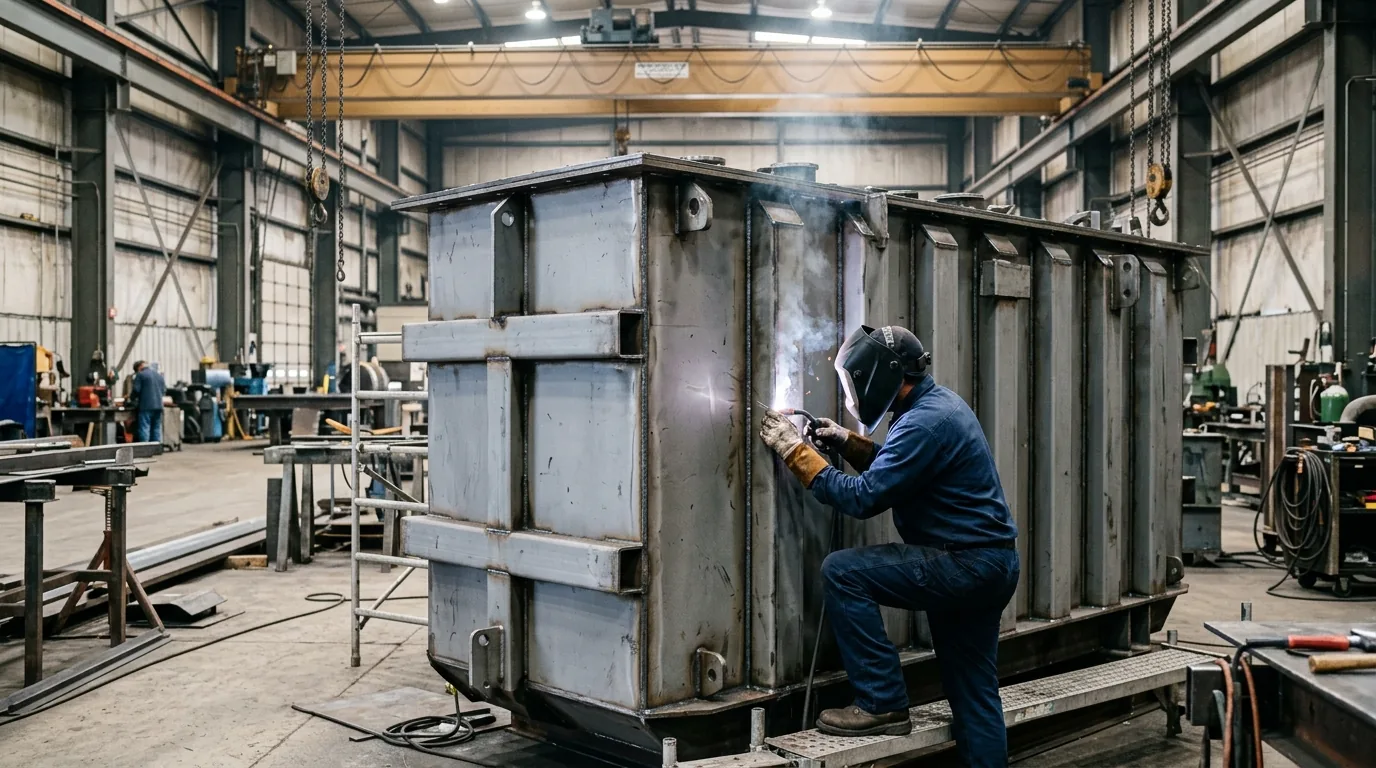
Here is the bottleneck that doesn't show up on the headline list, because in isolation it isn't one. Substation structures, switchgear enclosures, transformer cabinets and bus duct can be fabricated in weeks. The problem is sequencing and sourcing.
Sequencing. The fabricated metal has to be on site the day the long-lead equipment arrives. A transformer that shows up to a yard without its support steel, or switchgear that lands before its outdoor enclosure is ready, converts a two-year wait into a two-year-and-two-month wait — and the crane, crew and inspector who were scheduled for that day are now idle. Because the steel package is “short lead,” it is often ordered late, and a fabricator whose floor is already full cannot pull it forward.
Sourcing. A large share of enclosures and bus duct housing has historically been imported. That exposure has become expensive: tariff volatility on steel and fabricated goods, ocean freight that can add weeks and land damaged, quality that can't be inspected until it's on a dock, and no path to a rush replacement. We laid out the risk calculus in Domestic Fabrication: What Reshoring Means for Power Equipment. For a project whose entire schedule hinges on one delivery date, a fabricator a day's truck ride away is worth more than a lower unit price.
The transformer sets the date. The steel, the enclosures and the bus duct decide whether you actually hit it.
How builders are responding
The industry is adapting quickly, and the responses fall into a recognizable pattern:
- Order long-lead equipment first. Transformers, switchgear and generators are now ordered on preliminary designs — sometimes before the site is closed — and some operators carry inventory of standard units to deploy wherever the next campus lands.
- Standardize the design. Repeating the same electrical room, the same enclosure and the same bus duct layout across buildings lets OEMs and fabricators run the work as a product line rather than a series of custom jobs.
- Prefabricate and modularize. Complete electrical skids, containerized switchgear and pre-wired enclosures shift labor from a constrained site to a factory, arrive tested, and set in a day.
- Reserve fabrication capacity. Owners, EPCs and OEMs are signing blanket agreements for enclosures, bus duct and steel so that dedicated production lines are waiting when the drawings release, instead of joining a queue.
- Source domestically and regionally. Shorter freight, no tariff exposure, inspectable quality and the ability to expedite a rush replacement have made domestic fabrication a schedule decision, not just a policy one.
- Bring power behind the meter. On-site gas turbines, engines and battery storage are being used to energize campuses ahead of the grid connection — which, as Part 2 noted, adds enclosures and structural steel rather than removing them.
What a builder can actually control
Of the six bottlenecks, four are set by markets a developer doesn't control and one is set by demographics. The sixth is a procurement decision. The fabricated metal package — substation steel, switchgear enclosures, transformer cabinets, tanks, bus duct and structural miscellaneous — can be specified early, sourced domestically, pre-wired to cut site labor, and scheduled to land exactly when the long-lead gear does. Done well, it is the one part of the power schedule that never becomes the story.
FabTek Industries builds that package for data center, utility and OEM customers from four production sites in Hazlehurst, Mississippi, with dedicated lines and reserved monthly capacity for recurring builds, metal and electrical assembly under one roof, and field crews for erection and rush work. Part 5 of this series is a practical buyer's guide to specifying and sourcing that work. If your schedule is already set by a transformer date, talk to us about locking the steel around it now.
Frequently asked questions
What is the biggest bottleneck in data center construction?
Power. Utility interconnection and transmission can take years, and large power transformers now quote at two to four years, followed by switchgear and generators at 12 to 24 months or more. Skilled labor to install the equipment is the next constraint.
Why are transformer lead times so long?
A small number of manufacturers, a global shortage of grain-oriented electrical steel for cores, and a shortage of skilled coil winders — combined with simultaneous demand from utilities and data centers competing for the same factory slots.
Are fabricated enclosures and steel a bottleneck for data centers?
Not by lead time — enclosures, bus duct and substation steel can be fabricated in weeks. They become a bottleneck when they are ordered late and miss the arrival of long-lead equipment, or when imported product is delayed by tariffs, freight or quality problems.
How are data center developers dealing with equipment shortages?
By ordering transformers, switchgear and generators on preliminary designs, standardizing electrical room designs across buildings, prefabricating electrical skids and pre-wired enclosures, reserving fabrication capacity with blanket agreements, sourcing domestically, and in some cases building on-site generation.
How does domestic fabrication reduce data center schedule risk?
Shorter freight, no tariff exposure, quality that can be inspected in the shop, and the ability to expedite a replacement or a change order in days rather than months. For a project whose schedule hinges on a single equipment delivery date, proximity is worth more than unit price.