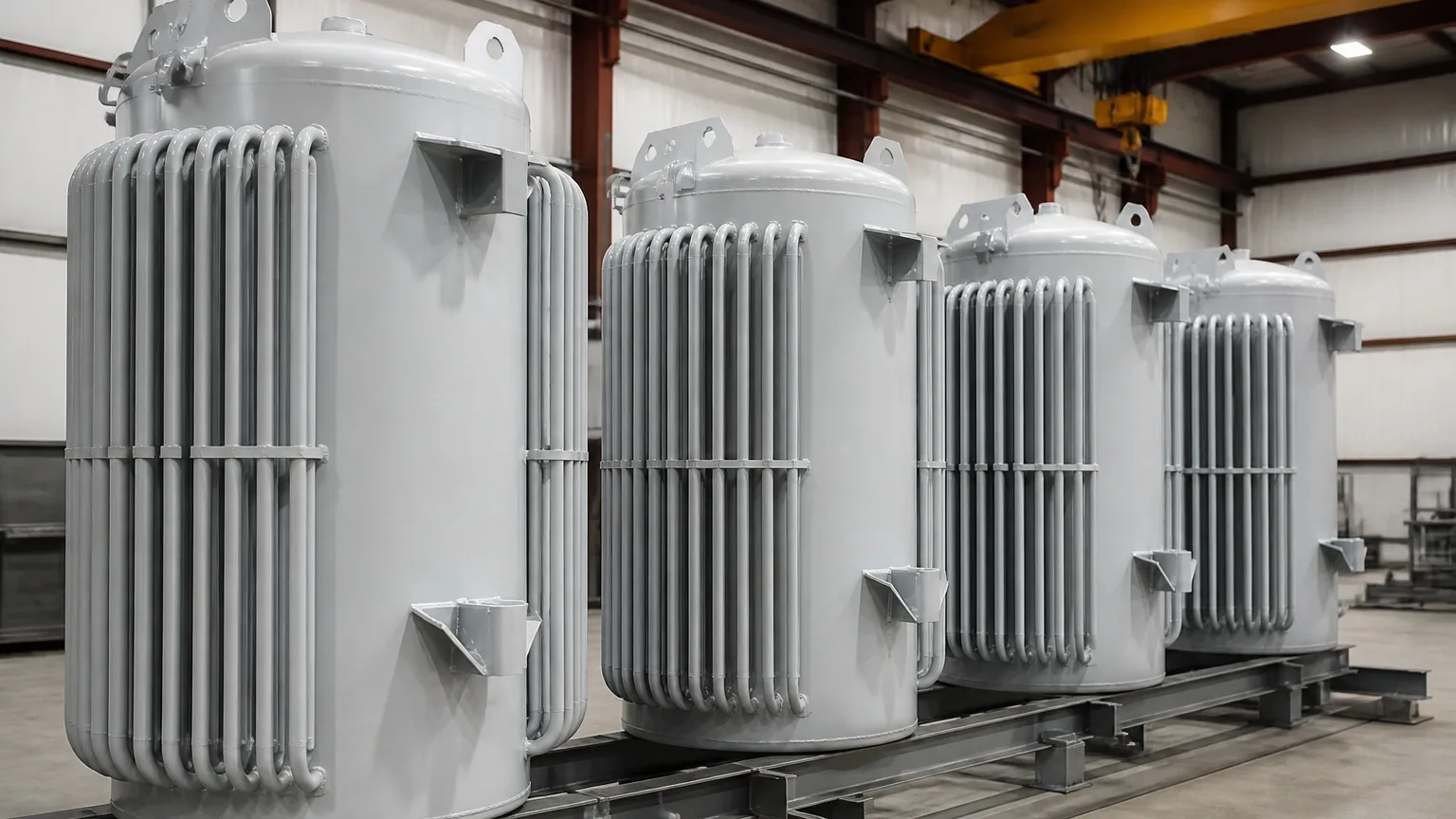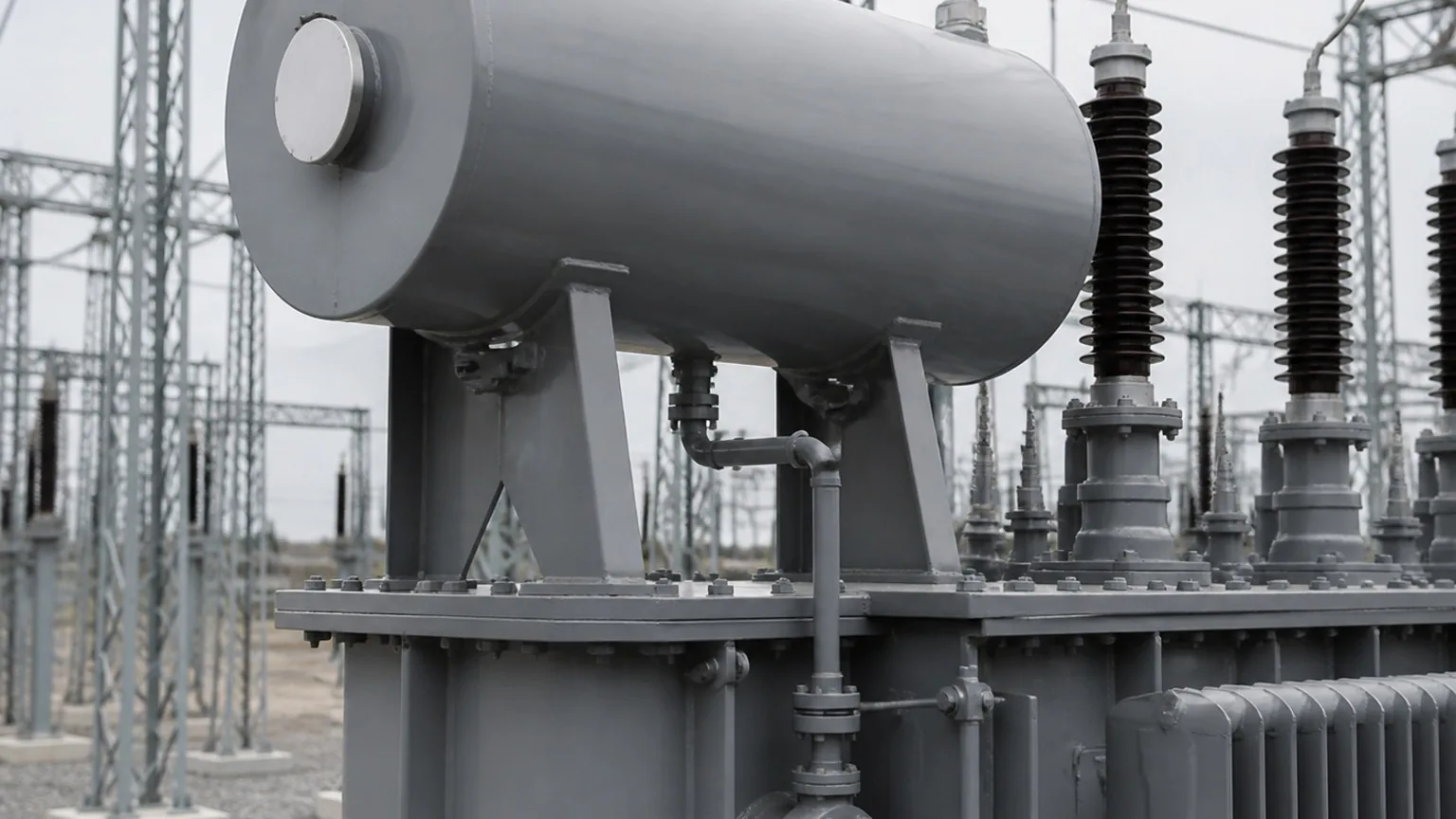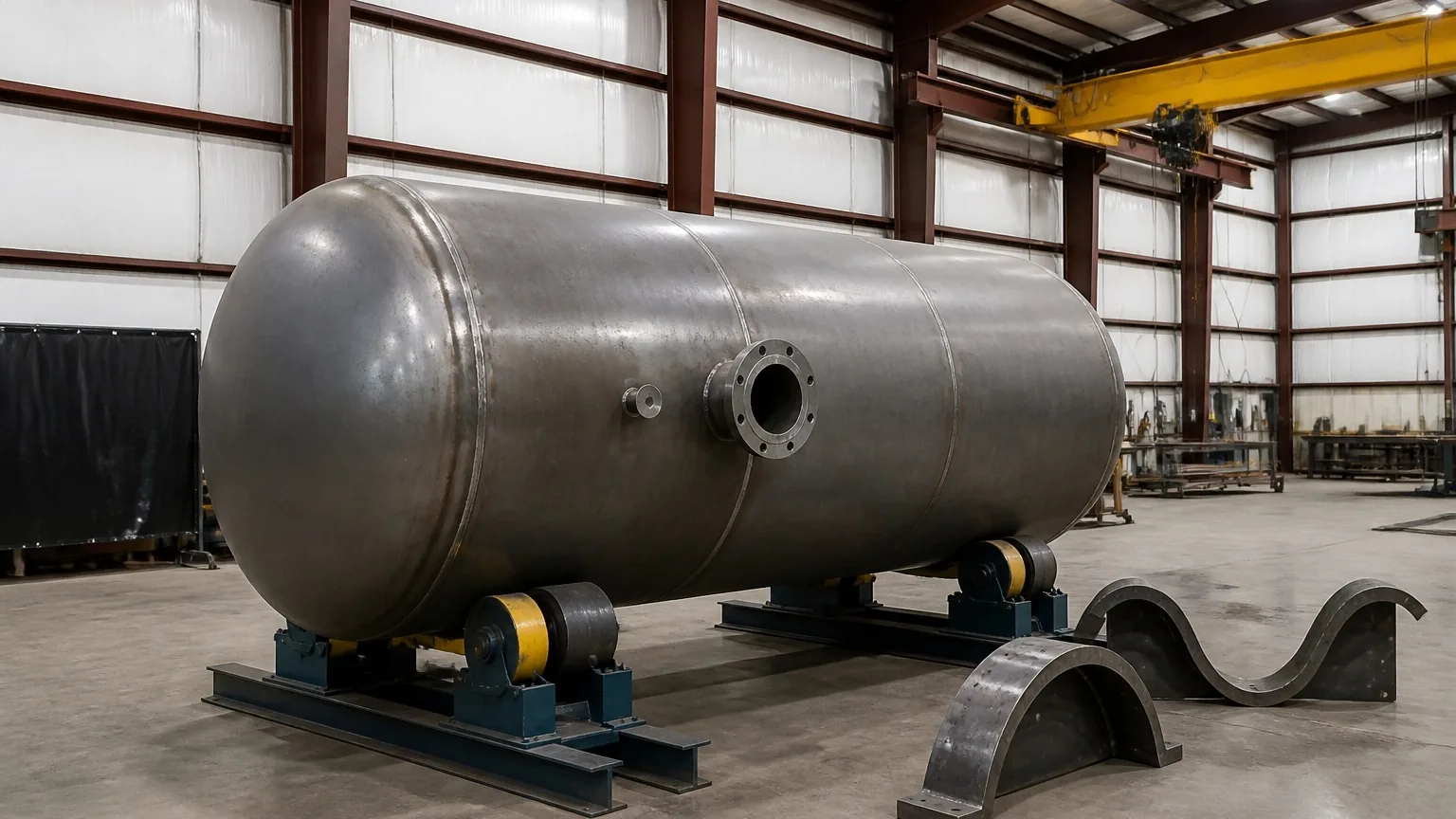
A round transformer tank, a conservator, a hopper cone, a large-diameter duct and a rolled flange ring all begin as flat plate. A plate roll bends that plate progressively into a curve, and the quality of the roll decides how well everything else fits — the longitudinal seam, the heads and covers, the flanges and the gaskets. Here is how plate rolling works, what limits it, and what to specify.
Need parts cut, formed, welded or finished? Call 601.892.5017 or email collin.t@fabtekindustries.com — send the drawing and we’ll quote it.
- A plate roll bends flat plate between three (or four) rolls into cylinders, cones and arcs; pre-bending the leading and trailing edges prevents flat spots at the seam.
- The smallest diameter you can roll is limited by the top-roll diameter — commonly about 1.2–1.5 times it — and the machine’s thickness-by-width capacity, which drops as yield strength rises.
- Shells are checked against a template or circumference tape before the seam is welded; roundness and peaking at the seam decide how well heads, flanges and covers fit.
- Laser vs. Plasma vs. Waterjet Cutting
- Fiber Laser Cutting: Thickness, Tolerance & Edge Quality
- Structural Steel Processing: Coping, Drilling & Sawing
- Press Brake vs. Panel Bender
- Plate Rolling: Cylinders, Cones & Tank Shells (you are here)
- When a Fabricated Part Needs Machining
- MIG vs. TIG vs. Laser Welding
- How Powder Coating Works
- Abrasive Blasting & SSPC Surface Prep
How a plate roll works
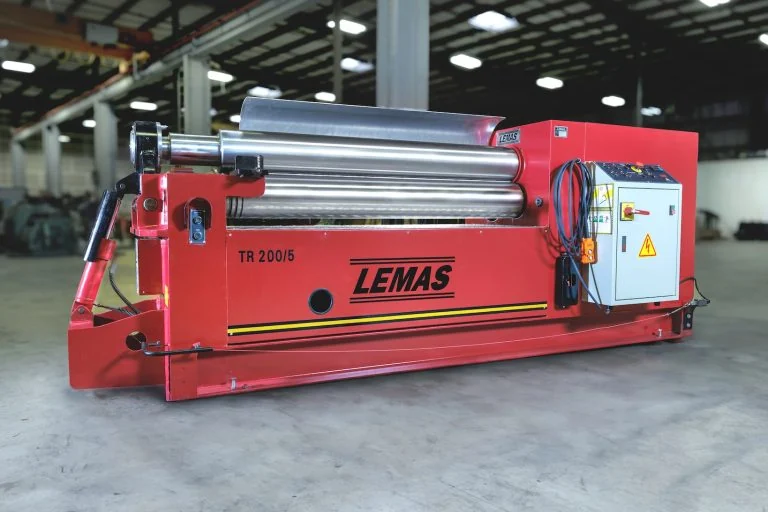
A plate roll has three or four long, hardened rolls. In the common three-roll design, the plate passes between a top roll and two lower rolls; raising the lower rolls (or lowering the top roll) forces the plate into a curve as the rolls turn and drive it through. Several passes, each a little tighter, bring the plate to the target diameter. Double-pinch three-roll machines clamp the plate between two rolls so it can be pre-bent at both ends without being removed, and four-roll machines add a pinch roll that holds the plate square and makes pre-bending and cone rolling faster. Variable-geometry machines move the lower rolls sideways to handle a wider range of thickness and diameter.
Rolling is incremental forming, so the operator — or the CNC — controls the result pass by pass, measuring as the shell closes up. Springback varies with the plate’s actual yield strength, which is why two plates of the same grade from different heats can roll slightly differently.
Pre-bending and flat ends
A roll can’t bend the part of the plate that never passes between the rolls, so if a plate is simply rolled, each end is left with a flat section roughly half the distance between the lower rolls. When the shell closes, those two flats meet at the seam and form a visible peak or flat spot. The fix is to pre-bend both edges to the final radius first — on the plate roll itself on double-pinch and four-roll machines, or on a press brake — and then roll the body. Pre-bending is the single biggest factor in how round a rolled shell is at the seam, and it matters most on thick plate and small diameters.
What limits capacity
| Factor | Effect |
|---|---|
| Plate thickness × width | Every roll has a rated capacity (e.g., a given thickness at full width); wider plate means less thickness |
| Yield strength | Capacity is rated for mild steel; higher-strength steel needs proportionally more force, so the rated thickness drops |
| Minimum diameter | Commonly about 1.2–1.5 × the top-roll diameter; thicker plate needs a larger minimum |
| Pre-bend capacity | Usually less than rolling capacity; limits how round the seam can be on heavy plate |
| Material | Stainless springs back more; aluminum marks easily and needs clean rolls |
For a buyer, the practical question is simple: send the diameter, plate thickness, width and grade, and the fabricator can tell you immediately whether the shell rolls in one piece, needs to be rolled in segments and welded, or needs a different approach.
Cones, segments and rings
Cones — hopper bottoms, reducers, transitions — are rolled from a flat pattern shaped like a segment of an annulus, with the rolls set at an angle so the small end curves tighter than the large end. Accurate cone rolling depends on an accurate flat pattern from engineering. Very large or heavy shells are rolled in segments and welded together. Rings and curved flanges are rolled from flat bar or angle on a section bender, the standard way to make stiffening rings, flange rings and curved frames.
Roundness and inspection
A shell is checked before the longitudinal seam is welded, while it can still be adjusted: circumference with a tape, diameter across several axes, and curvature at the seam with a template cut to the design radius, looking for peaking or flat spots. Pressure-vessel codes are the strictest reference point — they typically limit out-of-roundness to about 1% of the nominal diameter — and many non-pressure specifications borrow that limit. Transformer tanks are not pressure vessels, but they are sealed, vacuum-filled and leak-tested, so a round shell and a flat, true flange face are what make the gasket seal (see Transformer Tanks: Types, Welding & Testing).
Where rolled parts are used
In power and utility fabrication: round and pole-mount transformer tanks and step-voltage-regulator tanks; conservators and expansion tanks; tubular pole sections and base collars; rolled cover and flange rings. In industrial work: hoppers and cones, chutes, large ducts, screw-conveyor troughs and tubes, drums and guards. Anywhere a drawing shows a radius larger than a press brake can bump-form cleanly, a plate roll is usually the better tool.
How FabTek runs it
FabTek rolls on a Lemas hydraulic three-roll plate bending roll, with a hydraulic section bender for bar, angle and small sections. The shop pre-bends, rolls to diameter, rolls cones and rings, and checks every shell against a template and diameter measurements before it goes to welding. Plate is cut to the flat pattern on the plasma table or laser first, heat numbers are carried to the shell, and rolled parts move straight to seam welding, tube and fin attachment, leak testing and powder coat on site — which is how round tanks and conservators come out of the building finished.
Frequently asked questions
How does plate rolling work?
Flat plate is passed back and forth between three or four hardened rolls. Moving the rolls closer together on each pass forces the plate into a progressively tighter curve until it reaches the target diameter. The edges are pre-bent first so the finished cylinder has no flat spots at the seam.
Why do rolled plates have flat ends?
A plate roll cannot bend the portion of the plate that never passes between the rolls, so each end is left with a flat section unless it is pre-bent. Pre-bending both edges to the final radius, on the roll or on a press brake, prevents a peaked seam.
What is the smallest diameter a plate roll can make?
As a rule of thumb, about 1.2 to 1.5 times the diameter of the top roll, and more for thick plate. The exact limit depends on the machine, the plate thickness and width, and the material's yield strength.
How is a rolled shell checked for roundness?
Before the seam is welded, the shell is checked for circumference with a tape, diameter across several axes, and curvature at the seam with a template cut to the design radius. Pressure-vessel codes typically limit out-of-roundness to about 1 percent of the diameter, and many other specifications borrow that limit.