Every fabricated part starts as a flat sheet, a plate or a stock-length shape, and the first decision on the traveler is how to cut it. Fiber laser, plasma, oxy-fuel and abrasive waterjet all make a profile from a drawing, but they differ in the thickness they handle, the tolerance they hold, the edge they leave and what each inch costs. Here is how the four compare, and how a fab shop decides which one cuts your part.
Need parts cut, formed, welded or finished? Call 601.892.5017 or email collin.t@fabtekindustries.com — send the drawing and we’ll quote it.
- Fiber laser for sheet and light plate — gauge material to roughly 1″ mild steel. It holds the tightest tolerance of the thermal processes (about ±0.005″ on thin sheet) with the narrowest kerf, and it is the fastest on thin material.
- Plasma for medium and heavy plate, oxy-fuel for very heavy carbon plate: plasma holds about ±0.015–0.030″, lowest cost per inch on 1/2″ and up. Oxy-fuel takes carbon steel to several inches.
- Abrasive waterjet when heat is the problem: no heat-affected zone, nearly any material, very thick sections, about ±0.003–0.005″ — but the slowest and most expensive per inch.
- Laser vs. Plasma vs. Waterjet Cutting (you are here)
- Fiber Laser Cutting: Thickness, Tolerance & Edge Quality
- Structural Steel Processing: Coping, Drilling & Sawing
- Press Brake vs. Panel Bender
- Plate Rolling: Cylinders, Cones & Tank Shells
- When a Fabricated Part Needs Machining
- MIG vs. TIG vs. Laser Welding
- How Powder Coating Works
- Abrasive Blasting & SSPC Surface Prep
How each process cuts
Fiber laser. A laser generated in a doped optical fiber is focused to a spot a fraction of a millimeter wide and melts the metal, while an assist gas — oxygen, nitrogen or compressed air — blows the melt out of the kerf. The beam moves over a stationary sheet under CNC control, so every hole, slot and profile lands where the program puts it. Fiber lasers replaced CO₂ lasers across most sheet-metal shops in the 2010s because they cut thin material several times faster, cost less to run, and cut reflective metals like aluminum, brass and copper.
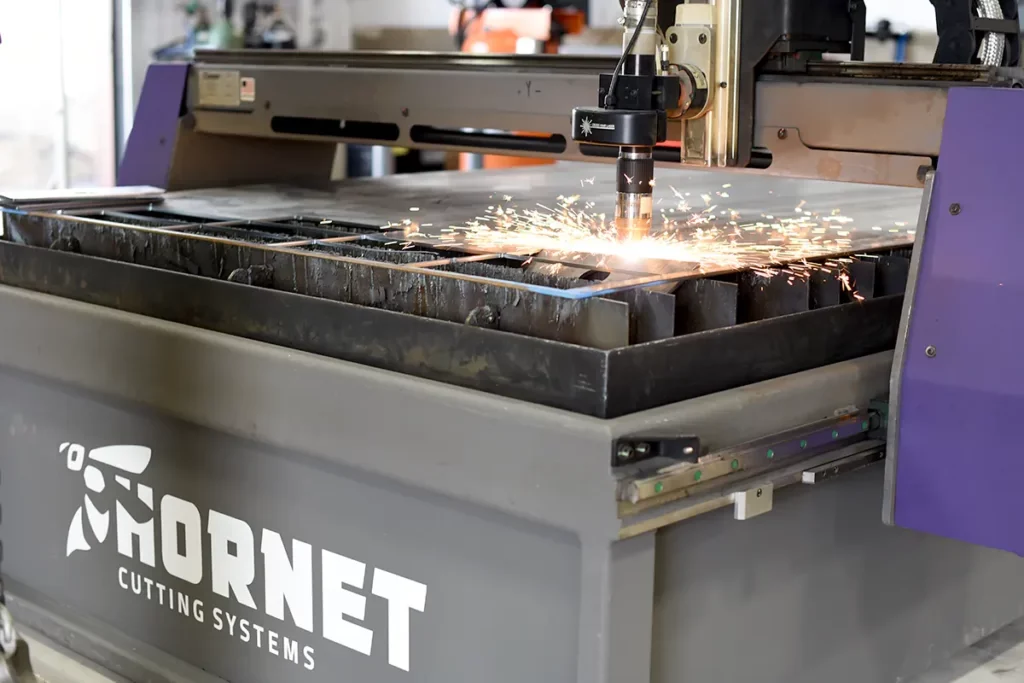
Plasma. An electric arc ionizes a gas jet into plasma at temperatures above 20,000°F, melting a path through any electrically conductive metal. Modern high-definition plasma on a CNC water table cuts clean, square-ish edges on plate and is far faster than a laser once material gets thick.
Oxy-fuel. A preheat flame brings carbon steel to ignition temperature and a jet of pure oxygen oxidizes (burns) the steel away. It only works on carbon and low-alloy steels, and it is slow, but it cuts plate several inches thick with inexpensive equipment — which is why plasma tables often carry an oxy-fuel torch for the heaviest plate.
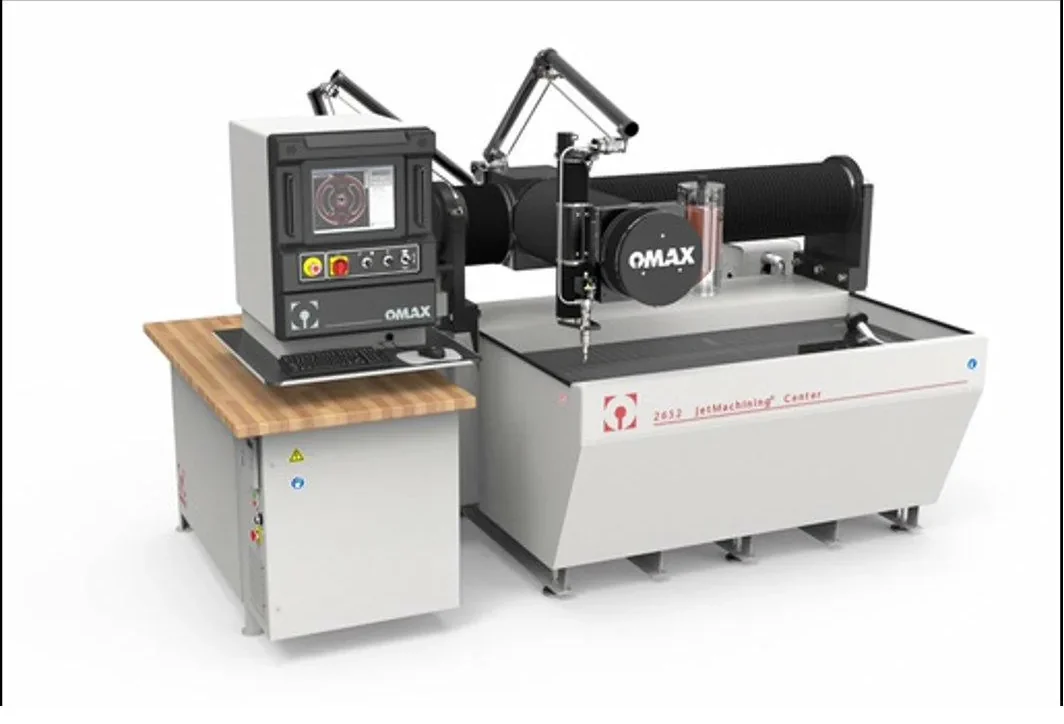
Abrasive waterjet. Water pressurized to roughly 60,000–90,000 psi is forced through a small orifice, picks up garnet abrasive in a mixing tube, and erodes through the material. There is no heat at all, so the material next to the cut is unchanged, and it will cut steel, stainless, aluminum, copper, titanium, rubber, phenolic, fiberglass, plastic, stone and glass.
Side-by-side comparison
| Fiber laser | Plasma (HD, CNC) | Oxy-fuel | Abrasive waterjet | |
|---|---|---|---|---|
| Sweet spot | Gauge sheet to ~1/2″ | 1/4″ to ~1-1/2″ plate | 1″ to 6″+ carbon plate | Thick or heat-sensitive parts, any material |
| Typical tolerance | ±0.004–0.010″ | ±0.015–0.030″ | ±1/32–1/16″ | ±0.003–0.010″ |
| Kerf | ~0.006–0.020″ | ~0.06–0.15″ | ~0.04–0.12″+ | ~0.03–0.05″ |
| Heat-affected zone | Very small | Moderate | Largest | None |
| Materials | Steel, stainless, aluminum, brass, copper | Any conductive metal | Carbon & low-alloy steel only | Almost anything |
| Speed on thin sheet | Fastest | Fast | Slow | Slowest |
| Cost per inch | Low on thin, rising with thickness | Lowest on medium plate | Low on very thick plate | Highest |
Typical production ranges, not brochure maximums. Actual capacity depends on machine power, material grade and the edge quality the drawing requires.
Thickness decides most jobs
For most parts, material thickness settles the question before anything else. Enclosure panels, cabinet doors, brackets and housings in 16 to 7 gauge are laser work; nothing else cuts them as fast or as accurately. Between about 3/8″ and 3/4″ the laser and plasma overlap, and the choice turns on tolerance, edge requirements and how many parts there are. Base plates, gussets, tank walls and heavy flanges from 3/4″ up are usually plasma, and very heavy carbon plate is oxy-fuel. Waterjet sits beside all of them: it is rarely the cheapest, but it is the answer whenever the others can’t do the job at all.
Edge quality, heat and what happens next
A cut edge is not the end of the part’s life, so the right process depends on what happens to that edge downstream.
Welding. Laser and plasma edges weld well; plasma and oxy-fuel can cut a weld-prep bevel as part of the profile, which saves a grinding step on heavy joints. Drilling and tapping. Thermal cutting hardens a thin layer at the edge and inside cut holes — most on oxy-fuel and plasma — so holes that will be tapped or reamed to a close fit are often drilled or machined afterward instead. Coating. Oxygen-assisted laser cuts on carbon steel leave a thin oxide layer that powder coat can lift from if it is not removed; nitrogen-assisted cuts leave a clean, oxide-free edge that is ready to coat (see Part 8). Fatigue and metallurgy. Where a heat-affected zone is unacceptable — some stainless, heat-treated material, parts under cyclic load — waterjet is the conservative choice.
Stainless, aluminum, copper and galvanized
Stainless steel cuts cleanly on a fiber laser with nitrogen assist, leaving a bright, oxide-free edge; heavy stainless plate goes to plasma or waterjet. Aluminum cuts well on a fiber laser in sheet gauges and on plasma in plate; waterjet avoids any edge change on critical parts. Copper and brass — bus bar, ground bars, shunts — are reflective and conductive; fiber lasers cut thinner sections, and waterjet is common for thicker bar. Galvanized and galvanneal sheet laser-cut routinely; the zinc at the cut edge is burned back slightly, which is why outdoor enclosures cut from coated sheet are still powder coated or edge-treated.
How a fab shop actually decides
On a real job the decision is made part by part, not job by job. A single outdoor equipment cabinet might have its panels, doors and brackets cut on the laser, its base channel and lifting lugs cut from plate on the plasma table, its copper ground bar and gasket cut on the waterjet, and its structural base members processed on a beam line (Part 3). The programmer nests parts from the same material and thickness together on a sheet to raise material yield, then routes each nest to the machine that cuts it best. The questions behind the choice are the ones in the table: thickness, tolerance, material, what the edge must do next, and quantity. What a buyer should look for is a shop that owns more than one process, so the part goes to the right machine instead of the only machine.
How FabTek runs it
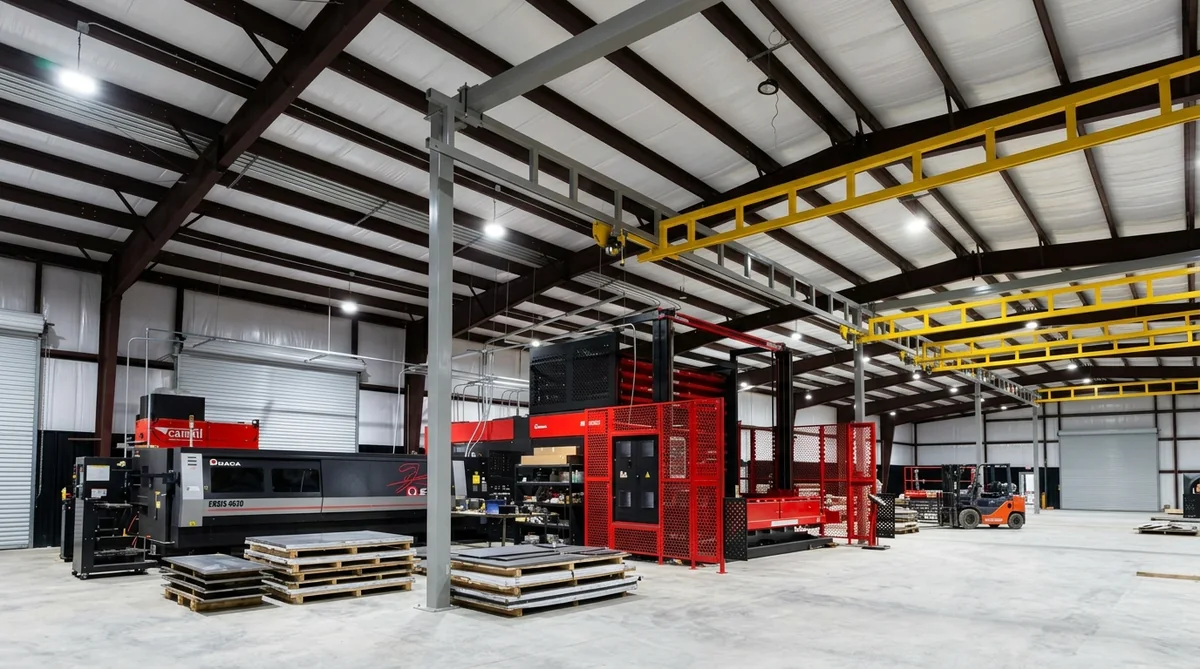
FabTek runs all four processes in house in Hazlehurst, Mississippi. Sheet work runs on an Amada ENSIS 3015 AJ fiber laser with a 5′ × 10′ bed and dual-shuttle pallet changer, backed by two additional laser cells. Plate runs on a Hornet CNC plasma with an oxy-fuel torch on a 120″ × 240″ water table. Thick, stainless, copper and heat-sensitive parts run on an OMAX abrasive waterjet. Structural shapes run on two Voortman V807 robotic plasma copers. Everything is nested from FabTek engineering’s flat patterns or from customer DXF, DWG and STEP files, heat numbers follow the material from sheet to part, and the cut parts move straight to forming, welding and powder coat in house. The full list is on the Cutting page.
Frequently asked questions
Which is more accurate, laser or plasma cutting?
Laser. A fiber laser typically holds about plus or minus 0.004 to 0.010 inch with a very narrow kerf, while CNC high-definition plasma holds about plus or minus 0.015 to 0.030 inch. Plasma is faster and cheaper on thicker plate, which is why shops use both.
When should I use waterjet instead of laser cutting?
Use waterjet when heat is a problem or the material is too thick or unusual for a laser: parts that cannot have a heat-affected zone, thick stainless or aluminum, copper bar, titanium, and non-metals such as rubber, phenolic, fiberglass or stone. It is slower and more expensive per inch than laser or plasma.
How thick can a fiber laser cut?
Production fiber lasers typically cut mild steel from thin gauge up to roughly 1 inch, with stainless and aluminum somewhat less, depending on laser power. They are fastest and most accurate on sheet and light plate; heavier plate usually moves to plasma, oxy-fuel or waterjet.
Is oxy-fuel cutting still used?
Yes, for heavy carbon steel plate. Oxy-fuel cuts carbon and low-alloy steel several inches thick with low equipment cost, but it is slow, leaves the largest heat-affected zone and cannot cut stainless or aluminum. Many CNC plasma tables carry an oxy-fuel torch for the heaviest plate.