The fiber laser is the machine most sheet-metal parts start on, and it is the machine engineers most often design around without knowing its limits. How thick can it cut? What tolerance should the drawing call for? How small can a hole be? And why do some laser-cut edges take powder coat perfectly while others flake? Here are the working answers.
Need parts cut, formed, welded or finished? Call 601.892.5017 or email collin.t@fabtekindustries.com — send the drawing and we’ll quote it.
- Production fiber lasers cut mild steel from thin gauge to roughly 1″, stainless and aluminum somewhat less, depending on power. They are fastest and most accurate on sheet up to about 1/4″.
- Design to ±0.005″ on thin sheet, opening to about ±0.010″ as material gets thicker. A practical minimum hole diameter is about one material thickness in mild steel, more in stainless and aluminum.
- Assist gas sets the edge: oxygen cuts carbon steel fast but leaves an oxide layer; nitrogen leaves a clean, bright edge ready to weld and powder coat.
- Laser vs. Plasma vs. Waterjet Cutting
- Fiber Laser Cutting: Thickness, Tolerance & Edge Quality (you are here)
- Structural Steel Processing: Coping, Drilling & Sawing
- Press Brake vs. Panel Bender
- Plate Rolling: Cylinders, Cones & Tank Shells
- When a Fabricated Part Needs Machining
- MIG vs. TIG vs. Laser Welding
- How Powder Coating Works
- Abrasive Blasting & SSPC Surface Prep
How a fiber laser cuts
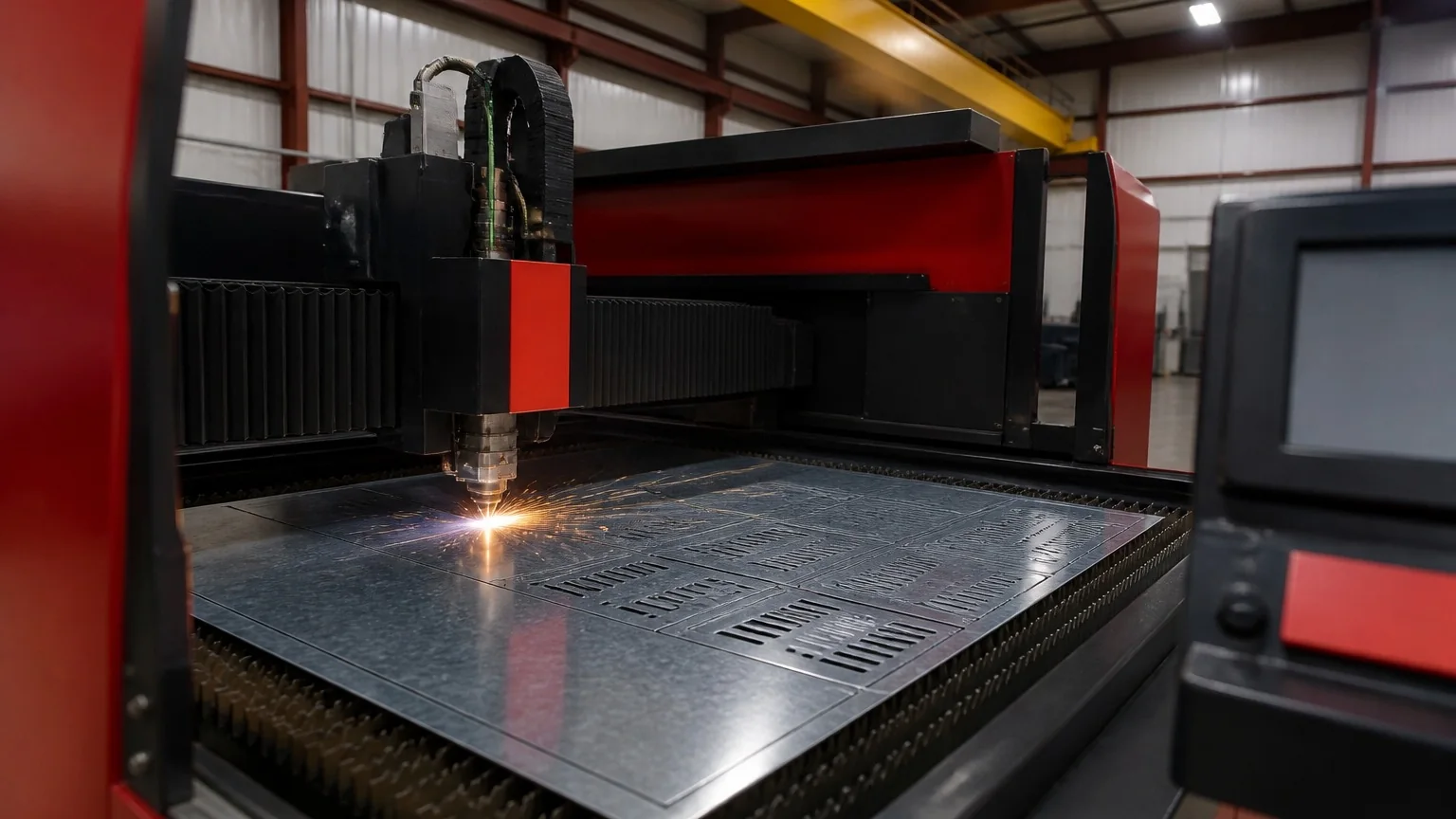
A fiber laser generates its beam in an optical fiber doped with rare-earth elements and delivers it through a flexible cable to a cutting head. A lens focuses the beam to a spot a fraction of a millimeter across, the metal melts, and a coaxial jet of assist gas blows the melt out the bottom of the kerf. The head moves over a stationary sheet on a CNC gantry, piercing and cutting each contour in the order the nesting software chose. Because the beam never touches the part, there is no tool wear and no mechanical load on thin material — the reason laser cutting replaced turret punching for most enclosure work.
Machines like the Amada ENSIS series also vary the beam profile automatically with material thickness, so the same laser cuts 16-gauge panels and heavy plate without an operator changing optics between jobs.
Thickness by material
| Material | Practical production range | Notes |
|---|---|---|
| Mild / carbon steel | Thin gauge to ~3/4–1″ | Oxygen assist for thick sections; nitrogen or air for clean edges on sheet |
| Stainless steel | Thin gauge to ~1/2–3/4″ | Nitrogen assist for a bright, oxide-free edge |
| Aluminum (5052, 6061) | Thin gauge to ~1/2″ | Fiber lasers cut reflective aluminum well; edge finish drops as thickness rises |
| Galvanized / galvanneal | Sheet gauges | Zinc burns back slightly at the edge; still powder coated for outdoor use |
| Copper & brass | Thin sheet and bar | Highly reflective; thicker bar usually goes to waterjet |
Ranges typical of production fiber lasers in the 3–12 kW class cutting to a quality edge. Brochure maximums are higher but slower and rougher. Heavier material moves to plasma, oxy-fuel or waterjet — see Part 1.
Tolerances and hole sizes
On sheet up to about 1/4″, a well-maintained fiber laser holds feature position and size to about ±0.004–0.005″. As thickness increases the kerf widens, the edge develops a slight taper and heat input rises, so ±0.010″ is a realistic call-out for 3/8″ to 1/2″ plate. Tighter than that on a feature that matters — a bearing bore, a dowel hole, a tapped pattern — is better done by cutting undersize and machining (Part 6).
| Feature | Design guideline |
|---|---|
| Minimum hole diameter | About 1 × thickness in mild steel; 1.5–2 × in stainless and aluminum |
| Minimum slot width | About 1 × thickness, with length at least 2 × width |
| Hole-to-edge web | At least 1 × thickness (more near bends) |
| Kerf | ~0.006–0.020″, compensated in the program |
| Taper | Negligible on sheet; measurable on thick plate |
Holes near a bend are a forming problem as much as a cutting one: a hole too close to the bend line distorts when the part is formed. Keep holes about 2 to 2.5 times material thickness plus the bend radius away from the bend (Part 4, and our 5052 bend radius spec sheet).
Assist gas and edge quality
Oxygen reacts exothermically with carbon steel and adds heat to the cut, which lets a laser cut thick carbon plate at lower power. It leaves a thin, dark oxide layer on the edge. That layer welds acceptably, but powder coat applied over it can lose adhesion at the edge, so oxygen-cut parts headed for coating are usually blasted or edge-cleaned first. Nitrogen is inert: it only shields and blows out the melt, leaving a bright, oxide-free edge that goes straight to welding or coating — the standard on stainless, aluminum and most enclosure sheet, at the cost of more gas and more laser power on thick parts. Compressed air is a lower-cost middle ground on thin material where a lightly oxidized edge is acceptable.
Other edge features to know: fine vertical striations (normal, and finer at the right speed), a small amount of dross on the bottom edge of thick parts, and a slight lead-in mark where each contour is pierced. Programmers place lead-ins on scrap-side or non-critical edges.
Design notes that save money
Nest-friendly parts are cheaper parts. Use one material and thickness per assembly where possible, so parts nest together on one sheet. Call out the tolerance each feature actually needs rather than a tight general tolerance for the whole drawing. Let the laser etch part numbers and bend lines — it costs almost nothing and saves sorting and layout downstream. Allow small micro-joints (tabs) that hold parts in the skeleton for unloading, and say on the drawing if an edge must be tab-free. For common-line cutting, where two parts share one cut, design adjacent parts with matching straight edges. And send a flat pattern or 3D model: a DXF, DWG or STEP file goes straight to programming, while a PDF has to be redrawn first.
How FabTek runs it
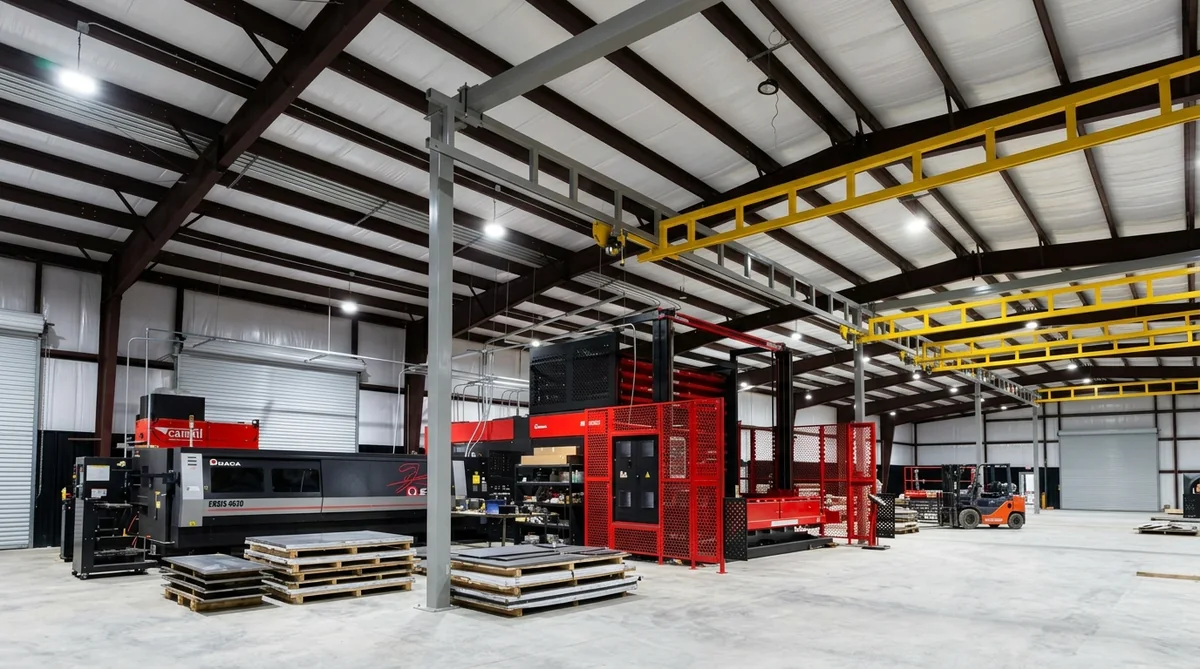
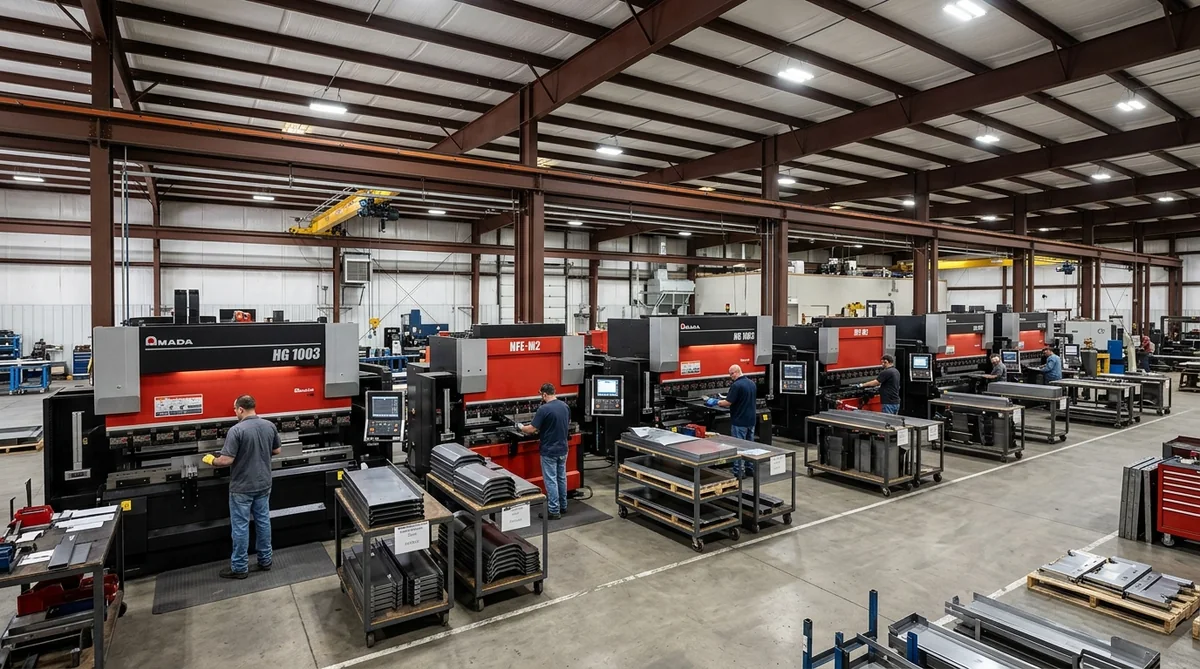
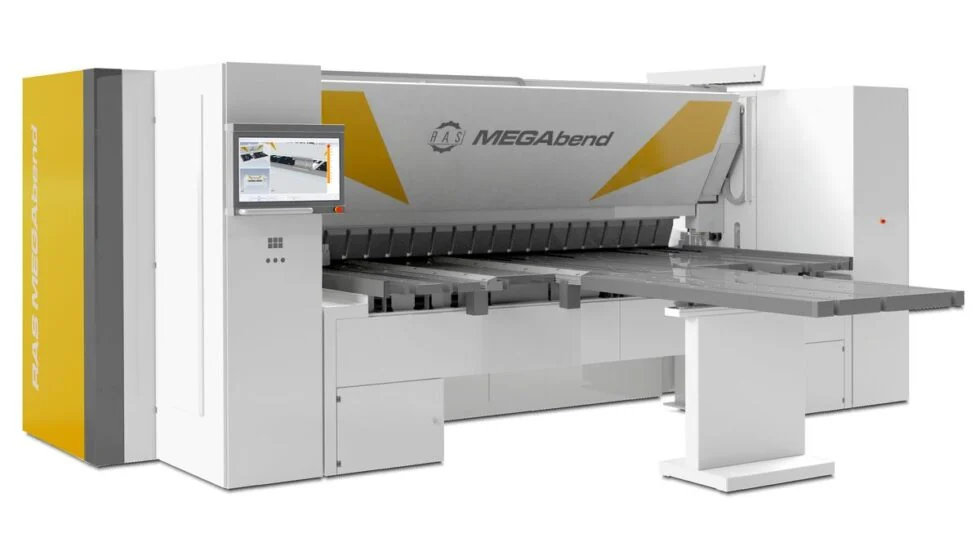
FabTek’s primary cell is an Amada ENSIS 3015 AJ — a variable-beam fiber laser with a 5′ × 10′ bed and a dual-shuttle pallet changer that loads the next sheet while the current one cuts — backed by two additional laser cells for overflow, secondary and specialty work. The lasers cut carbon, galvanized and galvanneal sheet, stainless and aluminum for cabinets, enclosures, switchgear panels, bus duct housings and brackets, nested from FabTek engineering’s flat patterns or from customer DXF, DWG, STEP, SolidWorks and Inventor files. Part numbers and bend lines are etched where the drawing calls for it, heat numbers are carried from sheet to part, and the parts go directly to the press brakes, the MEGAbend panel folder, welding and powder coat in house — the same flow the Laser Cutting page describes.
Frequently asked questions
How thick can a fiber laser cut steel?
Production fiber lasers typically cut carbon steel from thin gauge up to about 3/4 to 1 inch at a good edge quality, depending on laser power. Brochure maximums are higher, but cutting is slower and rougher near the limit, so heavier plate usually moves to plasma or oxy-fuel.
What tolerance can laser cutting hold?
About plus or minus 0.004 to 0.005 inch on sheet up to roughly 1/4 inch, opening to about plus or minus 0.010 inch on 3/8 to 1/2 inch plate. Features that need tighter tolerance are usually cut undersize and machined.
What is the smallest hole a laser can cut?
A practical minimum is a hole diameter about equal to the material thickness in mild steel, and about 1.5 to 2 times the thickness in stainless steel and aluminum. Smaller holes can be pierced but lose roundness and edge quality.
Should laser cutting use oxygen or nitrogen?
Oxygen cuts thick carbon steel faster but leaves an oxide layer on the edge that can weaken powder coat adhesion. Nitrogen leaves a clean, oxide-free edge ready for welding and coating and is standard for stainless steel, aluminum and most enclosure sheet.