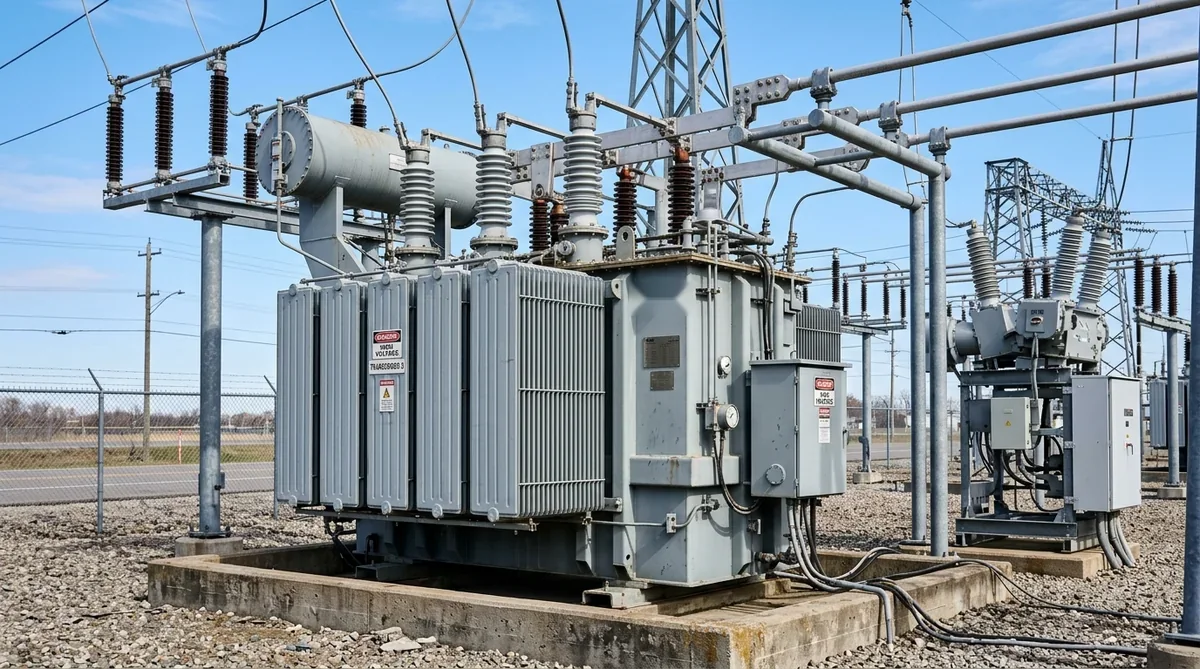
Once an OEM has moved tanks and cabinets to a contract fabricator, the question becomes what else on the bill of materials is metal that someone else could build. Quite a lot: covers with their bushing turrets and gasket faces, conservator vessels, cable and terminal boxes, radiator and cooler supports, bases, skids, lifting lugs and jacking pads. Part 4 of this series walks through that second tier — what each part does, what to specify, and why buying it alongside the tank simplifies the whole program.
Transformer OEM looking for tank, cabinet or coil capacity? Call 601.892.5017 or email collin.t@fabtekindustries.com — send a print and a monthly quantity and we’ll quote it.
- Beyond the tank body, a transformer carries a second tier of fabricated metal: covers, turrets, conservators, boxes, supports and hardware.
- Covers are the precision item — flatness and gasket-face finish decide whether the unit seals; conservators are small pressure vessels in their own right.
- Boxes, supports, bases and lugs are simpler but numerous, and they must arrive matched to the tank they bolt to.
- Sourcing the accessories with the tank, from the same shop keeps interfaces aligned and removes a set of small vendors from the schedule.
- Why Transformer OEMs Outsource Tanks, Cabinets and Enclosures
- How to Qualify a Contract Transformer Tank Fabricator
- Contract Coil Winding: When It Makes Sense to Outsource
- Conservators, Covers and Tank Accessories (you are here)
- Running an OEM–Fabricator Program
- The Cost of a Stalled Line vs. Reserved Capacity
The second tier of transformer metal
A liquid-filled transformer is a tank with a great deal bolted to it. Some of that is electrical — bushings, tap changers, gauges, relays — and comes from component suppliers. The rest is fabricated metal that the OEM historically built alongside the tank because it had the plate and the welders anyway. When the tank leaves the building, so should the parts that only make sense fitted to it. We described tank types in Transformer Tanks for Data Centers; this post is about everything attached to them.
Tank covers and bushing turrets
The cover is the precision part of a tank. It carries the bushings on welded turrets, the cover-mounted accessories, and lifting provisions, and it has to seal against the tank flange for the life of the unit. That means flatness of the gasket face across a large plate that has had turrets and fittings welded into it, bolt-hole pattern accuracy to the tank flange, turret position and perpendicularity to the bushing drawing, and a gasket-face finish that will not cut a gasket. Covers are fabricated from plate cut to the OEM’s program with all openings, stiffened as designed, fitted with turrets and fittings on fixtures, welded with distortion control, and then the gasket face is machined or flattened and checked. A cover built in the same shop as its tank is trial-fit to that tank before either ships — which is the single best argument for sourcing them together.
Conservators
On power transformers with conservator-type oil preservation, the conservator is a cylindrical vessel mounted above the tank that accommodates oil expansion and contraction, fitted with a breather connection, oil-level gauge mounting, drain and fill valves, and often a rubber-bag separator. Fabrication is rolled and seam-welded shell, welded heads, nozzles and flanges to the OEM’s drawing, mounting saddles, and an internal coating compatible with the fluid — a small pressure vessel with the same weld, test and cleanliness requirements as the main tank. FabTek lists conservator tanks as a standard product alongside main tanks.
Cable, terminal and control boxes
Cable boxes and terminal enclosures mount to the tank wall over the low-voltage or high-voltage connections, sealing the connection from weather while providing cable entry and access. Control and marshalling cabinets house gauges, relays and wiring, often delivered wired. These are sheet-metal enclosures — gasketed doors, gland plates, drip shields, NEMA 3R or 4 construction — whose only hard dimension is the mounting interface to the tank wall or cover. Built with the tank, they bolt on; built separately, they are checked twice.
Radiator supports, bases and skids
Radiator banks and coolers hang from welded brackets and headers on the tank wall or stand on their own supports; the tank sits on a base or skid designed for its filled weight and for rolling or sliding into position on the pad. Both are structural fabrication: plate and shape cut on plasma or laser, welded to AWS D1.1, coated to the exterior system. Radiator brackets in particular must match the radiator manufacturer’s flange pattern and the OEM’s tank-wall layout exactly, since a misaligned header is a leak path.
Lifting, jacking and hardware
Lifting lugs on cover and tank, jacking pads at the base, pulling eyes, grounding pads and nameplate mounts are small parts with serious consequences: lugs are rated for the filled unit and welded with full-penetration procedures; jacking pads take the transformer’s weight during installation. They are detailed on the tank drawing and fabricated with it; the qualification questions from Part 2 apply to them as much as to the seams.
What to specify
- Covers — plate grade and thickness, opening layout, turret drawings and bushing interfaces, flatness tolerance on the gasket face, bolt pattern to the tank flange, lifting provisions, interior and exterior coating.
- Conservators — volume, shell dimensions and thickness, nozzle and flange schedule, saddle positions, pressure/vacuum test values, internal coating, breather and gauge mounts.
- Boxes — enclosure rating, dimensions, mounting interface to the tank, cable entry, gasketing, wire-out scope.
- Supports, bases, skids — loads, member sizes, radiator flange patterns, anchor and rolling provisions, coating.
- Hardware — lug and pad ratings, positions, weld procedures, proof-test requirement if any.
- Kitting — how accessories ship with or ahead of the tank, labeled to unit serial.
Buy it with the tank
Every part in this post has one thing in common: its critical dimension is an interface to the tank. A cover to a flange, a box to a wall, a conservator to a saddle, a bracket to a radiator header. When the tank and the accessories come from one shop, those interfaces are fit-checked before shipment and the OEM receives a kit that assembles. When they come from several, the OEM becomes the integrator, and every mismatch lands on its floor. That is the practical case for a fabricator that builds tanks and conservators, cabinets, boxes and wired control cabinets under one roof — and it is the program structure Part 5 describes.
FabTek Industries builds transformer tanks and conservators, covers with turrets, cable and terminal boxes, radiator supports, bases and skids, and lifting and jacking hardware to print for transformer OEMs, remanufacturers and repair shops — fabricated to the OEM’s print, trial-fit to the tank they belong to, and kitted by unit serial — under an ISO 9001:2015 quality system with AWS-certified welding, from four production sites in Hazlehurst, Mississippi. Dedicated production lines with reserved monthly capacity are how most of our OEM programs run. See how we work with transformer OEMs, or send us a print.
Frequently asked questions
What transformer parts besides the tank can be outsourced to a fabricator?
Tank covers with bushing turrets, conservator vessels, cable and terminal boxes, control and marshalling cabinets, radiator and cooler supports, bases and skids, and lifting lugs, jacking pads and grounding hardware — all fabricated metal whose critical dimensions are interfaces to the tank.
What is a transformer conservator tank?
A cylindrical vessel mounted above a power transformer that accommodates the expansion and contraction of insulating oil with temperature, fitted with a breather, oil-level gauge, valves and often a rubber-bag air separator. It is fabricated as a small pressure vessel with the same weld, test and cleanliness requirements as the main tank.
Why is tank cover flatness important?
The cover's gasket face must seal against the tank flange for the life of the unit. Welding bushing turrets and fittings into the cover plate distorts it, so the gasket face must be flattened or machined and checked to tolerance after fabrication, and the bolt pattern must match the tank flange precisely.
Why buy tank accessories from the same fabricator as the tank?
Because every accessory's critical dimension is an interface to the tank — cover to flange, box to wall, conservator to saddle, bracket to radiator header. One shop fit-checks those interfaces before shipment and delivers a kit that assembles; multiple vendors make the OEM the integrator of mismatches.