Powder coating is the standard finish for electrical enclosures, cabinets, BESS and generator enclosures, conveyor frames and a growing share of transformer tanks. Done well, it is tough, uniform and long-lasting; done poorly, it chips at the edges and rusts underneath within a few seasons. Almost all of the difference is in the steps before the powder goes on. Here is how the process works, stage by stage.
Need parts cut, formed, welded or finished? Call 601.892.5017 or email collin.t@fabtekindustries.com — send the drawing and we’ll quote it.
- Powder coating is dry thermoset powder sprayed electrostatically onto grounded metal, then melted and cross-linked in an oven — typically around 350–400°F part temperature for 10–20 minutes, per the powder’s cure schedule.
- Most failures trace to prep, not powder: parts need cleaning and a conversion coating (iron phosphate, zinc phosphate or zirconium) or a blast profile before coating.
- Outdoor electrical equipment usually gets a two-coat system (primer plus top coat) at about 3–5 mils or more — the route to IEEE salt-spray performance — while indoor parts often get one coat at 2–3 mils.
- Laser vs. Plasma vs. Waterjet Cutting
- Fiber Laser Cutting: Thickness, Tolerance & Edge Quality
- Structural Steel Processing: Coping, Drilling & Sawing
- Press Brake vs. Panel Bender
- Plate Rolling: Cylinders, Cones & Tank Shells
- When a Fabricated Part Needs Machining
- MIG vs. TIG vs. Laser Welding
- How Powder Coating Works (you are here)
- Abrasive Blasting & SSPC Surface Prep
The stages of powder coating
| Stage | What happens | Why it matters |
|---|---|---|
| 1. Clean | Alkaline wash removes oil, drawing compound and shop soil | Powder won’t bond to oil |
| 2. Rinse | Water rinses between chemical stages | Carryover contaminates the next stage |
| 3. Conversion coat | Iron phosphate, zinc phosphate or zirconium treatment | Adhesion and underfilm corrosion resistance |
| 4. Dry-off | Oven drives off all moisture | Trapped water blisters the film |
| 5. Apply | Electrostatic guns spray charged powder on grounded parts | Even film, wraps edges and backsides |
| 6. Cure | Oven melts, flows and cross-links the powder | Hardness, adhesion, chemical resistance |
| 7. Inspect | Film thickness, appearance, adhesion and cure checks | Confirms the spec was met |
Pre-treatment or blast
Hot-rolled plate and heavy weldments carry mill scale, which chemistry alone won’t remove, so tanks, structural parts and heavy frames are usually abrasive blasted to a specified cleanliness and profile before coating (see Part 9). Cold-rolled, galvanized and galvanneal sheet — the material most cabinets and enclosures are made from — goes through a multi-stage chemical pre-treatment: cleaning, rinsing and a conversion coating that bonds to the steel and gives the powder a surface to grip. Iron phosphate is the common general-purpose treatment; zinc phosphate performs better outdoors; zirconium-based treatments are a newer, lower-sludge alternative. Laser-cut edges cut with oxygen carry an oxide layer that should be removed first, or the powder can lift at the edge (Part 2).
Application and two-coat systems
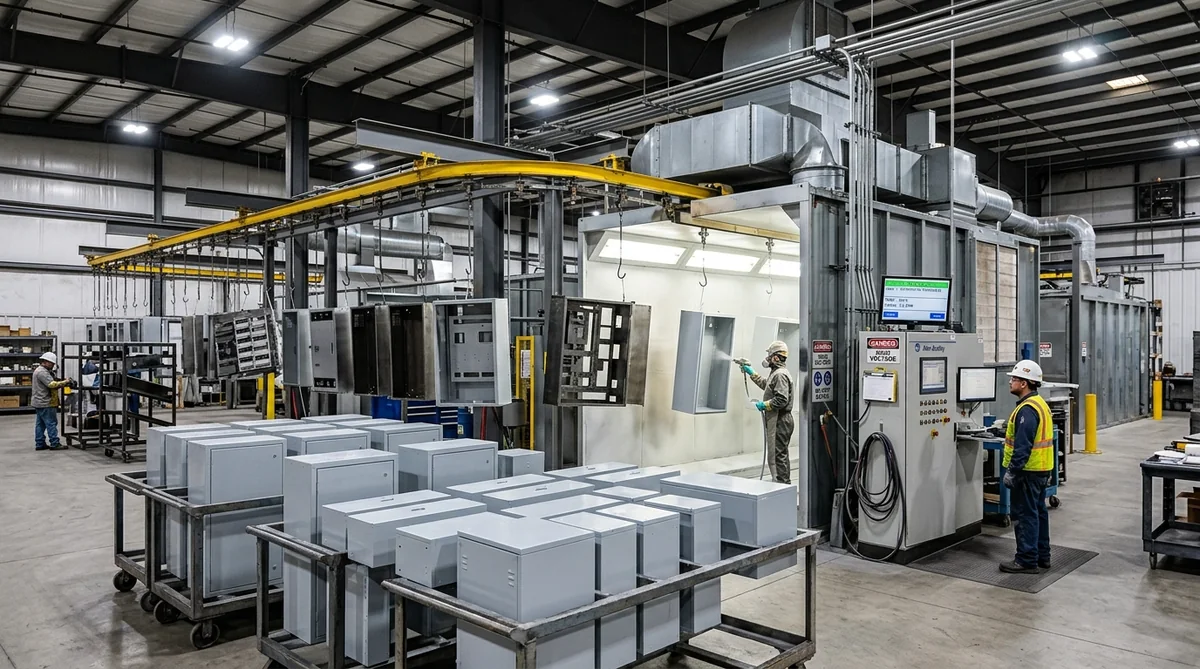
Powder is a finely ground, dry mixture of resin, pigment, curing agent and additives. A spray gun gives the particles an electrostatic charge; the part is grounded through its hanger, so the powder is drawn to it and clings until cured, wrapping around edges and onto surfaces the gun doesn’t face directly. Overspray is recovered and reused, which is part of why powder produces far less waste and almost no solvent emissions compared with liquid paint.
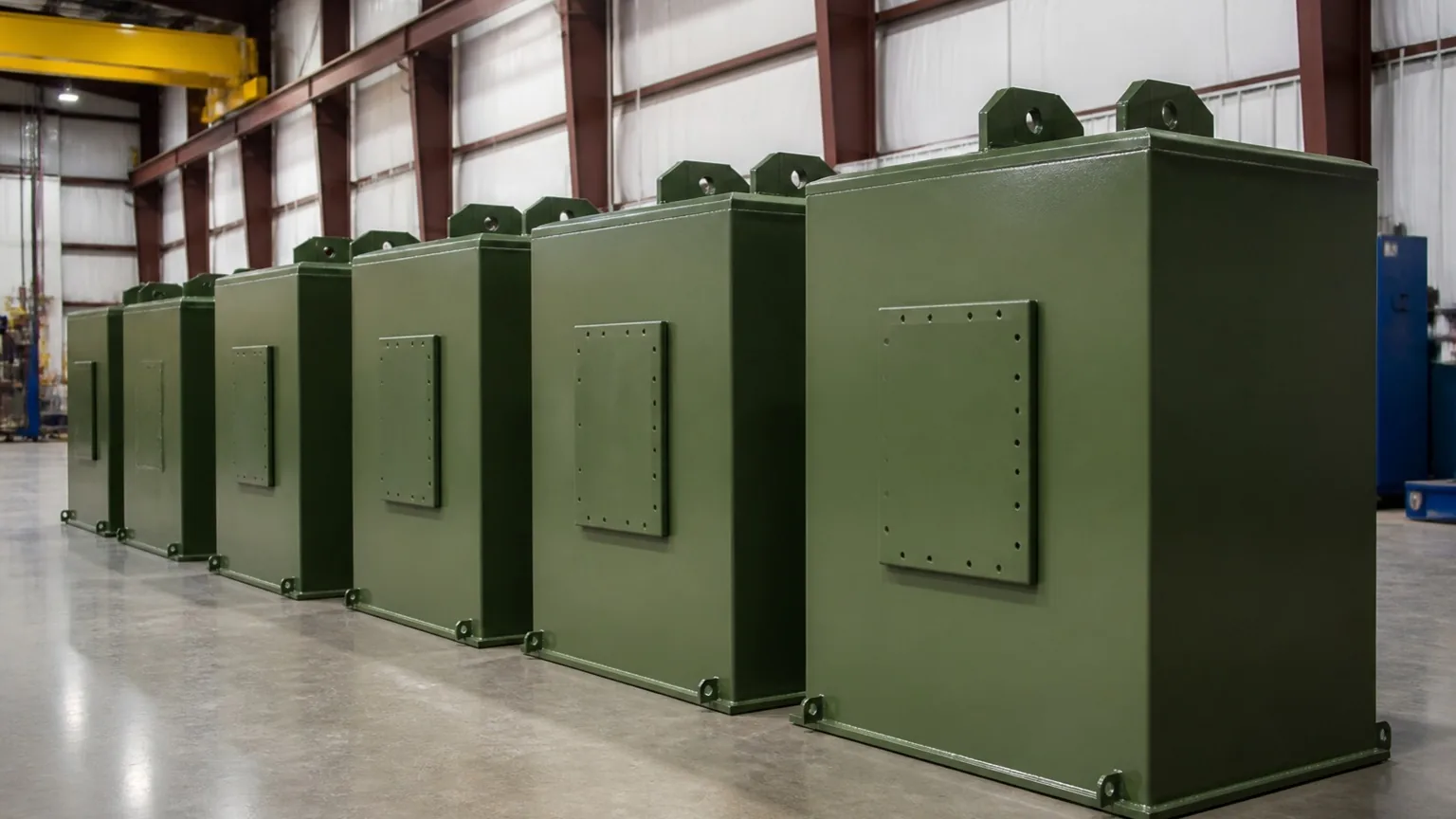
For outdoor electrical equipment the standard is a two-coat system: a corrosion-inhibiting primer (often epoxy or zinc-rich powder) followed by a UV-stable top coat (polyester or super-durable polyester) in the specified color — ANSI 61 or 70 gray and Munsell green are common for utility equipment. The primer carries the corrosion protection and the top coat carries the weathering and color. Indoor parts usually get a single coat. Film thickness targets by environment are in our powder coat film thickness spec sheet.
Cure
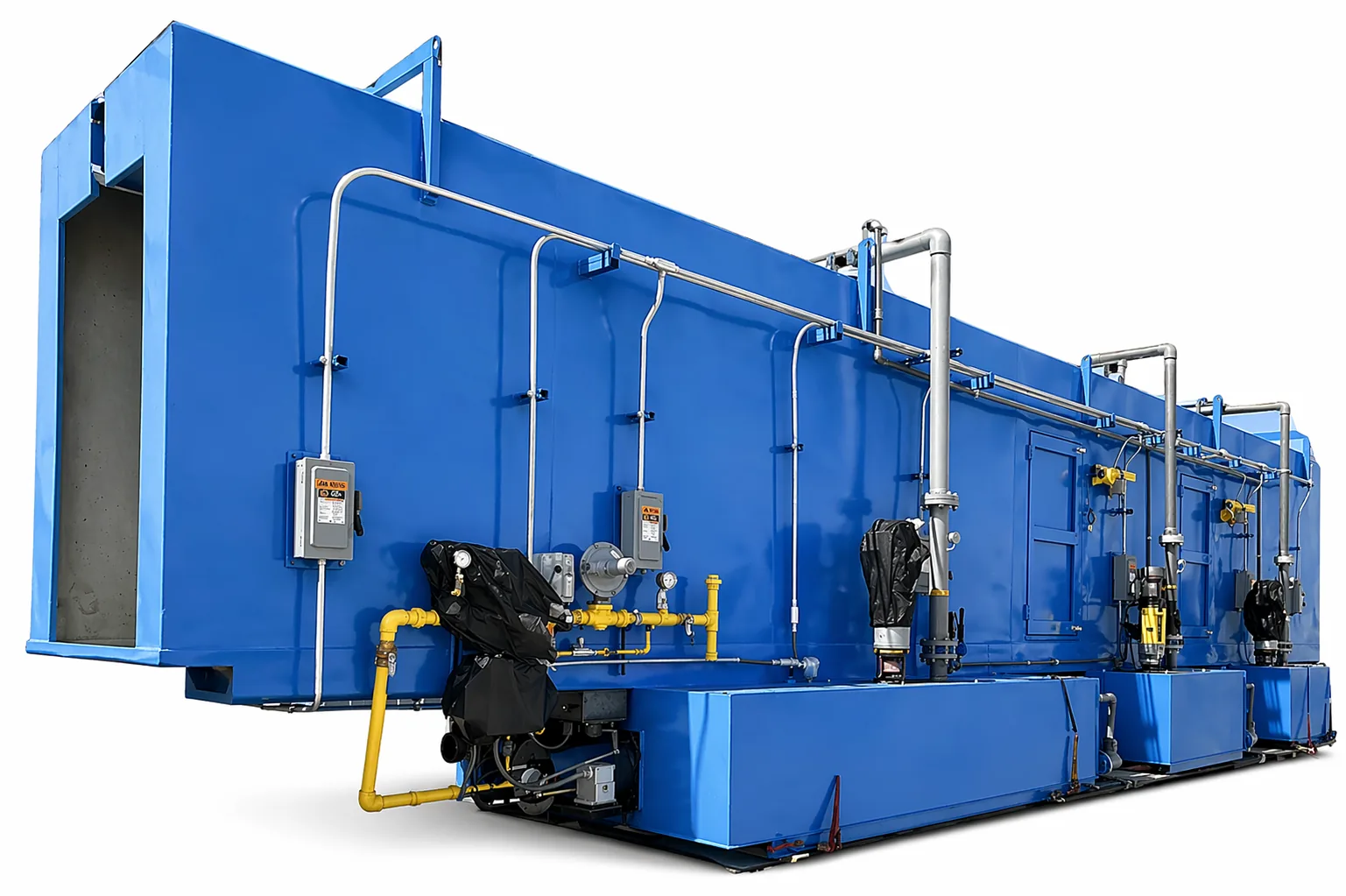
In the cure oven the powder melts, flows into a continuous film and chemically cross-links. What matters is the metal temperature held for the time on the powder manufacturer’s data sheet — commonly around 350–400°F for 10 to 20 minutes, though low-cure powders exist. Thin sheet reaches temperature quickly; a heavy transformer tank or weldment takes much longer, so large-part lines are designed with ovens sized for mass, not just for size. An under-cured film looks fine but is soft and fails adhesion and chemical tests; an over-cured film can discolor and embrittle.
Masking and hanging
Some surfaces must stay bare: gasket and flange faces, ground pads and grounding points, bushing pads, threaded holes and machined surfaces. They are masked with high-temperature tape, plugs and caps before coating. Every part also needs a hang point — a hole or tab where it hangs from the conveyor and makes electrical ground — ideally in a spot that doesn’t show. Good designs put hang holes on the drawing; otherwise the finisher chooses them. Threads that must accept a bolt after coating are masked or chased afterward.
Inspection and standards
Dry film thickness is measured with a magnetic or eddy-current gauge (ASTM D7091) and recorded. Adhesion is checked by cross-hatch tape test (ASTM D3359). Cure is checked by solvent-rub testing against the powder supplier’s criteria. Corrosion performance of the coating system is qualified by salt-spray testing (ASTM B117); for pad-mounted and outdoor utility equipment, IEEE C57.12.28 and C57.12.29 set the coating-system requirements, and the familiar 2,000-hour salt-spray rating is explained in our IEEE salt spray spec sheet.
Powder coat, paint or galvanizing?
Powder coat is the default for enclosures, cabinets and tanks because it is durable, uniform, available in any color and applied in the shop in one pass through a line. Liquid paint still suits very large parts that won’t fit an oven, field touch-up, and specialty coatings. Hot-dip galvanizing is the default for substation and transmission steel that sits outdoors for decades with no maintenance, and duplex systems — galvanize plus powder — combine both. The trade-offs for structures are covered in Galvanizing vs. Paint for Substation Steel.
How FabTek runs it
FabTek finishes in house on two powder lines. The automated powder coat line is a continuous-conveyor system with pre-treatment, a powder primer booth, a powder top-coat booth and a cure oven, for cabinets, enclosures and panels. The heavy-duty monorail line handles transformer tanks, structural weldments, long busway housings and platform steel, with blast and pre-treatment ahead of it and an oven sized for heavy mass. Both run the same IEEE 2,000-hour salt-spray certified system, in ANSI 61, ANSI 70, Munsell green, RAL or OEM-matched colors, with masking to the drawing and film thickness and cure recorded per rack under ISO 9001:2015. More on the Powder Coat Paint page.
Frequently asked questions
How does powder coating work?
Parts are cleaned and pre-treated, then dry powder is sprayed on with an electrostatic gun while the part is grounded, so the charged powder clings evenly. The part then goes through an oven where the powder melts, flows and cross-links into a hard, continuous film.
What temperature is powder coating cured at?
Most powders cure at a metal temperature of roughly 350 to 400 degrees Fahrenheit held for about 10 to 20 minutes, following the powder manufacturer's cure schedule. Heavy parts take longer to reach temperature, and low-cure powders are available for heat-sensitive parts.
Why does powder coating fail or peel?
Most failures come from surface preparation: oil or soil left on the part, a missing or poor conversion coating, mill scale on hot-rolled steel, or oxide on oxygen-cut laser edges. Under-cure and film that is too thin at sharp edges are the next most common causes.
What is a two-coat powder coating system?
A corrosion-inhibiting powder primer, often epoxy or zinc-rich, followed by a UV-stable polyester top coat in the finish color. It is the common system for outdoor electrical enclosures, BESS cabinets and transformer equipment that must meet salt-spray requirements.