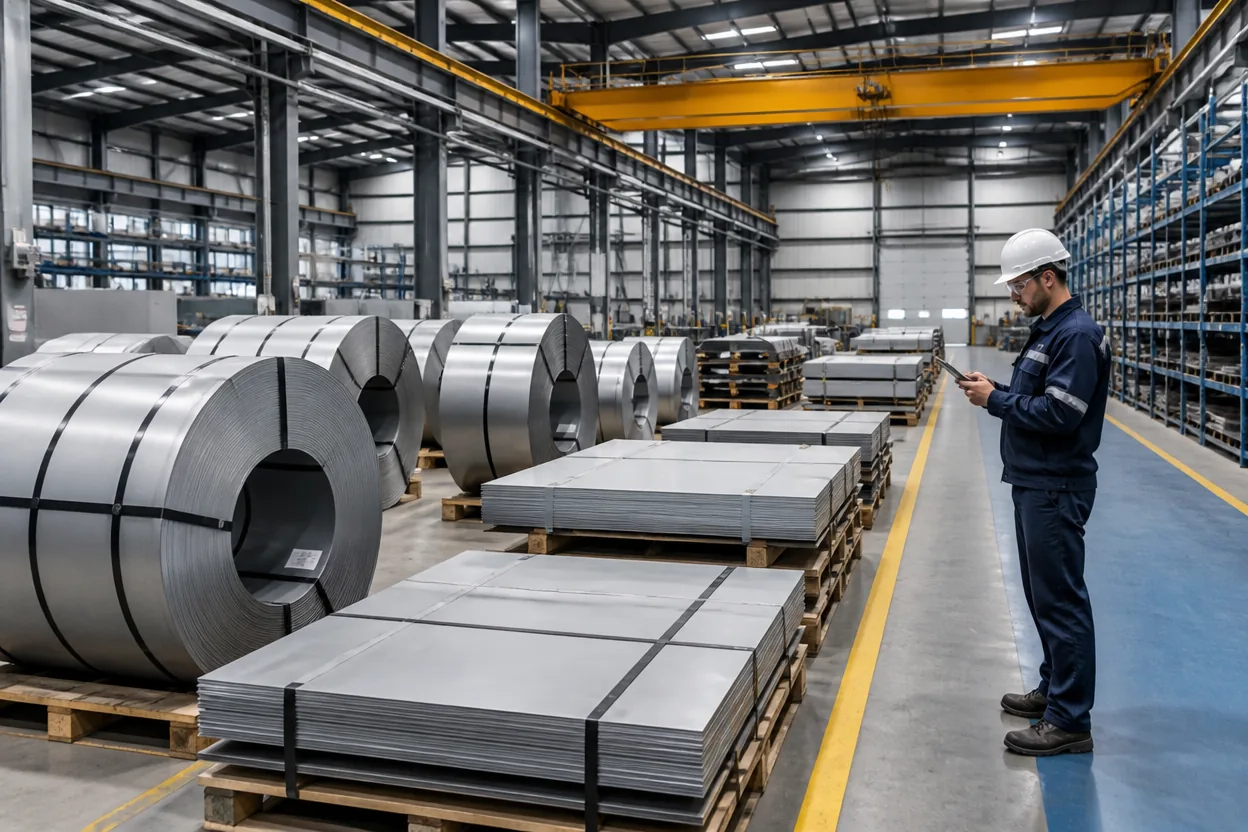
Every fabrication decision starts with the material. The grade decides how a part cuts, bends and welds; the gauge decides how strong and how heavy it is; the coating decides how long it survives outdoors. Part 3 of this series is a practical guide to the metals a fabricator works with — what they are, how they behave in the shop, and how a buyer chooses among them for power, utility and data center work.
Looking for a U.S. fabricator? Call 601.892.5017 or email collin.t@fabtekindustries.com — send a drawing or a scope and we’ll respond fast.
- Fabrication stock comes as sheet, plate, tube, pipe, bar and structural shapes; sheet is specified by gauge, plate by thickness, shapes by ASTM designation.
- Carbon steel (A36, A572, A1008/A1011) is the default: strong, cheap, weldable, and protected by powder coat or galvanizing.
- Stainless (304, 316) buys corrosion resistance at 3–5× the cost; aluminum (5052, 6061) buys weight savings and conductivity but demands different welding.
- Choose by environment, load, conductivity and cost — and specify the coating with the same care as the metal.
- What Is Metal Fabrication?
- The Machines of Metal Fabrication
- The Materials of Metal Fabrication (you are here)
- A Brief History of Metal Fabrication in America
- From Manual to Automated: How the Fabrication Floor Changed
- What Is Being Asked of U.S. Metal Fabricators Right Now
- Why Metal Fabrication Is Critical to U.S. Reindustrialization
Forms and how they're specified
Mills ship metal in standard forms, and each has its own vocabulary. Sheet is thin flat stock, specified by gauge in the U.S. (a higher gauge number is thinner: 16-gauge steel is about 0.060″, 11-gauge about 0.120″). Plate is flat stock roughly 3/16″ and thicker, specified by fraction or decimal inches. Structural shapes — wide-flange beams, channels, angles, HSS tube — are specified by ASTM grade and section size. Tube and pipe by outside diameter (tube) or nominal size (pipe) and wall. Bar by cross-section. A drawing that says “12-gauge A1011 CS Type B” or “1/2″ A572 Gr. 50 plate” tells the fabricator exactly what to buy; a drawing that says “steel” does not.
Carbon steel
Iron alloyed with a small amount of carbon, carbon steel is the default material of fabrication: strong, stiff, inexpensive, easy to cut with laser or plasma, forgiving to weld with MIG, and readily coated. The grades a power-and-utility fabricator sees most:
| ASTM A36 | General structural plate and shapes, 36 ksi yield. The everyday material for frames, bases, gussets, brackets and light structural steel. |
|---|---|
| ASTM A572 Gr. 50 | High-strength low-alloy structural steel, 50 ksi yield. Standard for substation and transmission structures, beams and columns where strength-to-weight matters. |
| ASTM A500 | Cold-formed structural tube (HSS), round and rectangular, for frames, skids, stands and handrail. |
| ASTM A1008 / A1011 | Cold-rolled (A1008) and hot-rolled (A1011) carbon steel sheet — the material of enclosures, cabinets, panels and bus duct housings. Cold-rolled for a smoother surface and tighter tolerance on lighter gauges; hot-rolled for heavier gauges and structural sheet. |
| ASTM A516 / pressure-vessel grades | Plate for tanks and vessels where notch toughness matters, including transformer tanks to the OEM’s specification. |
Carbon steel rusts; every outdoor carbon-steel part needs a specified coating system.
In the shop, carbon steel is the most predictable material: consistent springback on the brake, wide welding parameter windows, and compatibility with every coating from powder to hot-dip galvanizing. Its one weakness is corrosion, which is why the coating spec is as important as the grade — see Galvanizing vs. Paint.
Stainless steel
Steel alloyed with at least 10.5% chromium (plus nickel and other elements), stainless forms a passive oxide layer that resists corrosion without a coating. 304 is the general-purpose grade for food, process and clean environments; 316 adds molybdenum for chloride resistance — coastal, chemical and de-icing-salt exposure, and the usual choice for NEMA 4X enclosures. Stainless cuts well on fiber laser (nitrogen assist for a clean edge) and waterjet, springs back more than carbon steel on the brake, and welds best with TIG or pulsed MIG using matching filler and careful heat control to avoid distortion and loss of corrosion resistance. It costs three to five times as much as carbon steel, which is why the right answer is often galvanized or coated carbon steel unless the environment truly demands 316.
Aluminum
Roughly a third the density of steel, non-magnetic, highly conductive and naturally corrosion-resistant, aluminum shows up in fabrication where weight or conductivity matters: bus duct and busway housings (non-magnetic housings reduce eddy-current heating around live bus), enclosures that must be carried or mounted high, heat sinks and cooling components. 5052 is the workhorse sheet alloy — formable, weldable, corrosion-resistant. 6061 is the structural alloy for tube, plate and machined parts, stronger but less formable and prone to cracking at tight bends. Aluminum cuts cleanly on fiber laser and waterjet, needs larger bend radii and different tooling on the brake, and welds with TIG or pulsed MIG on AC or with dedicated wire feeders — a separate skill set and often a separate cell to avoid steel contamination.
Galvanized and galvanneal sheet
Carbon steel sheet that arrives from the mill already zinc-coated. Galvanized (G90 and similar) carries a pure zinc coating specified by weight; it is the material of pre-galvanized strut, hangers and light outdoor parts where the cut edges can tolerate minor exposure. Galvanneal (A60 and similar) is galvanized sheet heat-treated to form a zinc-iron alloy layer that is dull, paintable and weldable — the preferred base for powder-coated outdoor enclosures because the coating adheres well and the zinc backs up the paint at scratches. Both cut on laser with appropriate fume extraction; both weld, with attention to zinc fumes and spatter. Neither is a substitute for hot-dip galvanizing after fabrication on heavy structural steel, where the post-fabrication zinc coating covers every weld and cut edge.
Copper, brass and specialty metals
Copper is the conductor of the electrical world — bus bar, grounding, coil and winding conductor — and a fabricator cuts, bends and punches it for bus and grounding components; fiber lasers made cutting reflective copper practical. Brass appears in hardware and fittings. Weathering steel (A588) forms a stable rust patina for uncoated exposure. Higher-alloy and exotic materials — duplex stainless, nickel alloys, titanium — are waterjet territory and specialist welding. Coil and winding work, which FabTek performs for transformer OEMs, is its own discipline around copper and aluminum conductor; see Coils & Windings.
How to choose
- Environment first. Indoor and dry: coated carbon steel. Outdoor: coated galvanneal or hot-dip galvanized carbon steel. Coastal, chemical or wash-down: 316 stainless or heavily protected carbon steel. Match the NEMA rating to the exposure, not to the worst case imaginable.
- Load and stiffness. Structural loads push toward A572 shapes and heavier plate; enclosure stiffness is usually a gauge and stiffener decision, not a grade decision.
- Electrical function. Conductivity or non-magnetic behavior points to copper or aluminum; grounding and bonding requirements affect material and finish.
- Fabricability. Tight bends, complex forms and heavy welding favor carbon steel or 5052 aluminum; stainless and 6061 need more design allowance.
- Cost and availability. Carbon steel is cheapest and most available; stainless and aluminum carry price and sometimes lead-time premiums. A good fabricator will tell you when a coated carbon-steel part meets the requirement at a third of the cost.
Where the metal comes from
American fabricators buy from domestic mills and from service centers that stock and process mill product, and the supply chain has been anything but stable: steel tariffs since 2018, pandemic-era shortages, and demand spikes from the grid and data center build-out have all moved prices and lead times. The practical consequences for a buyer are that material certifications matter (traceability to heat number is how you know what you got), that fabricators who stock material for reserved-capacity programs insulate their customers from spot-market swings, and that domestic sourcing of both metal and fabrication shortens the chain. We wrote about that risk calculus in Domestic Fabrication: What Reshoring Means for Power Equipment — and Part 4 of this series goes back to where American steel and fabrication came from.
Frequently asked questions
What materials are used in metal fabrication?
Carbon steel (A36, A572, A500 tube, A1008/A1011 sheet) is the default; stainless steel (304, 316) for corrosion resistance; aluminum (5052, 6061) for weight and conductivity; galvanized and galvanneal sheet for coated outdoor parts; copper for bus and conductors; plus specialty alloys such as weathering steel and duplex stainless.
What gauge steel is used for electrical enclosures?
Light enclosure panels are commonly 16- to 14-gauge; switchgear enclosure and transformer cabinet doors and panels are typically 12- or 11-gauge; structural bases and sills use heavier gauge or plate. The OEM's design or the applicable standard governs.
When should stainless steel be used instead of carbon steel?
When the environment demands it — coastal, chemical, wash-down or NEMA 4X applications — and coated or galvanized carbon steel cannot provide the required life. Stainless costs three to five times as much, so it should be a deliberate choice, not a default.
What is galvanneal steel?
Galvanized sheet that has been heat-treated so the zinc coating alloys with the steel, producing a dull, paintable, weldable surface. It is the preferred base for powder-coated outdoor enclosures because the coating adheres well and the zinc protects at scratches.