Walk a modern fabrication floor and you are looking at a century of manufacturing history compressed into a few thousand square feet: a fiber laser that would have been science fiction in 1990, a press brake whose ancestors were hand-cranked, a welding cell descended from the shipyards of the 1940s. Part 2 of this series is a tour of that equipment — what each machine does, what it replaced, and why it matters to the parts that come out the door — using the machines FabTek runs as the worked example.
Looking for a U.S. fabricator? Call 601.892.5017 or email collin.t@fabtekindustries.com — send a drawing or a scope and we’ll respond fast.
- Fiber lasers replaced CO₂ lasers and most punching for sheet metal; robotic plasma beam lines replaced layout-by-hand for structural steel.
- CNC press brakes turned bending from craft into programmable, repeatable forming; angle-compensation and tooling libraries are what make part 500 match part 1.
- Abrasive waterjet cuts what heat processes can’t: thick plate, stainless, aluminum, heat-sensitive and exotic material, with no heat-affected zone.
- Owning cutting, forming, welding, machining and finishing in one building removes the handoffs where schedules slip.
- What Is Metal Fabrication?
- The Machines of Metal Fabrication (you are here)
- The Materials of Metal Fabrication
- A Brief History of Metal Fabrication in America
- From Manual to Automated: How the Fabrication Floor Changed
- What Is Being Asked of U.S. Metal Fabricators Right Now
- Why Metal Fabrication Is Critical to U.S. Reindustrialization
Cutting machines
Fiber laser cutters. The dominant sheet-metal cutting technology since the mid-2010s. A fiber laser generates the beam in a doped optical fiber and delivers it to a cutting head that moves over a stationary sheet, cutting with assist gas at speeds CO₂ lasers could not approach on thin material, with lower operating cost and the ability to cut reflective metals like aluminum, brass and copper. A machine like FabTek’s Amada ENSIS 3015 AJ adjusts its beam profile automatically across thicknesses, so the same machine cuts 20-gauge enclosure panels and half-inch plate. Every hole, slot, louver and feature is placed by program, which is why laser cutting is the foundation of repeatable enclosure work.
Plasma cutters and robotic beam processors. Plasma uses an electrically ionized gas jet to cut conductive metal, and it remains the economical choice for thicker plate. Its most consequential modern form is the robotic structural processor — FabTek runs a Voortman V807 — which cuts, copes, drills and marks beams, channels and angles in one pass from the CAD model. For substation and structural steel, that means bolt holes land to tolerance without a layout man and a magnetic drill, and a piece mark is on every part.
Abrasive waterjet. A stream of water at 60,000 psi or more, carrying garnet abrasive, that erodes through nearly any material with no heat. An OMAX waterjet handles what lasers and plasma cannot: very thick plate, stainless and aluminum where a heat-affected zone would compromise the part, gasket and non-metallic materials, and exotic alloys.
Saws, shears and punches. Band saws and cold saws cut tube, bar and shapes to length; shears cut straight blanks; CNC turret punches (once the workhorse of sheet-metal shops) still earn their keep on high-volume louver and hole patterns, though lasers have taken most of that work.
Forming machines
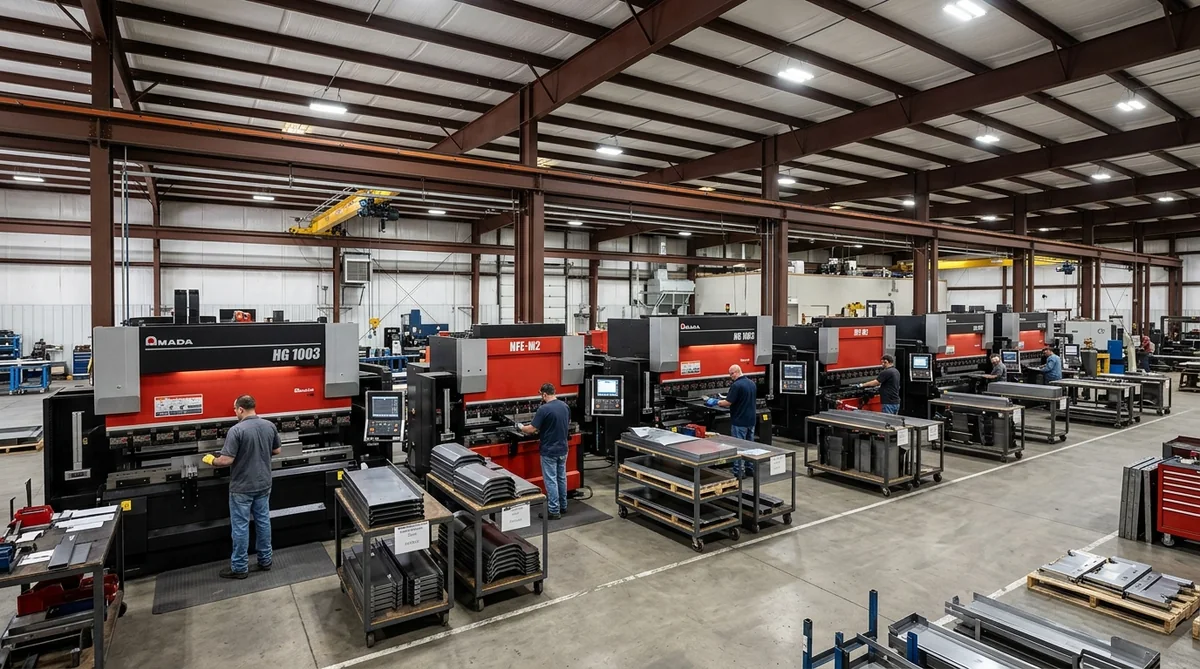
CNC press brakes. A press brake bends sheet or plate between a punch and a die. The CNC version controls ram depth, back-gauge position and crowning from a program, so a bend sequence for a cabinet door is stored, repeatable and independent of the operator’s feel. Angle-measurement systems and per-material-lot compensation correct for springback. FabTek’s Amada CNC press brakes form everything from 20-gauge enclosure panels to heavy structural bends, and the tooling library is a real asset: the right punch and die combinations, in the right lengths, are what let a shop form complex parts without special tooling.
Rolls, tube benders and roll formers. Plate rolls produce cylinders and cones (tank shells, conservators); tube and pipe benders produce handrail, frames and manifolds; roll formers produce long constant profiles like strut and panel stiffeners.
Welding equipment
MIG (GMAW). A continuously fed wire electrode with shielding gas; fast, versatile, the production workhorse for carbon steel enclosures, frames and structures. TIG (GTAW). A non-consumable tungsten electrode with separate filler; slower, precise, clean — the choice for stainless, aluminum and cosmetic or thin-wall work such as bus duct housings. Flux-cored and stick. Heavier deposition for thick plate and field work. Spot and stud welding. Fast joining of sheet and attachment of studs to panels.
The equipment is only half of it. What a buyer should look for is qualified procedures and qualified welders — AWS D1.1 for structural, D1.3 for sheet steel, D1.6 for stainless — with inspection records. FabTek’s welding cells are staffed by AWS-certified welders, and every structural weld is inspected against a weld map; see Quality & Compliance. Robotic welding cells, where a programmed arm welds fixtured parts, are the fastest-growing category and the subject of Part 5.
Machining centers
Fabricated parts often need a feature that cutting and forming can’t hold: a bored hole for a bearing, a machined gasket face on a tank flange, a tapped pattern to a thousandth. CNC vertical machining centers (FabTek runs Haas VF-Series) mill, drill and tap from a program; CNC lathes turn shafts, bushings and round features. Having them in the same building as the fabrication means a weldment goes from the welding cell to the mill without a truck.
Finishing equipment
Blast rooms. Abrasive blasting removes scale, rust and mill oil and gives the surface the profile a coating needs to adhere; it is the step most often skipped by shops that cut corners, and the reason coatings fail early. Pretreatment. Chemical washing and phosphating or zirconium conversion before coating. Powder coat lines. Electrostatically charged powder is sprayed onto grounded parts and cured in an oven into a hard, uniform, durable finish — the standard for enclosures and cabinets. An in-house powder coat line and blast room is a major capital commitment and a major schedule advantage, because the finish step is no longer a vendor. Liquid paint booths for specialty coatings. Hot-dip galvanizing — immersing steel in molten zinc — is done at specialist plants; the fabricator’s job is to detail parts for the kettle (vents, drains, hanging points) and coordinate the trip. We compared coatings in Galvanizing vs. Paint.
Material handling and software
The machines that don’t cut anything matter too. Overhead cranes, forklifts, sheet-loading towers and part sorters move material; fixtures and jigs hold weldments; coordinate-measuring and laser-scanning tools verify parts. And increasingly the most important equipment is software: CAD/CAM that turns a model into flat patterns and programs, nesting software that packs parts onto sheets to minimize scrap, and the ERP system that schedules every job through every machine and tracks it. FabTek is rolling out an AI-native ERP built for real-time job costing and scheduling — the digital layer that Part 5 argues is the next frontier of automation.
Why owning the machines matters
A buyer cares about equipment for one reason: it predicts what the shop can hold and how fast. A shop that owns its laser, brakes, beam line, welding cells, machining centers and finish line controls every step from sheet to ship; a shop that farms out cutting or coating has added a vendor, a freight leg and a schedule it doesn’t control. That is the practical meaning of “single source,” and it is why our vetting guide tells buyers to walk the floor. FabTek publishes its equipment list for exactly that reason.
Frequently asked questions
What machines are used in metal fabrication?
Cutting machines (fiber lasers, plasma and robotic beam processors, abrasive waterjets, saws, shears, punches), forming machines (CNC press brakes, plate rolls, tube benders), welding equipment (MIG, TIG, flux-cored, spot, robotic cells), CNC machining centers and lathes, and finishing equipment (blast rooms, pretreatment, powder coat lines, paint booths).
Why did fiber lasers replace CO2 lasers in metal fabrication?
Fiber lasers cut thin and medium sheet much faster, cost far less to operate, need little maintenance, and cut reflective metals such as aluminum, copper and brass that CO2 lasers struggled with. They became the dominant sheet-metal cutting technology in the 2010s.
What is a robotic plasma beam line?
A CNC structural processing machine that cuts, copes, drills and marks beams, channels and angles directly from the CAD model in a single pass — replacing manual layout and drilling on structural and substation steel and placing bolt holes to tolerance automatically.
Why does in-house powder coating matter?
Finishing is a separate vendor at many shops, adding freight, a second schedule and a handoff. An in-house blast room and powder coat line keep the finish step under the fabricator's control and quality system, shortening lead time and making the finish consistent across a production run.