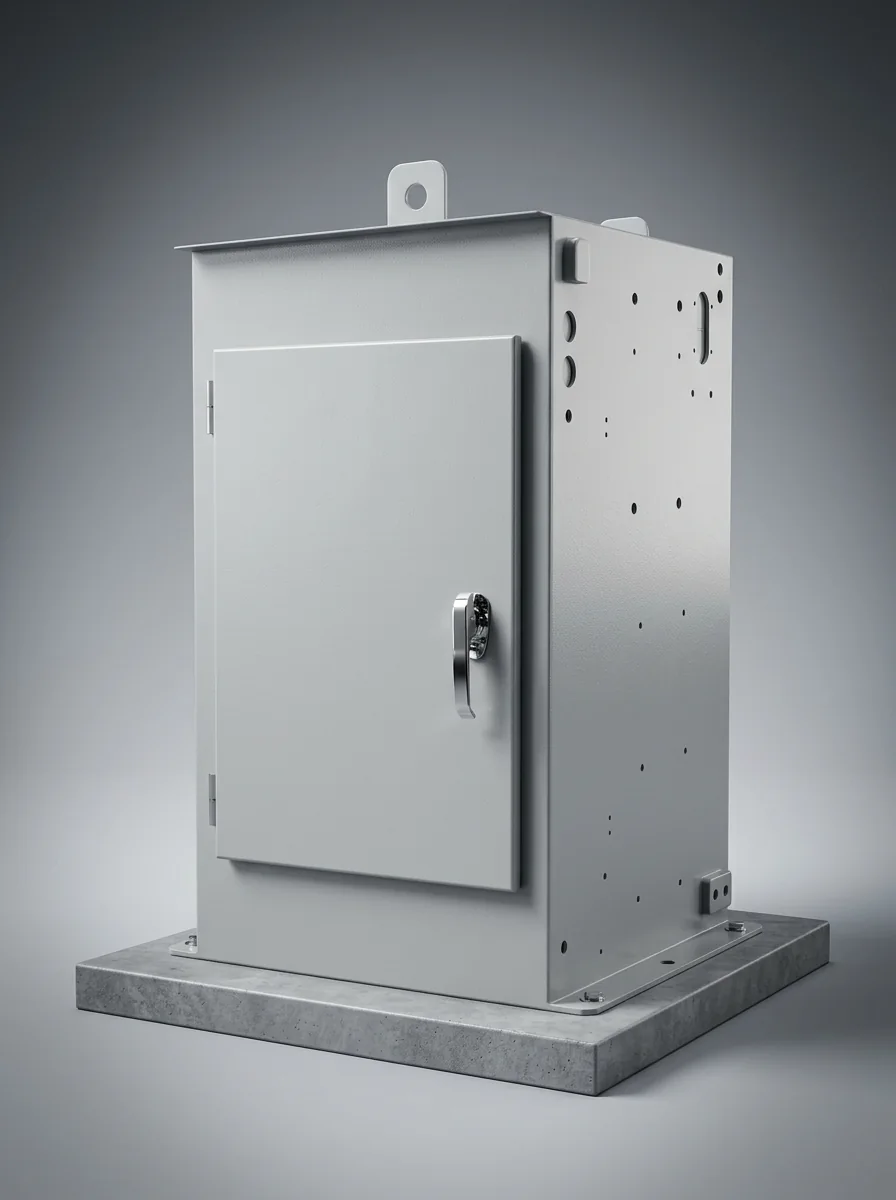
A recurring question from EPCs and switchgear buyers: what gauge should the steel be on an outdoor walk-in switchgear enclosure? The short answer is below, followed by the gauge table, what the NEMA rating does and does not require, and the factors that move a design heavier.
Need this built to your spec? Call 601.892.5017 or email collin.t@fabtekindustries.com — send the drawing and we’ll quote it.
- Walk-in NEMA 3R switchgear enclosures are typically 12-gauge (0.105″) or 11-gauge (0.120″) steel for wall panels, doors and roof skins.
- The base frame, roof structure and lifting members are heavier — 10-gauge, 7-gauge or structural channel and angle — because they carry the gear and the crane load.
- Smaller non-walk-in NEMA 3R boxes are commonly 14-gauge (0.075″); the rating itself does not specify gauge.
- What Gauge Steel for a NEMA 3R Walk-In Enclosure? (you are here)
- ASTM A123 vs. A153: Which Galvanizing Spec Applies?
- Minimum Bend Radius for 5052 Aluminum Sheet
- Powder Coat Film Thickness for Outdoor Electrical Enclosures
- IEEE 2000-Hour Salt Spray: What the Rating Actually Means
- AWS D1.1 vs. D1.3 vs. D1.6: Which Welding Code Applies?
- Bolt-Hole Tolerances for Substation Steel Structures
- Non-Segregated Bus Duct: Ampacity, Bar Size and Housing
- Material Certs and Heat Numbers: What Traceability Means
- How to Spec Anchor-Bolt Patterns for Equipment Stands
The answer
For an outdoor walk-in enclosure housing medium- or low-voltage switchgear, the industry norm is 12-gauge or 11-gauge carbon steel (galvanneal or cold-rolled, powder-coated) for wall panels, doors and roof skins, with a structural base of formed 7-gauge or hot-rolled channel sized to carry the switchgear and to be lifted as a unit, and roof framing stiff enough to carry snow, wind uplift and a technician. Door frames and hinge zones are often reinforced to 10-gauge. Free-standing indoor sections follow the switchgear OEM’s design and are frequently 12- to 14-gauge. Small wall-mount NEMA 3R boxes are 14- or 16-gauge. FabTek builds walk-in switchgear enclosures to these norms unless the print says otherwise.
Gauge table (steel sheet, manufacturers’ standard gauge)
| Gauge | Nominal thickness · Typical use in enclosures |
|---|---|
| 16 ga | 0.060″ (1.52 mm) · small boxes, interior panels, covers |
| 14 ga | 0.075″ (1.90 mm) · wall-mount NEMA 3R/4 boxes, PDU and control cabinets |
| 12 ga | 0.105″ (2.66 mm) · walk-in wall and roof skins, doors, transformer cabinets |
| 11 ga | 0.120″ (3.04 mm) · heavier walk-in skins and doors, pad-mount cabinets, bus duct housings |
| 10 ga | 0.135″ (3.42 mm) · door frames, hinge reinforcement, roof framing |
| 7 ga | 0.179″ (4.55 mm) · formed base channels, lifting members, generator bases |
Thicknesses are nominal for uncoated carbon steel; galvanneal adds coating thickness. Aluminum and stainless use different gauge tables.
What NEMA 3R requires
NEMA 250 Type 3R is a performance rating, not a construction spec. It requires the enclosure to provide protection against falling dirt, rain, sleet and snow, and to be undamaged by external ice formation; it permits ventilation and drainage, and it does not require a gasketed hose-down seal (that is Type 4) or corrosion-resistant material (Type 4X). The rating is verified by test — rain, rod entry, external icing — per NEMA 250 and UL 50/50E. Gauge enters indirectly: the enclosure has to stay rigid enough under wind, ice and handling to keep its drip shields, door seals and drainage working. We explain the ratings in NEMA 3R vs. 4 vs. 4X.
What pushes gauge up
- Panel span. Large unstiffened wall panels drum and oil-can at 14-gauge; 12- or 11-gauge with formed stiffeners is the walk-in standard.
- Arc-resistant gear. Enclosures around arc-rated switchgear follow the OEM’s tested design, which typically adds reinforced doors, hinges and latching and pressure-relief construction.
- Wind, snow and seismic. Site design loads on a tall, light building; roof framing and anchorage are engineered, not picked by gauge.
- Transport and lifting. A walk-in that ships with gear installed is lifted as one piece; the base is designed for that, not for the gear alone.
- Owner standards. Many utilities specify 11-gauge minimum for outdoor electrical enclosures; some data center owners specify 12-gauge minimum with defined stiffener spacing.
How to write it
State the gauge per component (“wall and roof panels 12 ga min., doors 12 ga with 10 ga hinge reinforcement, base 7 ga formed channel or C4×5.4”), the material (“ASTM A1008 CS Type B, or A653 galvanneal A60”), the rating (“NEMA 250 Type 3R, verified per UL 50E”), the finish (see powder coat film thickness), and the design loads. For the full enclosure spec, see Switchgear Enclosures for Data Centers.
How FabTek handles it: Our standard walk-in construction is 12-gauge galvanneal skins and doors with formed stiffeners, 10-gauge door frames, and a 7-gauge or structural-channel base engineered for the lifted weight, powder-coated over pretreatment on our in-house line. If your drawing calls for something different, send it — we build to print. Request a quote.
Frequently asked questions
What gauge is a NEMA 3R switchgear enclosure?
Walk-in NEMA 3R switchgear enclosures are typically 12-gauge (0.105 in.) or 11-gauge (0.120 in.) steel for wall panels, doors and roof skins, with 10-gauge door frames and a 7-gauge or structural-channel base. Small wall-mount NEMA 3R boxes are commonly 14-gauge.
Does the NEMA 3R rating specify a steel gauge?
No. NEMA 250 Type 3R is a performance rating for protection against rain, sleet, snow, falling dirt and external ice, verified by test. Gauge is chosen by the designer for rigidity, span, wind and snow loads, arc-resistance requirements and handling.
Is 14-gauge steel enough for an outdoor electrical enclosure?
For small wall-mount NEMA 3R or 4 boxes, yes. For walk-in enclosures, 14-gauge panels flex and oil-can over large spans; 12- or 11-gauge with formed stiffeners is the industry norm, and many utility and owner standards require 11- or 12-gauge minimum.