Aluminum enclosures, bus duct housings and cooling components are usually drawn with a bend radius, and a radius drawn too tight is a cracked part. Here is the working answer for 5052 — the alloy most of this work is made from — with a table by thickness and temper, how 6061 compares, and what else affects the bend.
Need this built to your spec? Call 601.892.5017 or email collin.t@fabtekindustries.com — send the drawing and we’ll quote it.
- 5052-H32 sheet bends to about 1t inside radius (radius equal to thickness) up to 1/8″, and about 1.5t to 2t at 3/16″ to 1/4″. Annealed 5052-O bends tighter, to roughly 0.5t.
- 6061-T6 needs 2.5t to 3t or more and cracks readily; 6061-O bends near 1t. Use 5052 for formed parts, 6061 for machined and structural.
- Bend across the grain where possible, expect more springback than steel, and use a wider V-die (8–10t).
- What Gauge Steel for a NEMA 3R Walk-In Enclosure?
- ASTM A123 vs. A153: Which Galvanizing Spec Applies?
- Minimum Bend Radius for 5052 Aluminum Sheet (you are here)
- Powder Coat Film Thickness for Outdoor Electrical Enclosures
- IEEE 2000-Hour Salt Spray: What the Rating Actually Means
- AWS D1.1 vs. D1.3 vs. D1.6: Which Welding Code Applies?
- Bolt-Hole Tolerances for Substation Steel Structures
- Non-Segregated Bus Duct: Ampacity, Bar Size and Housing
- Material Certs and Heat Numbers: What Traceability Means
- How to Spec Anchor-Bolt Patterns for Equipment Stands
The answer
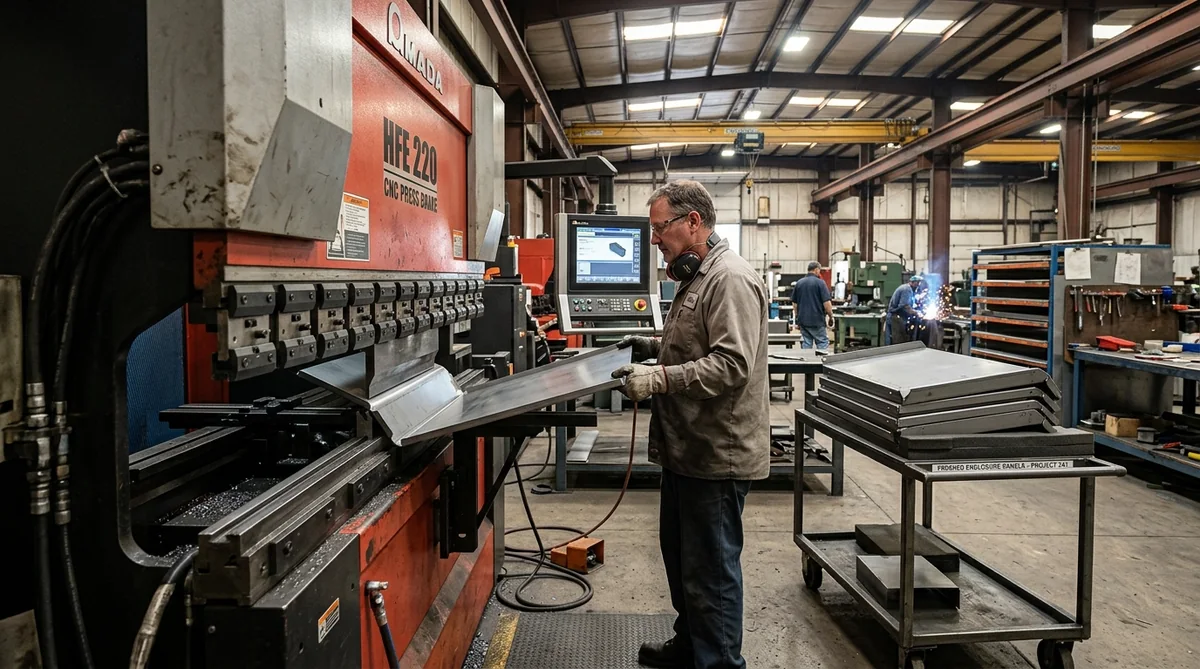
For 5052-H32 — the standard formable aluminum sheet alloy — a safe minimum inside bend radius is 1× material thickness (1t) through 1/8″, increasing to 1.5t at 3/16″ and about 2t at 1/4″, bending across the grain at 90°. Tighter radii are possible in the softer O temper (roughly 0.5t) and with careful tooling, but designing at these values avoids orange-peel and cracking on the outside of the bend across material lots. These are the radii FabTek forms aluminum bus duct housings and aluminum enclosures to on its CNC press brakes.
Minimum inside bend radius, 90° bend
| Thickness | 5052-O · 5052-H32 · 5052-H34 · 6061-T6 |
|---|---|
| 0.063″ (1/16) | 0–0.5t · 0.5–1t · 1t · 1.5–2.5t |
| 0.090″ | 0.5t · 1t · 1–1.5t · 2–3t |
| 0.125″ (1/8) | 0.5t · 1t · 1.5t · 2.5–3t |
| 0.190″ (3/16) | 1t · 1.5t · 2t · 3–4t |
| 0.250″ (1/4) | 1t · 1.5–2t · 2–2.5t · 3.5–4t |
Indicative values from industry and alloy-producer guidance; verify on first-article parts per lot, and consult the mill data sheet for the specific temper and thickness.
Why 5052 is the forming alloy
5052 is a magnesium-alloyed, non-heat-treatable aluminum with good strength, excellent corrosion resistance (including marine exposure) and the best formability of the common structural sheet alloys. H32 is strain-hardened and stabilized to a quarter-hard condition — the balance of strength and bendability that suits enclosures, housings, covers and brackets. 6061-T6, by contrast, is heat-treated to high strength and is brittle in bending; it is the alloy for machined parts, extrusions, tube and plate that stays flat, not for tight formed flanges. We compare the metals in The Materials of Metal Fabrication.
Grain, springback and tooling
- Grain direction. Rolled sheet has a grain; bending across it (bend line perpendicular to the rolling direction) tolerates a tighter radius than bending with it. Nest parts so critical bends run across the grain, or open the radius for bends that must run with it.
- Springback. Aluminum springs back more than mild steel; CNC brakes with angle measurement or per-lot compensation are how repeat parts hold angle. Coining reduces springback but marks the surface.
- V-die width. Aluminum wants a wider die than steel — roughly 8–10× thickness — and a radiused punch matching the drawing radius, not a sharp one.
- Surface. Use urethane or film to protect finish surfaces from die marks on cosmetic parts.
- Bend allowance. Flat-pattern development uses a K-factor that differs from steel; the fabricator’s CAM library handles this, but the drawing should call the finished dimension, not the flat.
How to write it
Call out alloy and temper (“5052-H32 per ASTM B209”), thickness, the inside bend radius on each bend (“R = 0.125 inside, typ.”), the bend angle tolerance (±1° is normal for CNC forming), and note grain-direction constraints only where a bend is critical. Where a design needs a radius tighter than the table, say so and ask the fabricator — a first-article bend test settles it before production.
How FabTek handles it: We form 5052-H32 to the table above on Amada CNC press brakes with angle measurement, nest critical bends across the grain, and run a first-article bend on any radius tighter than 1t or on new material lots. If your drawing calls for something different, send it — we build to print. Request a quote.
Frequently asked questions
What is the minimum bend radius for 1/8 inch 5052-H32 aluminum?
About 1t — a 0.125 in. inside radius for 0.125 in. material — bending across the grain at 90 degrees. Tighter radii are possible in the softer O temper or with careful tooling, but 1t is the reliable design value across lots.
Can 6061-T6 aluminum be bent?
Only at generous radii — roughly 2.5 to 3 times thickness at 1/8 in. and 3.5 to 4t at 1/4 in. — and it is prone to cracking. 6061 in the O (annealed) temper bends near 1t. For formed sheet-metal parts, 5052-H32 is the better alloy.
Does grain direction matter when bending aluminum?
Yes. Bending across the grain (bend line perpendicular to the rolling direction) tolerates a tighter radius than bending with it. For critical bends, either orient the part in the nest so the bend runs across the grain or increase the radius.