“Powder coated gray” is not a finish specification. The number that decides whether an enclosure looks the same in year fifteen is dry film thickness — and the pretreatment under it. Here is the working answer for outdoor electrical enclosures, the powder chemistry by environment, and how to measure and specify it.
Need this built to your spec? Call 601.892.5017 or email collin.t@fabtekindustries.com — send the drawing and we’ll quote it.
- Outdoor electrical enclosures: 3–5 mils (75–125 µm) dry film thickness of polyester or super-durable polyester powder over proper pretreatment. Indoor: 2–3 mils epoxy, hybrid or polyester.
- The thickness only means something with the pretreatment specified — blast or clean, then iron phosphate or zirconium conversion coating.
- Measure with a magnetic DFT gauge per ASTM D7091, report by part, and call out a salt-spray performance basis (see IEEE 2000-hour salt spray).
- What Gauge Steel for a NEMA 3R Walk-In Enclosure?
- ASTM A123 vs. A153: Which Galvanizing Spec Applies?
- Minimum Bend Radius for 5052 Aluminum Sheet
- Powder Coat Film Thickness for Outdoor Electrical Enclosures (you are here)
- IEEE 2000-Hour Salt Spray: What the Rating Actually Means
- AWS D1.1 vs. D1.3 vs. D1.6: Which Welding Code Applies?
- Bolt-Hole Tolerances for Substation Steel Structures
- Non-Segregated Bus Duct: Ampacity, Bar Size and Housing
- Material Certs and Heat Numbers: What Traceability Means
- How to Spec Anchor-Bolt Patterns for Equipment Stands
The answer
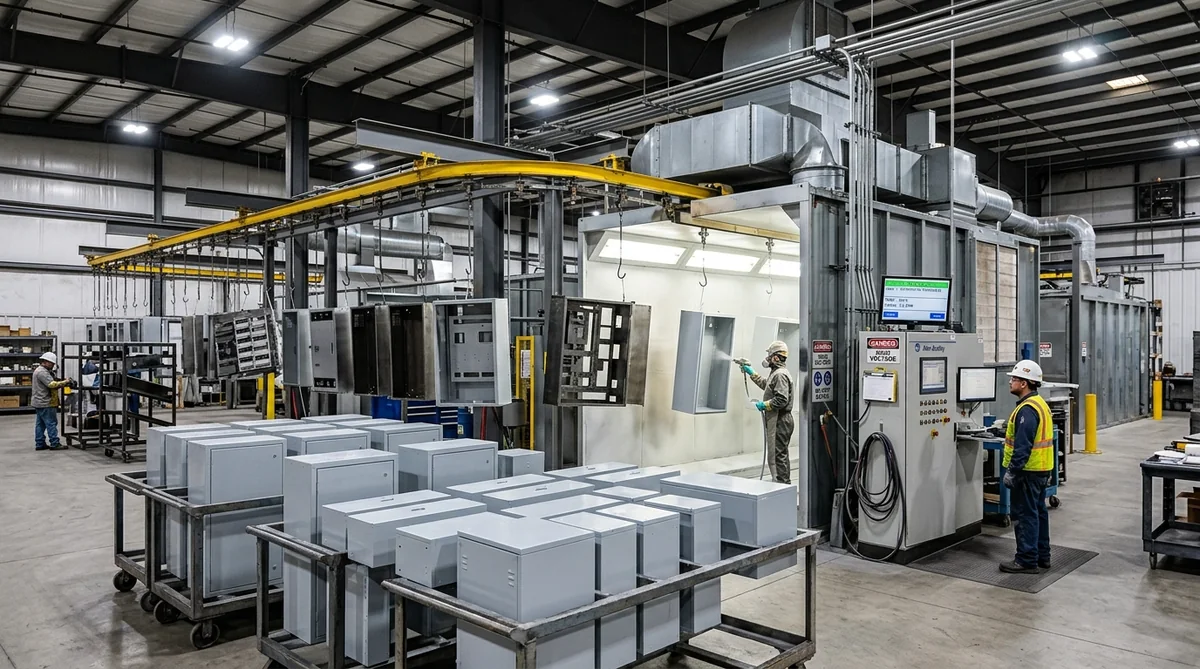
For a pad-mount cabinet, switchgear walk-in, control cabinet or any electrical enclosure that lives outdoors, specify 3 to 5 mils DFT (dry film thickness) of an exterior-grade polyester or super-durable polyester powder, applied over a cleaned and pretreated surface and cured to the powder manufacturer’s schedule. Below about 2.5 mils, coverage on edges and inside corners becomes unreliable and corrosion starts at those points; above roughly 6 mils, powder tends to orange-peel, chip on impact and cost more than it protects. Indoor enclosures are typically 2 to 3 mils. FabTek’s standard on transformer cabinets and outdoor enclosures is in the 3–5 mil range over pretreatment on our in-house powder coat line.
Film thickness by application
| Application | Powder · Typical DFT |
|---|---|
| Indoor control cabinets, PDUs, panels | Epoxy, epoxy-polyester hybrid or polyester · 2–3 mils (50–75 µm) |
| Outdoor enclosures, pad-mount cabinets, walk-ins | Polyester (TGIC or TGIC-free) · 3–5 mils (75–125 µm) |
| Outdoor, high-UV or long-warranty | Super-durable polyester · 3–5 mils |
| Coastal / de-icing salt exposure | Zinc-rich epoxy primer 2–3 mils + polyester topcoat 3–4 mils, or powder over hot-dip galvanizing (duplex) · 5–8 mils total |
| Chemical / wash-down | Epoxy or urethane per exposure; consult powder manufacturer |
DFT is measured on the flat; edges and corners receive less and are where specifications set a minimum, not an average.
What the number assumes
Film thickness is meaningless over mill scale, oil or rust. The finish system starts with surface preparation — abrasive blast to a commercial or near-white profile (SSPC-SP 6 / SP 10) for hot-rolled and heavy parts, or alkaline cleaning for cold-rolled and galvanneal sheet — followed by a conversion coating: iron phosphate or, increasingly, zirconium-based pretreatment, which gives the powder a chemically bonded surface to adhere to and slows under-film corrosion at scratches. Zinc phosphate is used where the highest salt-spray performance is required. Galvanneal sheet (see materials) adds a zinc-iron layer under the powder and is the preferred base for outdoor enclosures. A specification that names the DFT and not the pretreatment has specified half a finish.
Powder chemistry
- Epoxy — hard, chemical- and corrosion-resistant, poor UV resistance; chalks outdoors. Indoor and primer use.
- Epoxy-polyester hybrid — economical indoor finish.
- Polyester — the outdoor workhorse; good UV and weathering. ANSI 61 and ANSI 70 gray, Munsell green and utility colors are stocked.
- Super-durable polyester — formulated for extended gloss and color retention; the choice where a 10-year-plus appearance warranty matters.
- Urethane — smooth, chemical-resistant; specialty.
- Zinc-rich primer — a sacrificial base under a topcoat for severe environments.
Measuring and reporting
DFT is measured non-destructively with a magnetic or eddy-current gauge per ASTM D7091, on a sampling of parts and locations including at least one edge or inside corner. Cure is checked with a solvent rub (MEK) test, adhesion by cross-hatch (ASTM D3359), and the system’s corrosion performance by salt spray (ASTM B117) to the hours the owner specifies. Ask the fabricator for the DFT readings by part and the salt-spray report for the system.
How to write it
“Surface preparation: SSPC-SP 6 blast (hot-rolled) or alkaline clean (sheet), followed by zirconium or iron-phosphate conversion coating. Finish: super-durable polyester powder, color ANSI 61 gray, 3.0 mils minimum / 5.0 mils maximum DFT measured per ASTM D7091, cured per manufacturer. Adhesion 5B per ASTM D3359. System salt-spray performance: [hours] per ASTM B117 with [creepage] at scribe. Interior surfaces: white, 2.0 mils min.” For pad-mount cabinets, reference the IEEE C57.12.28 enclosure integrity tests as well.
How FabTek handles it: Enclosures are blasted or cleaned, pretreated and powder-coated on our in-house line to 3–5 mils with polyester or super-durable polyester, DFT-checked per D7091 and recorded by part; our finish system is certified to IEEE 2000-hour salt spray. If your drawing calls for something different, send it — we build to print. Request a quote.
Frequently asked questions
How thick should powder coating be on an outdoor electrical enclosure?
Three to five mils (75–125 micrometers) dry film thickness of polyester or super-durable polyester powder over a blasted or cleaned surface with a phosphate or zirconium conversion coating. Indoor enclosures are typically two to three mils.
What is the best powder coat for outdoor use?
Polyester powders — standard TGIC or TGIC-free polyester, or super-durable polyester for extended gloss and color retention — resist UV and weathering. Epoxy powders are harder and more chemical-resistant but chalk in sunlight and are used indoors or as primers.
How is powder coat thickness measured?
Non-destructively with a magnetic or eddy-current dry-film-thickness gauge per ASTM D7091, sampled across parts and locations including edges and corners, and reported by part. Cure and adhesion are checked with a solvent rub and ASTM D3359 cross-hatch test.