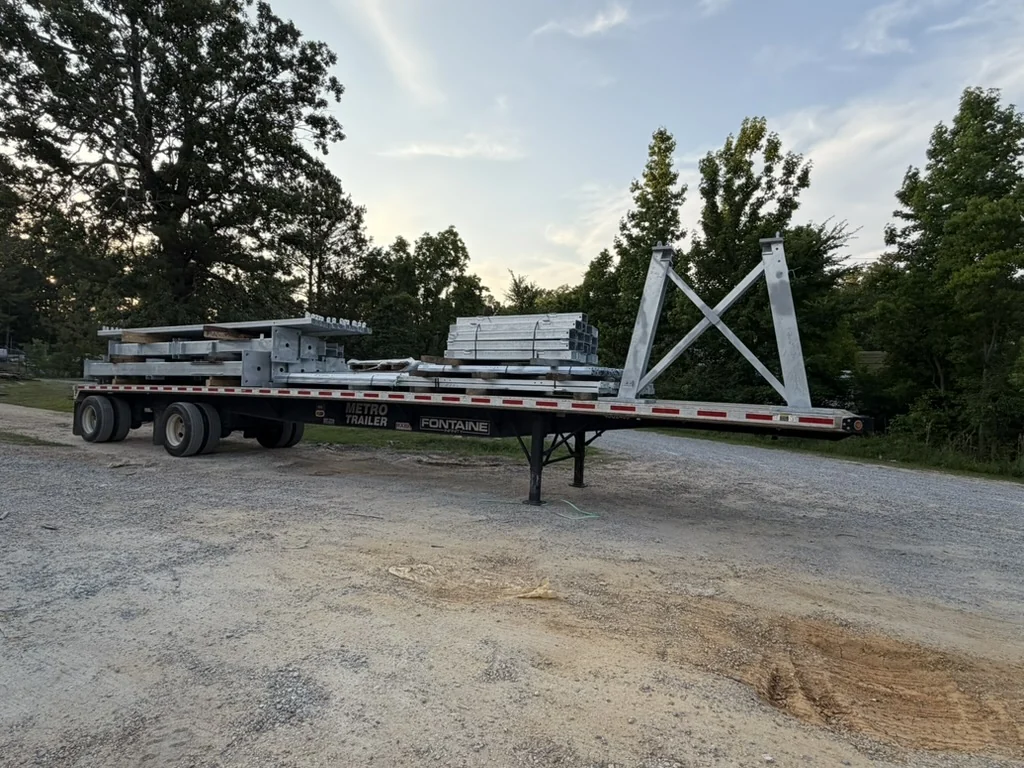
Substation and structural steel specs often cite “galvanized per ASTM A123” and leave the hardware to chance, or cite A153 for everything. The two specifications cover different products with different coating requirements. Here is which applies to what, the thicknesses they require, and the companion specs a complete galvanizing clause should reference.
Need this built to your spec? Call 601.892.5017 or email collin.t@fabtekindustries.com — send the drawing and we’ll quote it.
- ASTM A123 = hot-dip galvanizing of structural steel and fabricated assemblies (shapes, plate, bar, pipe, tube, welded structures). Coating grade set by product category and steel thickness.
- ASTM A153 = hot-dip galvanizing of hardware (bolts, nuts, washers, castings) that is centrifuged after dipping; ASTM F2329 is the current spec specifically for threaded fasteners.
- Cite the companions: A385 (detailing for galvanizing), A780 (repair), A143 (avoiding embrittlement).
- What Gauge Steel for a NEMA 3R Walk-In Enclosure?
- ASTM A123 vs. A153: Which Galvanizing Spec Applies? (you are here)
- Minimum Bend Radius for 5052 Aluminum Sheet
- Powder Coat Film Thickness for Outdoor Electrical Enclosures
- IEEE 2000-Hour Salt Spray: What the Rating Actually Means
- AWS D1.1 vs. D1.3 vs. D1.6: Which Welding Code Applies?
- Bolt-Hole Tolerances for Substation Steel Structures
- Non-Segregated Bus Duct: Ampacity, Bar Size and Housing
- Material Certs and Heat Numbers: What Traceability Means
- How to Spec Anchor-Bolt Patterns for Equipment Stands
The answer
Structures get A123. Hardware gets A153 or F2329. A dead-end column, a bus support, an equipment stand, a cable trench frame — anything fabricated from shapes, plate or tube and dipped as a piece — is galvanized to ASTM A123/A123M, Zinc (Hot-Dip Galvanized) Coatings on Iron and Steel Products. Bolts, nuts, washers and small castings, which are dipped in baskets and centrifuged to throw off excess zinc so threads stay usable, are galvanized to ASTM A153/A153M, Zinc Coating (Hot-Dip) on Iron and Steel Hardware, or for threaded fasteners specifically, ASTM F2329/F2329M. FabTek’s substation steel is specified and inspected to A123, with A153/F2329 hardware kitted to match.
ASTM A123: structures and fabrications
A123 sets a minimum average coating thickness by material category and steel thickness, expressed as a coating grade (the number is micrometers). Representative values:
| Material category & thickness | Coating grade · min. average thickness |
|---|---|
| Structural shapes & plate, ≥ 1/4″ | Grade 100 · 100 µm (3.9 mils, ~2.3 oz/ft²) |
| Structural shapes & plate, 1/8″ to < 1/4″ | Grade 75 · 75 µm (3.0 mils) |
| Structural shapes & plate, 1/16″ to < 1/8″ | Grade 65 · 65 µm (2.6 mils) |
| Pipe & tubing, all | Grade 75 · 75 µm (3.0 mils) |
| Wire, reinforcing bar | Separate categories in the standard |
Values from ASTM A123 Table 1 for common categories; consult the current edition for the full table and sampling rules.
Thickness is measured with a magnetic gauge on a sampling plan; the standard also covers appearance (bare spots not permitted beyond repair limits; dross, ash and roughness within limits), adherence, and renovation by A780. Thicker or higher-silicon steel builds thicker coating naturally, which is why heavy substation steel usually exceeds grade.
ASTM A153 and F2329: hardware
Hardware is dipped in perforated baskets and centrifuged immediately after withdrawal, which removes excess zinc from threads and recesses but leaves a thinner coating than a structure receives. A153 classes hardware by type and size; for fasteners the commonly cited values are Class C (fasteners over 3/8″ diameter) at about 1.25 oz/ft² (~2.1 mils) and Class D (3/8″ and under) at about 1.00 oz/ft² (~1.7 mils). F2329 is the newer specification written specifically for hot-dip zinc coating of threaded fasteners and is what most fastener suppliers certify to today; it also addresses nut tapping oversize to accommodate coating on the bolt. Structural bolts (F3125 / A325 type) are galvanized under their own specification’s provisions. The practical rule: match the coating spec to the product, and specify galvanized hardware from the same source as the galvanized steel so finishes and fits are consistent.
Companion specs to cite
- ASTM A385 — Practice for Providing High-Quality Zinc Coatings (Hot-Dip): how to detail for galvanizing — vents, drains, overlaps, sizes. See The Structures Package.
- ASTM A780 — Repair of Damaged and Uncoated Areas of Hot-Dip Galvanized Coatings: zinc-rich paint, zinc solder or thermal spray, with area limits.
- ASTM A143 — Safeguarding Against Embrittlement of Hot-Dip Galvanized Structural Steel: cold-work and steel-chemistry precautions.
- ASTM A384 — safeguarding against warpage and distortion during galvanizing.
How galvanizing compares with paint systems is covered in Galvanizing vs. Paint for Substation Steel; the process itself in Fabrication and Galvanizing.
How to write it
“All structural steel and fabricated assemblies shall be hot-dip galvanized after fabrication in accordance with ASTM A123/A123M. Hardware shall be hot-dip galvanized in accordance with ASTM A153/A153M or F2329 as applicable. Fabrication shall follow ASTM A385 and A143. Damaged coating shall be repaired per ASTM A780. Coating thickness shall be verified per A123 sampling and reported by piece mark.”
How FabTek handles it: Substation steel is detailed to A385, galvanized to A123 through qualified plants, thickness-inspected and recorded by piece mark on return, repaired to A780 where needed, and kitted with A153/F2329 hardware. If your drawing calls for something different, send it — we build to print. Request a quote.
Frequently asked questions
What is the difference between ASTM A123 and A153?
A123 covers hot-dip galvanized coatings on structural steel products and fabricated assemblies — shapes, plate, tube and welded structures — with coating grades by material category and thickness. A153 covers hardware such as bolts, nuts, washers and castings, which are centrifuged after dipping and carry thinner coatings by class.
What coating thickness does ASTM A123 require?
For structural shapes and plate 1/4 in. and thicker, Grade 100 — a minimum average of 100 micrometers (about 3.9 mils). For 1/8 to under 1/4 in., Grade 75 (75 micrometers, 3.0 mils). Pipe and tube are Grade 75. Values depend on material category and thickness per A123 Table 1.
What is ASTM F2329?
The current ASTM specification for hot-dip zinc coating of threaded fasteners (bolts, nuts, studs), covering coating requirements and nut oversize tapping. Most fastener suppliers certify to F2329; A153 Class C and D are still commonly cited for hardware.