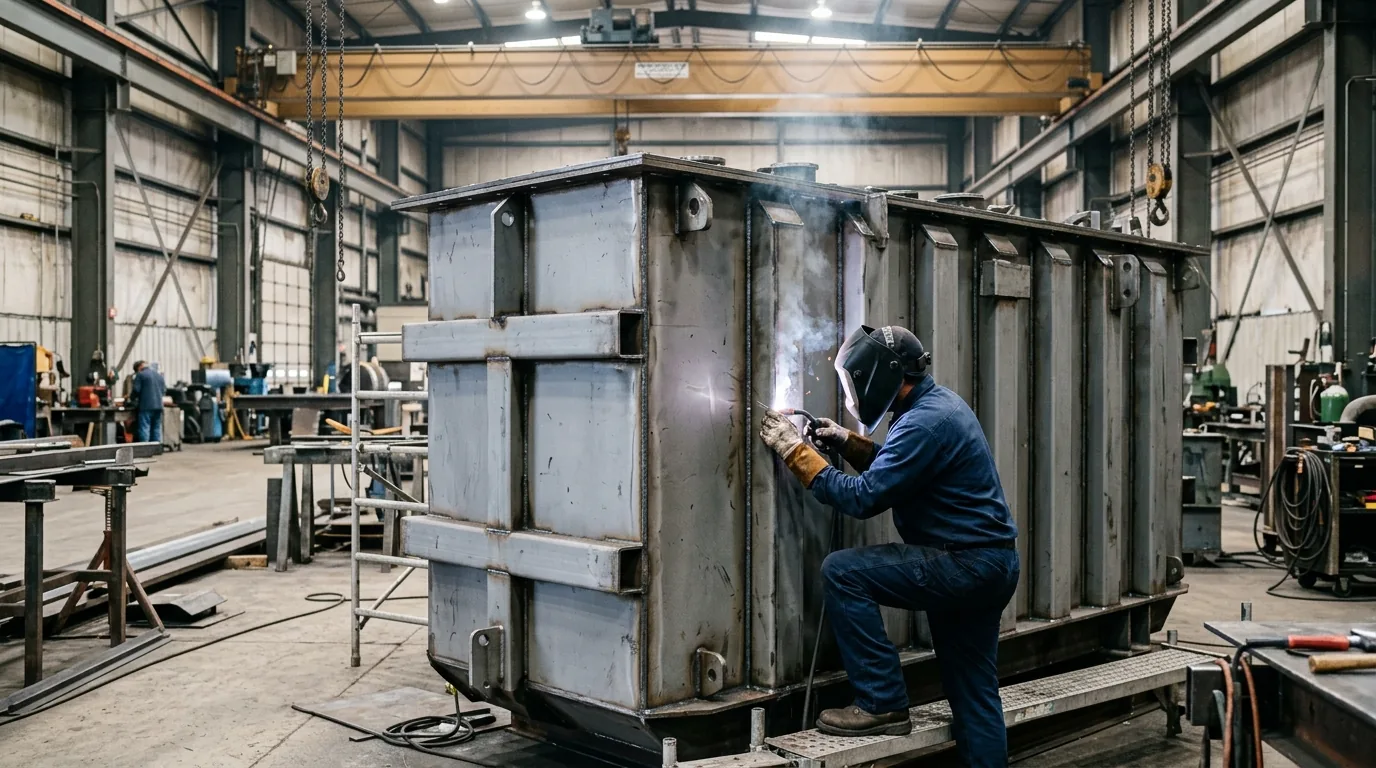
A transformer tank is a pressure vessel that has to stay leak-free for forty years, and a cabinet is the first thing a lineman touches. When an OEM moves that fabrication outside its walls, the fabricator’s process becomes the OEM’s warranty exposure. Part 2 of this series is the qualification an OEM should run before the first purchase order — not a vendor form, but the specific things to see, ask for and test.
Transformer OEM looking for tank, cabinet or coil capacity? Call 601.892.5017 or email collin.t@fabtekindustries.com — send a print and a monthly quantity and we’ll quote it.
- Qualify the welding first: written procedures (WPS/PQR), certified welders, weld maps and inspection records for tank seams.
- Confirm pressure and vacuum test capability and documentation to your values — a tank that hasn’t been pulled to vacuum has not been tested.
- Insist on material traceability to heat number, coating systems that match your fluid and exterior spec, and a first-article process before volume.
- Then verify the boring things that actually fail: capacity, cadence, financial stability and audit-ready documentation.
- Why Transformer OEMs Outsource Tanks, Cabinets and Enclosures
- How to Qualify a Contract Transformer Tank Fabricator (you are here)
- Contract Coil Winding: When It Makes Sense to Outsource
- Conservators, Covers and Tank Accessories
- Running an OEM–Fabricator Program
- The Cost of a Stalled Line vs. Reserved Capacity
Why qualification matters more for tanks
Most contract fabrication is forgiving: a bracket that is slightly off is reworked, a cabinet with a scratch is touched up. A tank is different. A porous seam that passes visual inspection weeps oil in the field three years later, in a substation, under warranty, with the OEM’s name on the nameplate. A wall that is a fraction out of square doesn’t accept the core and coil, and the unit sits. The OEM cannot inspect quality into a tank after delivery; it has to be built in by the fabricator’s process. Qualification is how the OEM confirms that process exists before it depends on it. Our general guide, How to Vet a Power & Utility Fabricator, covers the fundamentals; this post is the tank- and cabinet-specific layer on top.
Welding qualification
- Written procedures. Welding Procedure Specifications with supporting Procedure Qualification Records for the joints on your print — plate-to-plate seams, corrugated fin seams, cover-to-flange, turret and fitting welds — to AWS D1.1 or the code your design calls for.
- Certified welders. Welder performance qualifications on file for each welder assigned to tank work, in the positions and processes your joints require.
- Weld maps and inspection. A weld map per tank design, visual inspection to a written acceptance criterion, and dye-penetrant or ultrasonic inspection where your spec requires it, with records retained.
- Walk the cells. Look for fixturing that holds tank squareness through welding, distortion control on thin corrugated walls, and clean, consistent bead profiles on the tanks in process. FabTek’s welding is documented on the Quality & Compliance page.
Testing capability
Ask what the fabricator can test and how it is recorded. At minimum: a pressure test to your value and hold time, a vacuum test (tanks are pulled to vacuum during oil filling and must hold), and a leak test method — soap solution under pressure, or a tracer method for tighter requirements. Ask to see the gauges and their calibration records, the test procedure, and a completed test report from a recent tank. A fabricator that pressure-tests but cannot pull vacuum is not fully testing a liquid-filled tank.
Material and traceability
Tank plate should be purchased to your specified grade with mill test reports, stored so that certs stay with material, and marked so that heat numbers carry through cutting to the finished tank. Ask how the fabricator maintains traceability through a nest that mixes parts, and ask for the MTR package on a recent tank. The same applies to cabinet sheet — galvanneal versus cold-rolled matters for coating adhesion, and your customers’ specs may call it out. We described the materials in The Materials of Metal Fabrication.
Coatings
Two systems, two questions. Interior: what coating does the fabricator apply inside the tank, is it compatible with your insulating fluid (mineral oil, natural ester, silicone), and how is the interior cleaned and inspected before it is sealed? Exterior: blast profile, primer and topcoat or powder coat to your system and color, film thickness verification, and a salt-spray performance basis — FabTek’s exterior system is certified to IEEE 2000-hour salt spray. Ask to see the blast room and finish line; a fabricator that sends coating out has added a vendor to your schedule.
Forming and fit-up
Corrugated-wall tanks are the forming test: continuous fin panels formed to consistent depth and pitch, then seam-welded without distortion. Ask what equipment forms them and to see finished walls. For rectangular tanks and cabinets, confirm press-brake capacity for your wall lengths and thicknesses, and ask how the fabricator holds cover-flange flatness and bolt-pattern accuracy — the two dimensions that decide whether your cover seals and your cabinet bolts on without shimming.
Capacity, cadence and stability
The fabricator that passes every technical check and then misses deliveries has still stopped your line. Confirm how many tanks or cabinets of your size per month the shop can produce on one shift and on two, what else is on those lines, and whether it will reserve capacity for your program. Ask about floor space to stage finished tanks against your pull schedule, freight to your plant, and — plainly — financial stability and ownership. A supplier growing into new buildings with a visible backlog is a different risk from one running a single line at capacity. FabTek’s footprint growth and dedicated-line model are described in Scaling Ahead of Grid Demand and on the Production page.
First article and PPAP-style approval
Before volume, build one. A first-article tank or cabinet inspected against every dimension on the print, tested to your procedure, coated to your system and documented in a report the OEM approves is the cheapest insurance in the program. Many OEMs run a PPAP-style package — drawings, control plan, inspection results, material certs, test reports — and only then release the blanket order. A fabricator experienced with OEM programs will expect this and have the format ready.
The qualification checklist
- ISO 9001:2015 certificate, current, with scope covering fabrication and welding
- WPS/PQR for every joint on the print; welder qualifications on file
- Weld maps, inspection criteria and records; NDE capability where required
- Pressure, vacuum and leak test capability; calibrated gauges; sample test report
- Material traceability to heat number; sample MTR package
- Interior coating compatible with your fluid; interior cleaning and inspection method
- Exterior blast, primer/topcoat or powder coat to your system; film-thickness verification; salt-spray basis
- Forming capacity for your wall sizes and corrugation; cover-flange flatness control
- Monthly capacity on one and two shifts; willingness to reserve a line
- Staging space, freight distance, packaging method
- First-article and PPAP-style approval process
- Financial stability, ownership, growth trajectory, customer references in power
FabTek Industries builds transformer tanks and cabinets to print for transformer OEMs, remanufacturers and repair shops — welded to qualified procedures by AWS-certified welders, pressure- and vacuum-tested with calibrated equipment, traceable to heat number, and coated inside and out to the OEM’s system — under an ISO 9001:2015 quality system with AWS-certified welding, from four production sites in Hazlehurst, Mississippi. Dedicated production lines with reserved monthly capacity are how most of our OEM programs run. See how we work with transformer OEMs, or send us a print.
Frequently asked questions
How do you qualify a transformer tank fabricator?
Verify written, qualified weld procedures and certified welders for every joint on your print; pressure, vacuum and leak test capability with calibrated gauges and reports; material traceability to heat number; interior and exterior coating systems matched to your fluid and spec; forming capacity for your walls; monthly capacity and willingness to reserve a line; and a first-article approval process — then confirm financial stability and audit-ready documentation.
What tests should a transformer tank fabricator perform?
A pressure test to the OEM's specified value and hold time, a vacuum test to confirm the tank holds vacuum for oil filling, and a leak test by soap solution or tracer method, all with calibrated gauges and a written report per tank. Weld inspection by visual and, where specified, dye-penetrant or ultrasonic methods.
What welding code applies to transformer tanks?
Tank seams and structural attachments are typically welded to AWS D1.1 or the OEM's own specification, with Welding Procedure Specifications supported by Procedure Qualification Records and welder performance qualifications on file for each welder assigned to tank work.
What is a first-article tank?
A single tank or cabinet built before volume production, inspected against every print dimension, tested to the OEM's procedure, coated to spec and documented in an approval report — often in a PPAP-style package with drawings, control plan, certs and test results — that the OEM signs off before releasing the blanket order.