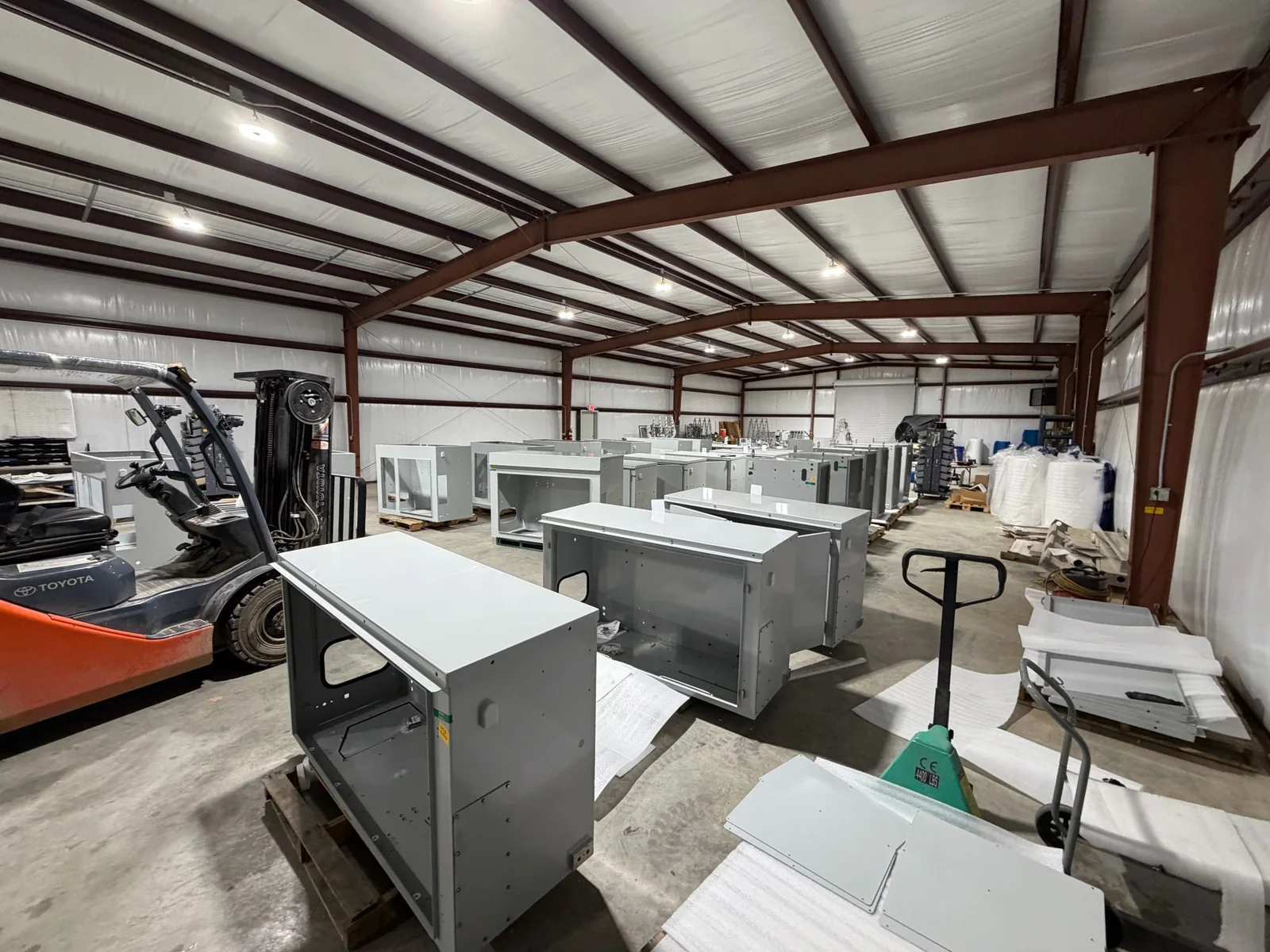
A single tank order is a transaction. Five hundred tanks and cabinets a year, in the OEM’s color, arriving the week before each unit is tanked, for three years, is a program — and programs fail on mechanics, not on fabrication. Part 5 of this series is the operating manual: how the agreement is structured, how releases flow, how drawing changes are controlled, who buys the steel, and the cadence that keeps an OEM and its fabricator aligned.
Transformer OEM looking for tank, cabinet or coil capacity? Call 601.892.5017 or email collin.t@fabtekindustries.com — send a print and a monthly quantity and we’ll quote it.
- A program is a blanket agreement plus a reserved line: the OEM commits volume, the fabricator commits capacity, and releases flow against the OEM’s build plan.
- Revision control is the highest-risk process — a drawing change that reaches the floor late produces a lot of correct parts to the wrong print.
- Decide who buys material deliberately: consignment protects the OEM’s spec and price; fabricator sourcing removes a task and a freight leg.
- Run it on a standing weekly cadence with a short set of metrics — on-time delivery, first-pass yield, release accuracy — and it stays boring, which is the goal.
- Why Transformer OEMs Outsource Tanks, Cabinets and Enclosures
- How to Qualify a Contract Transformer Tank Fabricator
- Contract Coil Winding: When It Makes Sense to Outsource
- Conservators, Covers and Tank Accessories
- Running an OEM–Fabricator Program (you are here)
- The Cost of a Stalled Line vs. Reserved Capacity
The program structure
The foundation is a blanket purchase agreement: the OEM commits to an annual or multi-year quantity by part number, with pricing, material assumptions, revision-control terms and delivery terms defined, and the fabricator commits to reserve capacity — often a dedicated production line with a named monthly output — against it. The blanket is not a purchase order; releases are. It exists so the fabricator can buy material, tool fixtures, staff the line and hold floor space with confidence, and so the OEM can plan its build without re-quoting every month. We covered the contract structures in Long-Term Fabrication Contracts; this post is about running the program the contract sets up.
Releases against the build plan
The OEM issues releases — firm quantities by part number and due date — on a fixed cadence, typically monthly with a rolling forecast two to three months out. The release should be derived from the OEM’s own core-and-coil schedule so that tanks and cabinets arrive the week before they are needed, not the month before (which ties up the OEM’s floor) or the day after (which stops the line). Good practice: a firm window (this month, no changes without agreement), a planning window (next month, quantities may flex within an agreed band) and a forecast window (months three and beyond, for material planning only). The fabricator confirms each release within a set number of days and flags any constraint immediately, not at the due date.
Revision control
This is where programs get hurt. A cover opening moves, a cabinet gains a vent, a tank stiffener changes gauge — and if the new revision reaches the fabricator’s floor after the month’s nests are cut, the OEM receives a pallet of correct parts to the wrong drawing. The controls are simple and must be written into the agreement:
- One controlled drawing set per part number, transmitted through one channel, with revision letter and date; the fabricator confirms receipt and effectivity.
- Effectivity by release, not by calendar — “Rev C applies to the October release and later” — so both sides know which parts on the floor are which.
- A change-cost process: the fabricator quotes the impact (scrap, rework, fixture change, new first article) before the OEM commits the revision.
- First article on any revision that changes a critical dimension or interface, approved before the release runs.
- Marking: revision letter on the part or its label, so receiving inspection at the OEM can verify.
Consigned vs. fabricator-sourced material
Someone has to buy the plate, sheet, conductor and hardware, and both models work. Consignment — the OEM buys material to its own spec and ships it to the fabricator — keeps the OEM’s mill relationships, pricing and traceability intact, and is common for specialty items (electrical steel, conductor, bushings) and for OEMs with volume leverage on plate. Fabricator-sourced — the fabricator buys to the OEM’s spec and includes it in the part price — removes a purchasing task, a freight leg and a receiving step from the OEM and lets the fabricator nest across programs. Hybrid is normal: the OEM consigns what it buys well, the fabricator sources the rest. Whichever model, the agreement should define material escalation (how price moves are passed through), minimum inventory, and what happens to consigned material if the program ends.
A good program is boring. Releases arrive on the same day each month, parts arrive the week before they’re needed, and the weekly call ends early.
Kanban, safety stock and staging
For high-volume cabinets and standard tanks, many programs move from monthly releases to a kanban: the fabricator holds a defined quantity of finished goods, the OEM pulls against it, and each pull triggers replenishment. It smooths the fabricator’s line and gives the OEM same-week availability, at the cost of finished-goods inventory someone carries. Agree who owns that inventory, where it is staged (the fabricator’s yard, a third-party warehouse, the OEM’s dock), and the trigger levels. For lower-volume or engineered items, a small safety stock of long-lead components (hardware, gaskets, coating) at the fabricator is usually enough.
Packaging and kitting
Define it in the agreement: skid design and dimensions to fit the OEM’s forklifts and racks, protection of gasket faces and finished surfaces, stacking limits, labeling (part number, revision, release, and unit serial where parts are kitted to a specific transformer), and returnable versus disposable packaging. For accessory kits — the covers, boxes and hardware from Part 4 — kitting by unit serial so the OEM’s assembly floor receives one labeled kit per transformer is worth the fabricator’s effort many times over.
The standing cadence
- Weekly — a 20-minute call: this week’s shipments, next week’s, open quality items, any release or revision changes. Same people, same time.
- Monthly — release issued and confirmed; forecast rolled; metrics reviewed; material position reviewed.
- Quarterly — pricing and escalation review, capacity review against the OEM’s forward plan, process improvements, audit findings.
- Annually — blanket renewal, volume reset, supplier audit against the documentation in ISO 9001 and AWS-Certified Welds.
What to measure
Keep it to a handful, tracked by both sides: on-time delivery to the release date; first-pass yield at the OEM’s receiving inspection; release accuracy (how often the OEM changed a firm release — the OEM’s metric, not the fabricator’s); revision-related rework; and lead time from release to dock. When those are stable, the program is working, and the conversation can move to the topic every OEM eventually raises: what it costs to have this capacity versus not having it — which is Part 6.
FabTek Industries builds tanks, cabinets, accessories and windings on recurring programs to print for transformer OEMs, remanufacturers and repair shops — run on dedicated lines with monthly releases, controlled revisions, consigned or sourced material, and serial-kitted delivery — under an ISO 9001:2015 quality system with AWS-certified welding, from four production sites in Hazlehurst, Mississippi. Dedicated production lines with reserved monthly capacity are how most of our OEM programs run. See how we work with transformer OEMs, or send us a print.
Frequently asked questions
What is a blanket purchase agreement in contract fabrication?
An agreement in which the OEM commits to an annual or multi-year quantity by part number at defined pricing and terms, and the fabricator commits to reserve capacity against it. Individual releases — firm quantities and dates — are issued against the blanket, typically monthly with a rolling forecast.
How should drawing revisions be controlled with a contract fabricator?
One controlled drawing set per part number sent through a single channel; effectivity defined by release rather than calendar date; a change-cost quote before the OEM commits; a first article on any revision affecting a critical dimension; and revision marking on parts or labels so receiving inspection can verify.
Should an OEM consign material to its fabricator?
Consignment keeps the OEM's mill relationships, pricing and traceability, and suits specialty materials such as electrical steel and conductor. Fabricator sourcing removes a purchasing task and freight leg and allows nesting across programs. Most programs use a hybrid, with escalation and end-of-program terms defined in the agreement.
What metrics should an OEM–fabricator program track?
On-time delivery to release date, first-pass yield at receiving inspection, release accuracy (changes to firm releases), revision-related rework, and lead time from release to dock — reviewed on a standing weekly call and monthly release cycle.