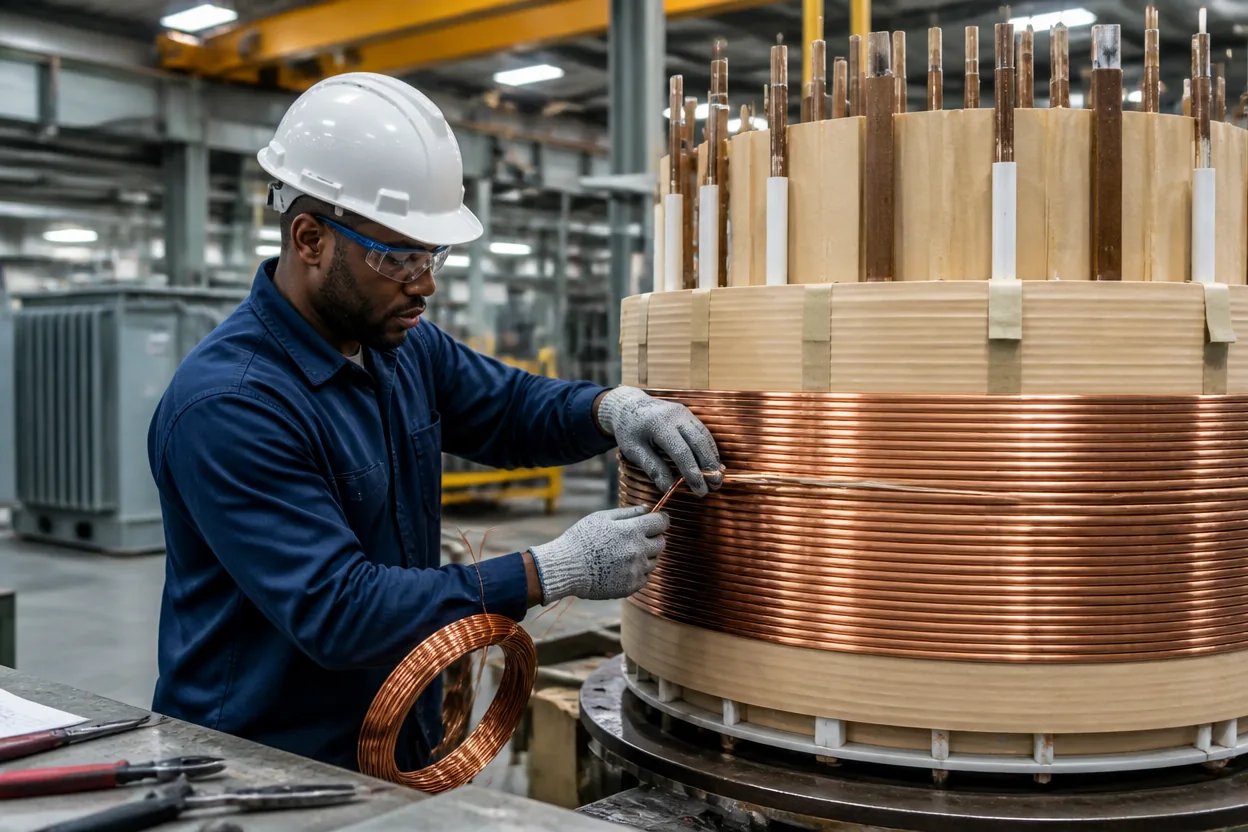
If tanks and cabinets are the metal an OEM would rather not build, windings are the electrical heart it cannot build fast enough. The shortage of skilled winders is the single hardest constraint in the transformer industry, and it is pushing OEMs toward an option that was once rare: contract coil and winding. Part 3 of this series is about when that makes sense, what to specify, and how a winding program runs.
Transformer OEM looking for tank, cabinet or coil capacity? Call 601.892.5017 or email collin.t@fabtekindustries.com — send a print and a monthly quantity and we’ll quote it.
- The industry’s binding constraint is winding labor, a trade that takes years to develop; contract winders add capacity an OEM cannot hire.
- Outsource preformed and tape-wrapped windings and core-and-coil sub-assemblies on standard designs; keep design, final assembly, processing and test in-house.
- The spec must carry conductor, insulation, turns and geometry, tolerances, clearances and test requirements — a winding is built to an electrical design, not just a drawing.
- Quality rides on incoming conductor certs, in-process turn and dimension checks, and documented electrical tests before the winding leaves the winder.
- Why Transformer OEMs Outsource Tanks, Cabinets and Enclosures
- How to Qualify a Contract Transformer Tank Fabricator
- Contract Coil Winding: When It Makes Sense to Outsource (you are here)
- Conservators, Covers and Tank Accessories
- Running an OEM–Fabricator Program
- The Cost of a Stalled Line vs. Reserved Capacity
The winding constraint
We laid it out in Winding Labor Is the Real Bottleneck: roughly two billion dollars of announced transformer plant capacity will not clear the backlog on its own, because winding is a skilled trade that takes years to learn and the industry stopped training winders for a generation. Core steel can be ordered, tanks can be outsourced, buildings can be built — but an OEM cannot conjure winders. That is why contract coil and winding has moved from a niche service into a legitimate capacity strategy for distribution and small power OEMs, remanufacturers and repair shops.
When outsourcing windings makes sense
- Winding is the bottleneck, not tanking. If your core-and-coil stations are the constraint and your tank line has slack, buy windings; if the reverse, buy tanks (Part 1).
- Standardized designs at volume. Distribution transformer windings repeat; a contract winder can tool and staff for a design family and hold it.
- Surge and program demand. A utility or data center program that doubles your volume for two years is exactly the demand you should not permanently staff for.
- Repair and remanufacturing. Rewinds to an existing design where the shop’s own winders are booked.
- New product introduction. Prototype and pilot windings while the OEM’s floor stays on production.
It makes less sense on large power units with unique, engineering-intensive windings, where the winding and the design are inseparable and the OEM’s winders are the product.
What can be outsourced
FabTek’s coil and winding operation produces preformed windings (layer, disc and helical types formed to the OEM’s geometry), tape-wrapped windings with the specified insulation build, and core-and-coil sub-assemblies where the OEM supplies or specifies core steel and the winder delivers a stacked, clamped assembly ready for the OEM’s processing and tanking. Conductor may be copper or aluminum, round or rectangular, CTC or foil as the design calls for. What does not leave the OEM is the electrical design itself, the final assembly and lead dress, drying and oil processing, and test — the steps that define the transformer’s performance and warranty.
A contract winder does not design your transformer. It gives your designers more transformers to design into.
What to specify
| Design data | Winding type (layer, disc, helical, foil), turns per layer/section, taps, conductor dimensions and material, transposition, direction of wind |
|---|---|
| Insulation | Conductor insulation type and build, interlayer and interdisc insulation, spacer material and pattern, end-insulation, tape type and overlap for wrapped windings |
| Geometry & tolerances | Inner and outer diameters or dimensions, axial height, radial build, tolerance on each, clearances to core and to adjacent windings, lead exit positions and lengths |
| Materials | Conductor and insulation specifications and approved sources; certs required with each lot |
| Process | Winding tension, any pressing or drying the OEM wants performed before shipment, lead brazing or crimping standard |
| Tests | Turns-ratio or turns count verification, resistance, dimensional inspection, insulation resistance where applicable; acceptance criteria and report format |
| Handling | Protection from moisture and contamination, packaging, orientation, and the OEM’s receiving requirements |
| Volume | Design families, monthly quantity, release cadence, and the OEM’s core-and-coil schedule the windings must precede |
The winding is built to the OEM’s electrical design; the OEM retains design responsibility, the winder retains process and workmanship responsibility.
Quality controls
A winding program lives or dies on a few controls the OEM should see in place: incoming inspection of conductor and insulation with certificates per lot; in-process checks of turn count, layer dimensions and insulation placement at defined points, recorded on a traveler; tension and cleanliness controls on the winding floor, because a winding is an insulation system as much as a conductor; final dimensional and electrical verification to the OEM’s acceptance criteria before packaging; and traceability of each winding to its conductor lot and its traveler. FabTek runs winding under the same ISO 9001:2015 system as its metal fabrication, described on the quality page, and we wrote about the contract model in Contract Coil Winding.
How a winding program runs
Like a tank or cabinet program, but with more front-end engineering. The OEM and the winder review the design data and agree the spec; the winder builds first-article windings, which the OEM inspects, assembles and tests in a pilot unit; adjustments to process or tolerance are made; then a blanket agreement with monthly releases begins, with conductor purchased or consigned, capacity reserved, and deliveries sequenced to the OEM’s core-and-coil plan. Design revisions are controlled through a change process both parties sign. Part 5 covers the program mechanics in detail.
Windings, tanks and cabinets from one shop
An OEM outsourcing both metal and windings can buy them from separate specialists, or from a fabricator that does both. The single-source case is practical: one supplier relationship, one quality system to audit, one release schedule that already knows the tank and the winding for the same unit are due the same week, and one shop that can absorb a schedule shift across both. It is a rare combination — a metal fabricator with a winding floor — and it is the model FabTek was built around; the deck-level summary is on the transformer OEM page.
FabTek Industries builds preformed and tape-wrapped windings and core-and-coil sub-assemblies alongside tanks and cabinets to print for transformer OEMs, remanufacturers and repair shops — wound in-house in copper or aluminum to the OEM’s electrical design, with incoming conductor certs, in-process turn and dimension checks and documented verification before shipment — under an ISO 9001:2015 quality system with AWS-certified welding, from four production sites in Hazlehurst, Mississippi. Dedicated production lines with reserved monthly capacity are how most of our OEM programs run. See how we work with transformer OEMs, or send us a print.
Frequently asked questions
What is contract coil winding?
A transformer manufacturer outsources the winding of coils — preformed layer, disc or helical windings, tape-wrapped windings, or complete core-and-coil sub-assemblies — to a specialist that builds them to the OEM's electrical design and delivers them ready for the OEM's assembly, processing and test.
When should a transformer OEM outsource windings?
When winding capacity, not tanking, is the plant's constraint; on standardized distribution and small power designs that repeat; for surge or program demand the OEM should not permanently staff for; for rewinds at busy repair shops; and for prototype work. It fits less well on large, unique power transformer windings.
What should a winding specification include?
Winding type, turns and taps, conductor material and dimensions, insulation type and build, dimensions with tolerances and clearances, lead positions, material specs and cert requirements, process requirements such as tension and pressing, test and acceptance criteria, handling and packaging, and volume and release cadence.
Does FabTek wind transformer coils?
Yes. FabTek produces preformed and tape-wrapped windings and core-and-coil sub-assemblies in copper or aluminum to the OEM's design, in-house in Hazlehurst, Mississippi, under the same ISO 9001:2015 system as its tank and cabinet fabrication.