An OEM whose enclosures come from one plant has a single point of failure on the metal around every product it ships. Most live with it until the day the plant floods, loses its welders or fills up with another customer’s program. Dual-sourcing is the insurance, and done well it also sharpens both suppliers. Done badly, it doubles tooling, splits volume below the level that earns program pricing and produces enclosures that do not match. This guide covers how to do it well.
OEM looking to qualify a second enclosure source? Call 601.892.5017 or email collin.t@fabtekindustries.com — send a print and a quantity and we’ll quote it.
- Dual-sourcing pays when the enclosure is on the critical path and the volume supports two programs.
- Qualify in four steps: sample parts, first-article kit on your line, finish and fit match, trial release.
- Drawing control is the hard part: one revision process, both plants on the same revision, always.
- Split volume so both sources keep program economics; a token share buys no insurance.
What a single source carries
- Capacity risk — another customer’s surge takes the line; your releases slip.
- Event risk — weather, fire, power loss or a major equipment failure at one plant.
- Labor risk — a shop that loses its welders or brake operators cannot staff your program.
- Financial risk — a supplier in trouble is a supplier that stops buying steel.
- Pricing risk — one source, no benchmark.
The stalled line post quantifies what a missed enclosure delivery costs an OEM; dual-sourcing is one of the two ways to cap it, reserved capacity being the other, and most OEMs eventually do both.
When it pays
When the enclosure is on the critical path — the product cannot ship without it — and when the annual volume is large enough that two fabricators can each run a program with staged material and reserved capacity. Below that, a second source gets one-off pricing and no commitment, which is not insurance; the better answer is one well-qualified source with a documented drawing package that could be moved in an emergency. Program economics are explained in running an OEM–fabricator program.
The qualification sequence
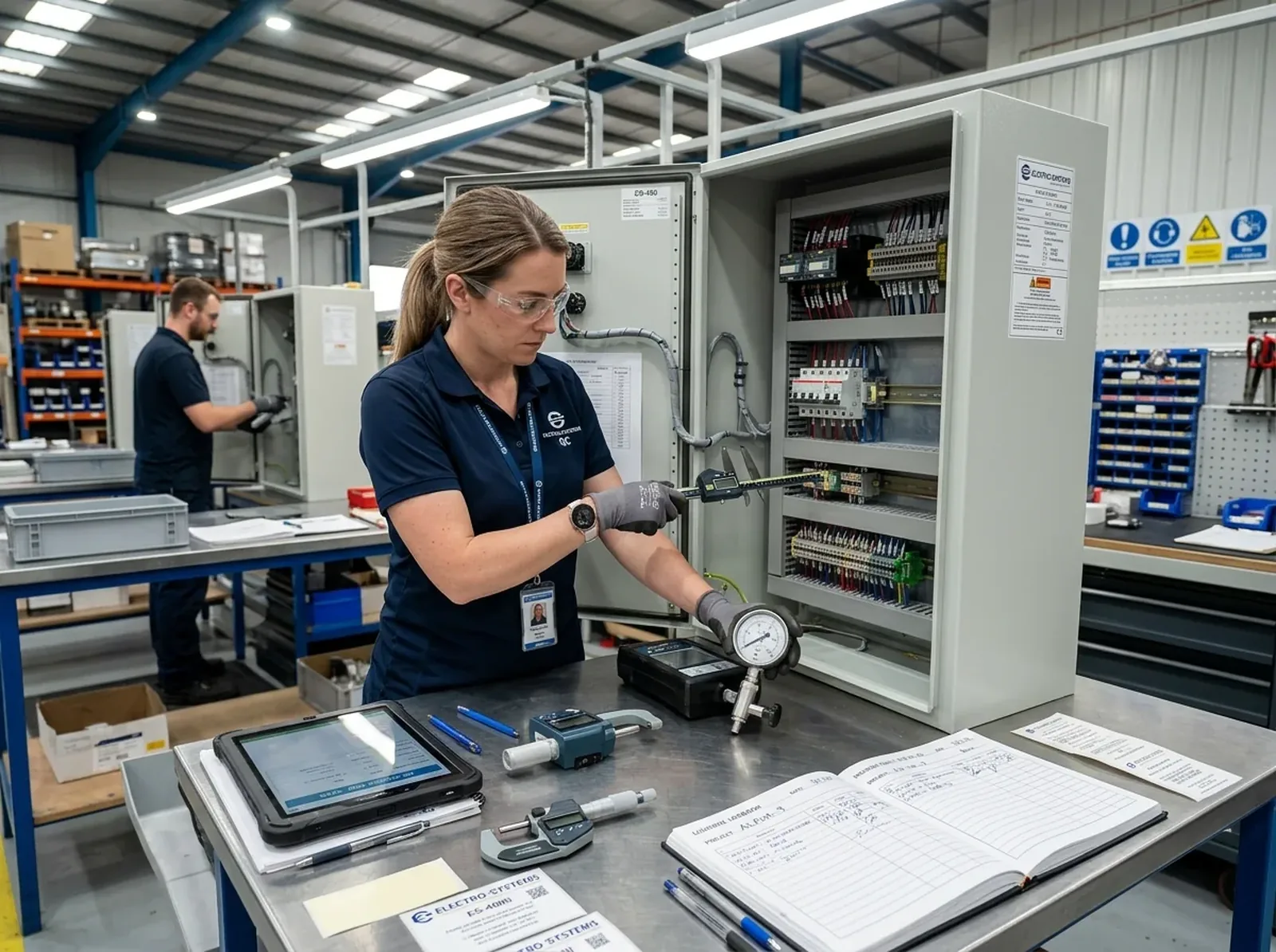
| 1. Sample parts | The hardest three or four parts in the family — the deepest door, the tightest frame, the stainless 4X box — built from the drawing without coaching; inspected against the incumbent’s parts |
|---|---|
| 2. First-article kit | A complete enclosure or kit assembled on the OEM’s line by the OEM’s people; every fit and hardware issue recorded |
| 3. Finish and fit match | Color, gloss and texture matched to a signed panel under the OEM’s lighting; doors from one source hung on frames from the other |
| 4. Trial release | A production release at the expected cadence for one or two cycles; on-time and quality tracked against the incumbent |
The audit behind step one follows qualifying a tank fabricator and the switchgear RFQ checklist; both apply to any enclosure family.
Drawing and revision control
Two plants building one part number must build the same revision, which means the OEM owns the drawing package — not the incumbent fabricator — and runs one revision process that releases to both plants on the same day. Fabricator-specific details (fixture notes, nest files, brake programs) stay with each plant; the controlled print does not. Finish specs, hardware part numbers and the inspection plan live in the package, so neither plant is guessing. The build-to-print spec package describes what the OEM should hold.
Splitting volume
A 70/30 or 60/40 split keeps the incumbent’s economics intact while giving the second source enough to stage material, hold a fixture set and reserve capacity; a 95/5 split gives the second source a reason to deprioritize you. Many OEMs split by family rather than by percentage — one plant builds the pad-mount cabinets, the other the control cabinets, each qualified on the other — so each has a program it owns and a backup it can take. Surge is handled by the plant with room; the arrangement is written into both programs.
A second source that gets five percent of the volume is a supplier that has met you once. Insurance is a supplier that runs your program every month and could run all of it next month.
The mistakes
- Letting the incumbent own the drawings — the second source gets a print the first source controls.
- Skipping the finish match — enclosures from two plants on one lineup, half a shade apart.
- Qualifying on easy parts — the door that oil-cans shows up in production, not qualification.
- Splitting below program economics — two spot-priced suppliers instead of one program.
- No surge plan — both sources at capacity when the surge comes.
Family-specific notes on second sources are in MCC and switchboard kits and combiner enclosures.
FabTek Industries qualifies as a second enclosure source for OEMs and integrators on switchgear enclosures, kitted sheet metal, control cabinets, transformer cabinets and NEMA enclosures — sample parts, first-article kits, signed finish matches and trial releases — with dedicated production lines and reserved capacity, under an ISO 9001:2015 quality system, from four production sites in Hazlehurst, Mississippi. Send us a part family to qualify on.
Working on something like this? Send a print or a scope — pricing and lead time within one business day, from four Mississippi plants.
Frequently asked questions
When should an OEM dual-source its enclosures?
When the enclosure is on the critical path — the product cannot ship without it — and the annual volume supports two fabricators each running a program with staged material and reserved capacity. Below that volume, one well-qualified source with an OEM-owned drawing package is the better answer.
How is a second enclosure fabricator qualified?
Sample parts from the hardest items in the family, a first-article kit assembled on the OEM’s line, a finish and fit match against the incumbent’s parts under the OEM’s lighting, and a trial release at production cadence with on-time and quality tracked.
How should volume be split between two enclosure sources?
Enough for both to keep program economics — commonly 60/40 or 70/30, or split by enclosure family with each plant qualified on the other’s — never a token share that gives the second source no reason to prioritize the program.
Who should own the enclosure drawings in a dual-source program?
The OEM. One controlled drawing package and one revision process releasing to both plants on the same revision, with fabricator-specific nest files and fixture notes staying at each plant.