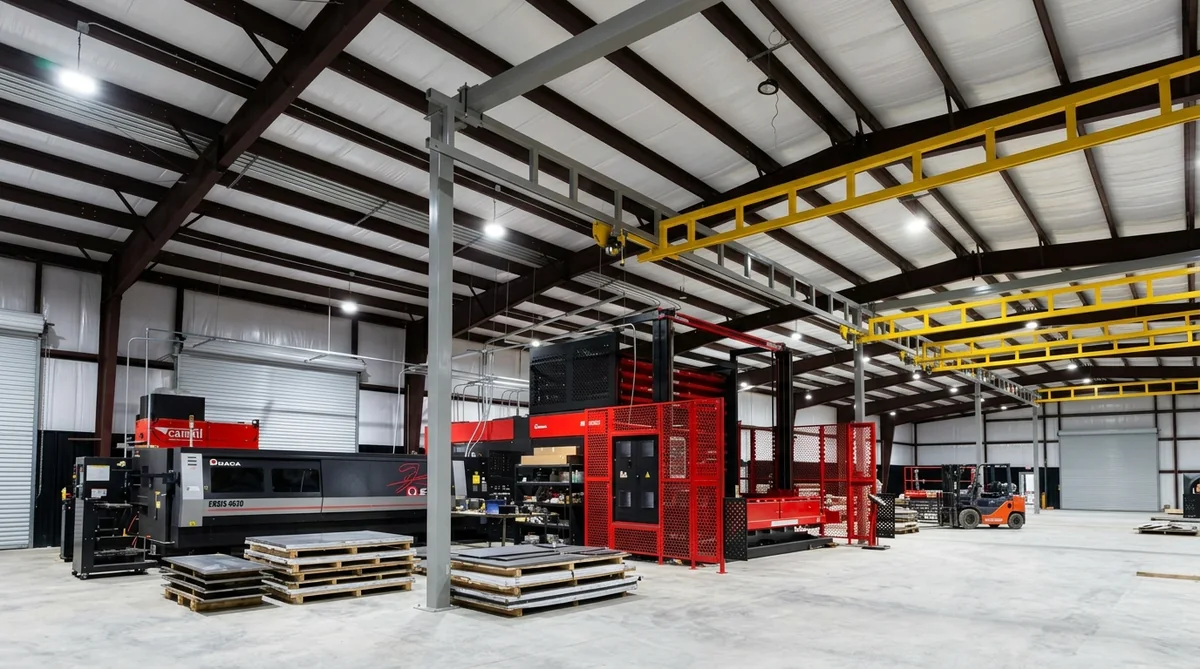
Metal fabrication is the industry behind almost every physical thing in the built world — the substation steel that carries the grid, the enclosures that house switchgear, the frames inside data centers, the tanks, racks, skids and brackets that nobody photographs. This seven-part series is about that industry in the United States: what it is, how it evolved, what is being asked of it now, and why it matters to the country’s manufacturing future. Part 1 starts with the basics.
Looking for a U.S. fabricator? Call 601.892.5017 or email collin.t@fabtekindustries.com — send a drawing or a scope and we’ll respond fast.
- Metal fabrication is the cutting, forming, joining and finishing of metal stock — sheet, plate, tube and structural shapes — into parts and assemblies built to a drawing.
- Six process families cover almost all of it: cutting, forming, welding, machining, finishing and assembly.
- It differs from casting and stamping (which make shapes from molten metal or dies) and from machining (which removes material) — though modern shops combine them.
- A job moves drawing → program → cut → form → weld → machine → finish → assemble → inspect → ship, and the quality system runs through every step.
- What Is Metal Fabrication? (you are here)
- The Machines of Metal Fabrication
- The Materials of Metal Fabrication
- A Brief History of Metal Fabrication in America
- From Manual to Automated: How the Fabrication Floor Changed
- What Is Being Asked of U.S. Metal Fabricators Right Now
- Why Metal Fabrication Is Critical to U.S. Reindustrialization
The definition
Metal fabrication is the process of building parts, structures and assemblies from raw metal stock — sheet, plate, bar, tube, pipe and structural shapes like beams and angles — by cutting it, forming it, joining it and finishing it to a drawing. The fabricator does not make the metal; a mill does that. The fabricator takes mill product and turns it into something with a function: a transformer cabinet, a bus duct housing, a dead-end structure, a mezzanine, a machine frame.
That definition covers a huge range of scale. The same word describes a two-person shop bending brackets and a plant with fiber lasers, robotic plasma lines and a paint system running hundreds of cabinets a month. What unites them is the sequence of processes, not the size.
Fabrication vs. machining, casting and stamping
These terms get used loosely, so it helps to separate them. Casting pours molten metal into a mold and lets it solidify into a shape. Forging shapes hot metal under pressure. Stamping forms sheet metal between hardened dies in a press, producing identical parts at very high volume — think car body panels. Machining removes material from a solid block with cutting tools to reach a precise dimension. Fabrication is what happens to mill stock that is cut, bent and welded rather than poured, pressed or carved — and it is the natural process for low- to mid-volume, larger, structural or enclosure-type parts where tooling up a die or a mold makes no sense.
In practice a modern fabricator uses several of these. FabTek, for instance, machines mating features on CNC machining centers and lathes after parts are cut and welded, because a bracket often needs both a formed shape and a precisely bored hole. Fabrication is the backbone; machining is a step within it.
The six core processes
| Cutting | Separating stock into blanks and profiles. Operations: fiber-laser cutting, plasma cutting (including robotic beam processing), abrasive waterjet, oxy-fuel, sawing, shearing, punching. Cutting is where the drawing first becomes metal, and where holes, slots and features are placed. |
|---|---|
| Forming | Bending or shaping without removing material. Operations: press-brake bending of sheet and plate, rolling (cylinders, cones), roll forming of long profiles, tube bending, hemming, embossing and louvering. Forming turns a flat blank into a three-dimensional part. |
| Welding & joining | Permanently joining parts. Operations: MIG (GMAW), TIG (GTAW), stick (SMAW), flux-cored, spot and stud welding, robotic welding, plus mechanical joining — riveting, self-clinching fasteners, bolting, adhesives. Welding turns parts into structures. |
| Machining | Precision material removal on fabricated parts or components. Operations: CNC milling, turning, drilling, tapping, boring and grinding. Used where a fabricated part needs a bearing fit, a gasket face or a hole tolerance forming can’t hold. |
| Finishing | Surface preparation and protection. Operations: deburring and grinding, media blasting, chemical pretreatment, powder coating, liquid painting, hot-dip galvanizing (typically at a specialist plant), plating, anodizing, passivation. Finishing decides how long the part lasts in its environment. |
| Assembly | Turning parts into products. Operations: hardware installation, gasketing, sub-assembly, mechanical assembly, electrical assembly and wiring, testing, labeling and packaging. Assembly is where fabricated metal becomes something a customer can install. |
Nearly every fabricated product passes through at least four of these six families.
How a job flows through a shop
- Drawing and quote. The customer supplies drawings — ideally native CAD plus PDF — with material, finish, quantity and tolerance called out. The fabricator quotes material, labor and finish. We describe what a good package looks like in What Belongs in a Build-to-Print Spec Package.
- Engineering and programming. Drawings become flat patterns, bend sequences, nests (layouts of many parts on one sheet to minimize scrap) and machine programs. This is where bend allowances, kerf and tolerances are resolved.
- Material. Sheet, plate and shapes are ordered or pulled from stock, with certifications tied to heat numbers for traceability.
- Cutting. Nests run on the laser, plasma or waterjet; structural shapes run through the beam line; parts are sorted and tagged.
- Forming. Blanks are bent on press brakes to programmed sequences; rolled or tube-bent where needed. First-article checks confirm angles and dimensions.
- Welding and fit-up. Parts are fixtured, tacked, welded to qualified procedures and inspected. Fixtures are what make part 500 match part 1.
- Machining. Any post-weld precision features are cut on CNC equipment.
- Finishing. Parts are blasted, pretreated and powder-coated or painted in-house, or sent out for galvanizing or plating, then inspected for coverage and thickness.
- Assembly and test. Hardware, gaskets, doors, components and wiring are installed; assemblies are tested to the customer’s procedure.
- Inspection, documentation and shipping. Final inspection against the drawing; material certs, weld records and test reports assembled; parts packaged and shipped in the sequence the customer needs.
A quality system — ISO 9001:2015 in FabTek’s case — wraps all of it: controlled drawings, documented procedures, calibrated equipment, inspection records and a corrective-action process. We explained why buyers ask for it in ISO 9001 and AWS-Certified Welds.
A fabricator’s product is not the part. It is the part, made the same way, on the date promised, with the paperwork to prove it.
Types of fabrication shops
The industry is usually divided by the kind of stock and the kind of work. Sheet-metal shops work thin material (roughly 24- to 10-gauge) into enclosures, cabinets, panels and housings on lasers and press brakes. Plate and heavy fabricators work thicker material into tanks, frames and weldments. Structural fabricators process beams, columns and angles into building and substation steel, usually galvanized. Job shops build whatever comes through the door; production fabricators run the same parts repeatedly on dedicated lines; contract manufacturers deliver finished, assembled products to an OEM’s print. Many shops, including FabTek, span several of these — sheet metal for enclosures, plate for tanks, structural for substation steel, and both job-shop and production-line models.
Why it matters
Fabrication is the layer between raw material and finished infrastructure. The mill makes steel; the utility needs a substation; the fabricator is the only step in between. The same is true of the switchgear OEM that needs enclosures, the data center that needs bus duct and the manufacturer that needs a machine frame. The United States has roughly 1.4 million people employed in fabricated metal products — one of the largest manufacturing sectors in the country — spread across tens of thousands of mostly small and mid-sized shops. When the grid, the data center boom and the reshoring of manufacturing all demand more physical infrastructure at once, this is the industry that has to build it. That is where the rest of this series goes: the machines (Part 2), the materials (Part 3), the history, the shift to automation, the demand on U.S. shops today and the case for fabrication as the foundation of reindustrialization.
FabTek Industries is one of those shops: a power and utility fabricator founded in 1999 in Hazlehurst, Mississippi, now operating four production sites and 250,000 square feet, cutting, forming, welding, machining, finishing and assembling under one quality system. If you have a drawing, we’d like to see it.
Frequently asked questions
What is metal fabrication in simple terms?
Metal fabrication is turning raw metal stock — sheet, plate, tube and structural shapes — into finished parts and assemblies by cutting, forming, welding, machining, finishing and assembling it to a drawing. The fabricator builds with metal; the mill makes it.
What are the main metal fabrication processes?
Six families cover most of it: cutting (laser, plasma, waterjet, sawing, punching), forming (press-brake bending, rolling, tube bending), welding and joining, machining, finishing (blasting, powder coat, paint, galvanizing) and assembly (hardware, wiring, testing).
What is the difference between metal fabrication and machining?
Machining removes material from a solid piece with cutting tools to hit a precise dimension. Fabrication cuts, bends and welds stock into shapes and structures. Most fabrication shops also machine features on fabricated parts, so machining is usually a step within fabrication.
What is a build-to-print fabricator?
A fabricator that manufactures parts and assemblies exactly to the customer's drawings and specifications — the customer owns the design, the fabricator owns the process, quality and delivery.