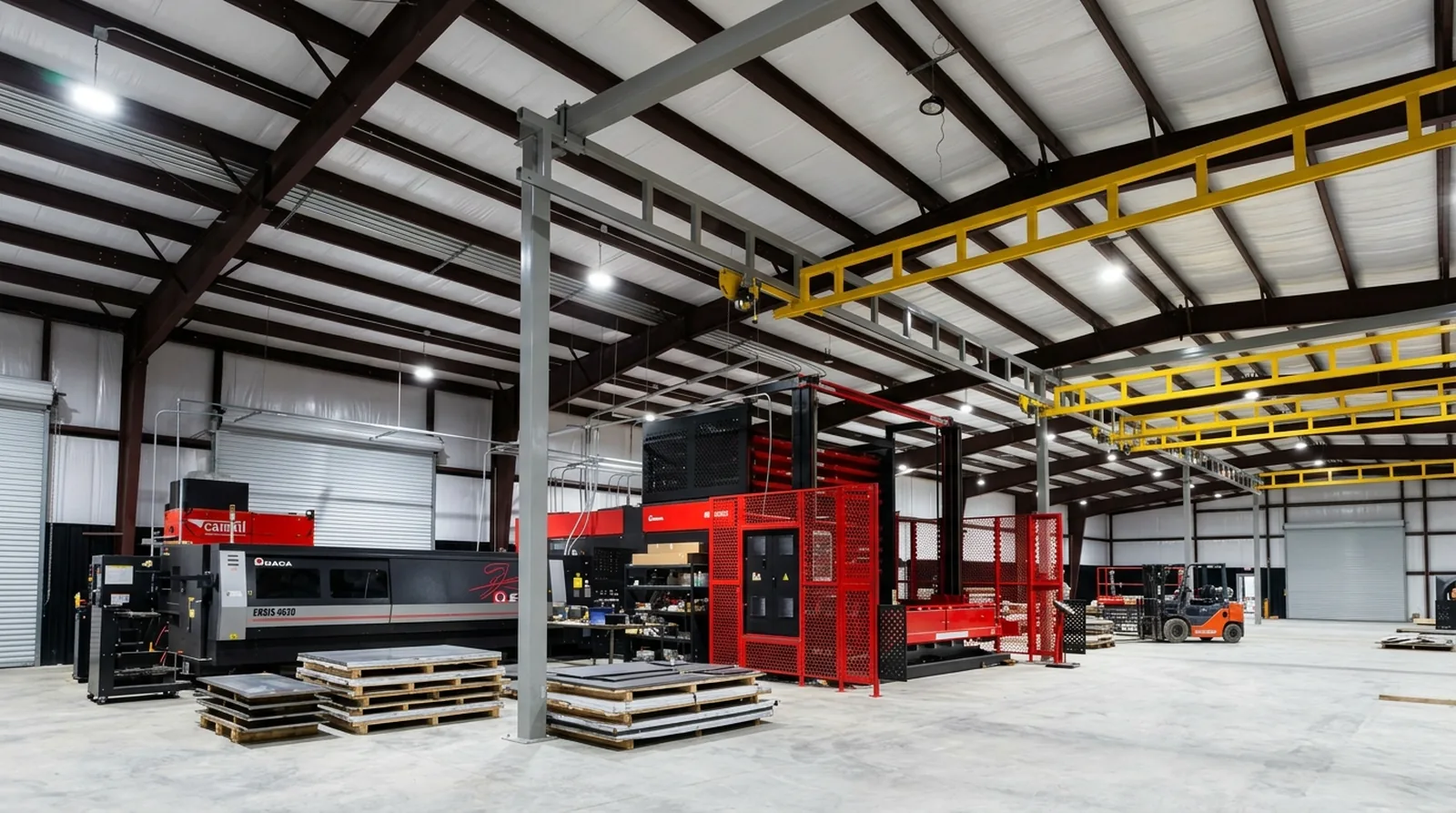
For forty years the question facing an American fabricator was where the next job would come from. Today it is how to build everything that is being asked for. Grid modernization, the hyperscale data center boom, reshored manufacturing and OEMs outsourcing their metal are all landing on the same shops at the same time — shops that spent decades shrinking their workforce and deferring capital. Part 6 of this series looks at that demand from the floor.
Looking for a U.S. fabricator? Call 601.892.5017 or email collin.t@fabtekindustries.com — send a drawing or a scope and we’ll respond fast.
- Four demand waves are converging: the grid (transformers, substations, transmission), data centers (enclosures, bus duct, steel), reshored manufacturing (plant and equipment fabrication) and OEM outsourcing of metal.
- The constraints are people, steel and electrical lead times: a thin trades pipeline, volatile material, and two-to-four-year waits on transformers and switchgear.
- Shops are responding with automation, reserved-capacity contracts, integrated metal-plus-electrical scope, and regional expansion.
- For buyers, the market has flipped: capacity is the scarce good, and locking it early is the strategy.
- What Is Metal Fabrication?
- The Machines of Metal Fabrication
- The Materials of Metal Fabrication
- A Brief History of Metal Fabrication in America
- From Manual to Automated: How the Fabrication Floor Changed
- What Is Being Asked of U.S. Metal Fabricators Right Now (you are here)
- Why Metal Fabrication Is Critical to U.S. Reindustrialization
Four waves at once
Any one of the demand drivers below would have been the story of the decade for American fabrication. All four arriving together is why lead times on fabricated power equipment have moved from weeks to months, why shops that were quoting for work in 2019 are turning it away in 2026, and why fabricators are expanding in places like central Mississippi. Each wave asks for a different kind of metal, but they all ask for it from the same finite floors.
1. The grid
The U.S. electric grid is being asked to grow faster than at any point since the 1960s — to serve electrified transport and heating, new manufacturing, and above all data centers — while replacing infrastructure that is decades past its design life. Every piece of that is fabricated metal: substation structures for new and expanded yards, transmission structures for new lines, tanks and cabinets for the transformers everyone is waiting on, enclosures for switchgear and controls. Utilities that once bought steel project by project are now signing multi-year agreements to guarantee supply. We wrote about the local version in The Grid Boom Is Happening in Our Backyard.
2. Data centers
The hyperscale build-out is the single largest new source of fabrication demand in the country. Federal analysis projects data centers could consume 6.7% to 12% of U.S. electricity by 2028, up from 4.4% in 2023, and every megawatt of that arrives through fabricated metal — the on-site substation, the switchgear houses, the bus duct, the transformer cabinets, the generator enclosures, the cable tray supports, the skids. We devoted an entire series to it, Metal Fabrication for Data Centers, and another to how data centers work. The defining feature of this demand is repetition at volume: operators standardize designs and build the same electrical room dozens of times, which favors fabricators that can run dedicated production lines.
3. Reshoring and new plants
Since roughly 2021, a combination of supply-chain shocks, federal industrial policy — infrastructure, semiconductor and energy legislation — and tariffs on imported steel and goods has driven a wave of new and expanded manufacturing plants in the United States: semiconductors, batteries, vehicles, pharmaceuticals, and the transformer and switchgear plants meant to fix the electrical shortage. Each plant is a fabrication customer twice over — once for the building’s own steel, platforms, skids and equipment supports, and again as an ongoing buyer of fabricated components once it runs. The tariff environment cuts both ways for a fabricator: it raises material cost, but it also pulls demand back from imported fabricated product toward domestic shops. We covered the policy tailwinds in Reindustrialization Tailwinds and the Mississippi version in Mississippi Manufacturing Momentum.
4. OEM outsourcing
Transformer, switchgear, generator and UPS manufacturers are capacity-constrained on the parts of their product only they can make — cores, coils, breakers, electronics — so they are outsourcing the metal that surrounds it: tanks, cabinets, enclosures, sections, bases and wired sub-assemblies. For a fabricator this is the most attractive demand of all, because it is recurring, drawing-driven, and lends itself to reserved-capacity agreements. It is also the demand with the strictest quality requirements, because the OEM’s customers audit the OEM’s suppliers. We described the structures in Long-Term Fabrication Contracts.
The constraints
- People. Welders, press-brake operators, fitters, electricians and field crews are all short, and the shortfall is measured in hundreds of thousands nationally. The average welder is in his mid-fifties. Shops are competing with data center construction itself for the same trades. See The Field Crew Labor Bottleneck.
- Steel. Tariffs, mill consolidation and demand spikes have made material cost and availability volatile; shops that stock for programs insulate customers, shops that buy spot pass on the swings.
- Electrical lead times. Fabricators build around transformers, switchgear and generators that take years to arrive; the fabricated metal is short-lead only if it is sequenced correctly, as we argued in Where Data Center Builds Get Stuck.
- Capital. A fiber laser, a beam line and a powder coat line are multi-million-dollar commitments for a mid-sized shop, and the shops that deferred them for twenty years are now trying to catch up in a seller’s market for equipment.
- Space. The physical footprint to run more lines and stage more material; FabTek’s own growth from 50,000 to 250,000 square feet in two years is a response to exactly this.
How shops are responding
The fabricators growing into this market are doing a recognizable set of things. They are automating where automation is mature — cutting, structural processing, forming — to raise output per person. They are signing capacity agreements with utilities, OEMs and data center programs so investment is backed by committed volume. They are integrating scope — adding electrical assembly, field erection and finishing — so a customer buys a finished, installed product from one source. They are expanding regionally, near the utilities and campuses they serve, to keep freight short. And they are investing in people: in-house training, partnerships with community colleges, wages that compete with construction. FabTek’s version — four production sites, a North Campus expansion adding roughly 100 jobs, a dedicated bus duct line, an in-house finish line, electrical assembly and field crews — is described in Scaling Ahead of Grid Demand.
For four decades the scarce thing in American fabrication was work. Now the scarce thing is capacity — and the buyers who understand that are the ones locking it in.
What it means for buyers
The market has inverted, and procurement habits formed in a buyer’s market will get a project hurt. Three adjustments matter most. Engage early — at preliminary design, not at drawing release — because the shops that can hold your tolerance and your date are full. Commit volume where you can; a blanket agreement or reserved line is how a fabricator justifies adding a shift or a machine for you. And value proximity and integration: a domestic shop a day’s haul away that builds, finishes, wires and installs is worth more than the lowest unit price in a market where every schedule hinges on a delivery date. We laid out the specifics in How to Source Fabricated Power Equipment for a Data Center — and Part 7 closes the series on why all of this matters beyond any one project.
Frequently asked questions
What is driving demand for metal fabrication in the U.S.?
Four overlapping drivers: grid modernization (substations, transmission, transformer components), the hyperscale data center build-out (enclosures, bus duct, structural steel), reshored and new manufacturing plants under recent industrial policy, and OEMs outsourcing tanks, cabinets and enclosures to free their own capacity.
Why are lead times for fabricated power equipment longer than before?
Fabrication shops are near capacity as grid, data center, reshoring and OEM demand arrive together, while the skilled workforce is thin and the electrical equipment fabricators build around — transformers, switchgear, generators — has stretched to multi-year lead times.
How are U.S. fabricators expanding capacity?
By automating cutting, structural processing and forming; signing reserved-capacity agreements with utilities, OEMs and data center programs; adding electrical assembly, finishing and field erection to their scope; expanding regionally near customers; and investing in workforce training and wages.
How should buyers adapt to a capacity-constrained fabrication market?
Engage fabricators at preliminary design rather than at drawing release, commit volume through blanket agreements or dedicated lines so the shop can invest for you, and weight proximity, integration and reliability over lowest unit price when a project's schedule depends on delivery dates.