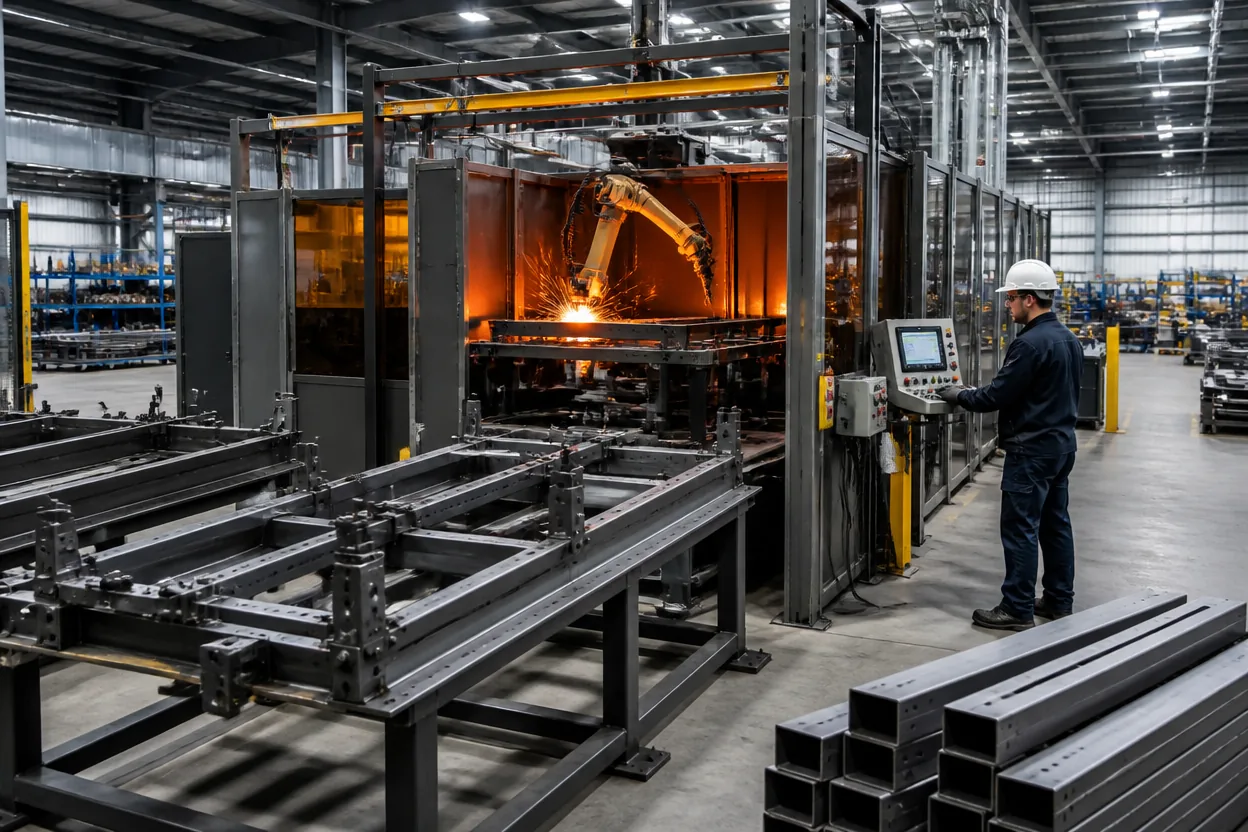
A fabrication shop in 1985 and a fabrication shop in 2026 make the same things — cabinets, frames, tanks, structures — from the same steel. Almost nothing about how they make them is the same. Part 5 of this series follows the journey from the layout table and the hand-fed shear to the fiber laser, the robotic beam line, the welding robot and the software that schedules all of it, and asks what the next decade of automation looks like for an industry that suddenly has more work than people.
Looking for a U.S. fabricator? Call 601.892.5017 or email collin.t@fabtekindustries.com — send a drawing or a scope and we’ll respond fast.
- The manual shop ran on layout, templates and operator feel; every part carried the variance of the hands that made it.
- The breakthroughs came in a sequence: NC/CNC → CAD/CAM → CO₂ then fiber lasers → CNC brakes → robotic structural processing → robotic welding → automated material handling → digital scheduling.
- Automation has not removed people from fabrication; it has moved skill from the hands to the program, the fixture and the process — and made each person far more productive.
- The next decade is about automating the gaps: bending, welding, handling and the scheduling layer between machines.
- What Is Metal Fabrication?
- The Machines of Metal Fabrication
- The Materials of Metal Fabrication
- A Brief History of Metal Fabrication in America
- From Manual to Automated: How the Fabrication Floor Changed (you are here)
- What Is Being Asked of U.S. Metal Fabricators Right Now
- Why Metal Fabrication Is Critical to U.S. Reindustrialization
The manual shop
Picture a fabrication shop before numerical control. A part started on a layout table, where a fitter scribed lines and center-punched holes from a paper drawing, often using a sheet-metal template made for the job. Blanks were cut on a hand-fed shear or a punch press with hand-changed tooling; holes were drilled one at a time; plate was cut with a torch following the scribed line. Bending was done on a hydraulic or mechanical brake by an operator who set the stop, made a test bend, measured, adjusted and bent again — the quality of the angle lived in his experience. Welding was stick or early MIG, by hand, with fit-up held by clamps and eyeball. Structural steel was laid out, marked and drilled with magnetic drills by a crew working from shop drawings. Scheduling was a whiteboard and a foreman’s memory.
Good shops made excellent parts this way. But every part carried the variance of the hands that made it, throughput was tied to headcount, and a job’s knowledge lived in the people who had run it before. When those people retired, the knowledge left with them — which, as Part 4 described, is exactly what happened across the industry in the offshoring decades.
The breakthroughs, in order
| NC and CNC (1950s–80s) | Machine motion driven by a program rather than an operator’s hands. Reached fabrication in the late 1970s and 80s as CNC turret punches and press brakes with programmable back gauges. Replaced: layout, templates, trial bends. |
|---|---|
| CAD/CAM (1980s–90s) | Part geometry designed on a computer and translated directly into machine programs, flat patterns and nests. Replaced: the drafting board and the hand-written program; made the drawing the single source of truth. |
| CO₂ lasers (1980s–2000s) | Program-driven cutting of any 2-D profile without tooling, at speeds and precision punching could not match on complex parts. Replaced: much punching, template work, and torch cutting on sheet. |
| Fiber lasers (2010s) | Several times the speed on thin material, a fraction of the operating cost, and the ability to cut copper and aluminum. Replaced: CO₂ lasers and most remaining punch work; made laser cutting the default first operation. |
| CNC press brakes with angle measurement (1990s–2010s) | Stored bend programs, automatic crowning, real-time angle correction. Replaced: operator feel; made forming repeatable across a run. |
| Robotic structural processing (2000s–2010s) | Beam lines that cut, cope, drill and mark shapes from the model in one pass. Replaced: layout, mag-drilling and manual coping of structural steel. |
| Abrasive waterjet (1980s–) | Cold cutting of thick, exotic and heat-sensitive materials. Replaced: sawing and machining for many plate parts; opened materials heat processes couldn’t handle. |
| Robotic welding (1980s–now) | Programmed arms welding fixtured parts with consistent parameters. Replaced: repetitive manual welding on production parts; now the fastest-growing automation category. |
| Automated material handling (2000s–now) | Sheet towers that load lasers unattended, part sorters, automated tool changers on brakes. Replaced: forklift-and-operator loading; enabled lights-out cutting. |
| Digital scheduling / ERP (now) | Every job, machine, material and labor hour tracked and scheduled in software, increasingly with AI assistance. Replacing: the whiteboard and the foreman’s memory. |
Dates are approximate periods of adoption in general fabrication, not first invention.
The floor today
A well-equipped shop in 2026 runs a fiber laser fed by a sheet tower that cuts nests overnight; CNC press brakes with angle measurement that form the parts to stored programs; a robotic beam line that processes structural shapes from the model; welding cells where certified welders work alongside a growing number of robotic cells; CNC machining for precision features; and an in-house blast room and powder coat line. Jobs are released, tracked and scheduled in an ERP that knows where every part is. FabTek’s equipment list is a fair snapshot of this generation of floor, and Part 2 walked through each machine.
What has not changed is instructive. Fit-up and welding of complex, low-volume weldments is still largely skilled manual work. Assembly, wiring and testing are manual. Inspection is faster with scanners but still a person’s judgment. And the design-to-program step — deciding how a part should be nested, bent and fixtured — is expert human work that the machines depend on.
Automation did not take the skill out of fabrication. It moved the skill from the hands on the brake to the program, the fixture and the process — and made every person on the floor several times more productive.
What automation does to the workforce
The fear that automation eliminates fabrication jobs has not matched the experience of the industry. Employment in fabricated metal products has been roughly stable for years while output per worker has climbed steeply; the constraint on almost every American shop today is not too few jobs but too few people qualified to fill them. What automation has changed is the kind of work. A laser operator today is a programmer and a quality checker more than a machine tender. A press-brake operator manages a tooling library and a bend program. A welder who runs a robotic cell is a fixture designer and a weld-procedure specialist. The work is safer, cleaner, better paid and more technical than it was — which is the case shops have to make to a generation that was told the trades were a dead end.
For a buyer, the practical implication is that a fabricator’s automation level predicts consistency and capacity, but its people still predict quality on anything complex. Ask about both.
Where it goes next
- Bending automation. Robotic and panel-bending cells that form parts without an operator, and brakes with automatic tool changers, are moving from high-volume OEMs into general fabrication.
- Welding automation for lower volumes. Collaborative robots with easy teaching and offline programming from the CAD model are making robotic welding economical on runs of tens rather than thousands — the exact profile of enclosure and frame work.
- Handling and sorting. Automated part removal and sorting from lasers, and material flow between machines, is where the remaining manual labor in cutting lives.
- Inspection. Laser scanning and vision systems checking parts against the model in-process, not at the end.
- The software layer. AI-assisted nesting, scheduling, quoting and job costing — systems that see every machine and every job and re-plan in real time. This is the frontier with the highest leverage, because the biggest waste in most shops is not machine speed but the gaps between machines.
- Digital continuity. Customer CAD flowing straight into programs, quotes and schedules without re-drawing — the reason we ask for native files in a spec package.
How FabTek is approaching it
FabTek’s bet is the same one the industry is making: brand-name automated machinery on the floor — Amada lasers and brakes, Voortman robotic processing, OMAX waterjet, Haas machining, an in-house powder coat line — to lift throughput and consistency without adding headcount risk, plus a proprietary AI-native ERP rolling out to give customers real-time job costing, scheduling and demand visibility across the company. The goal is not fewer people; the company grew from 40 to more than 100 employees in eighteen months and is adding roughly 100 more jobs with its North Campus expansion. The goal is that each of those people, and each machine, is never waiting on the next one. That is what a customer feels as lead time.
Frequently asked questions
How has metal fabrication changed with automation?
Program-driven cutting (lasers, robotic beam lines) replaced manual layout and templates; CNC press brakes with angle measurement replaced operator feel; robotic welding is taking over repetitive production welds; automated material handling enables unattended cutting; and ERP software has replaced whiteboard scheduling. Complex fit-up, welding, assembly and inspection remain skilled manual work.
Does automation reduce jobs in metal fabrication?
The industry's experience is that automation has raised output per worker while employment has held roughly steady, and the binding constraint on most U.S. shops is a shortage of qualified people, not a shortage of work. Automation has changed the work toward programming, fixturing, process control and quality.
What is the next big thing in metal fabrication automation?
Bending automation and cobot welding cells that are economical at low volumes, automated part sorting and material flow, in-process scanning inspection, and AI-assisted software for nesting, scheduling, quoting and job costing that removes the waiting time between machines.
What is an AI-native ERP for a fabrication shop?
An enterprise resource planning system built around AI-assisted scheduling, job costing and demand forecasting, so every job, machine, material lot and labor hour is visible in real time and the shop can re-plan continuously. FabTek is rolling out a proprietary system of this kind.