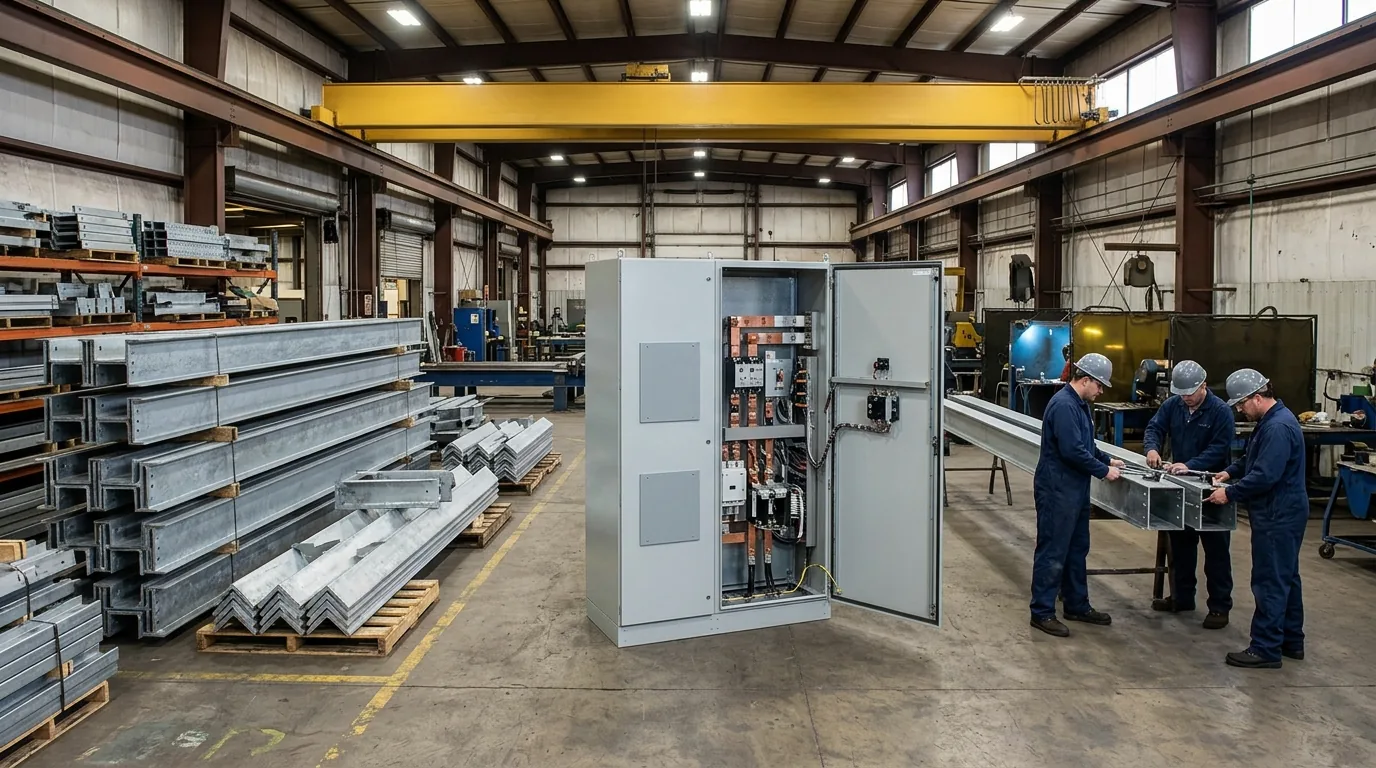
The first four parts of this series explained what's inside a data center, how it gets its power, how that power is distributed and where the build gets stuck. This final part is practical: how owners, EPCs, electrical contractors and switchgear OEMs should specify and source the fabricated metal — switchgear enclosures, transformer cabinets and tanks, bus duct, substation steel — so it arrives right, arrives once, and arrives when the long-lead equipment does.
Building or supplying a data center? Call 601.892.5017 or email collin.t@fabtekindustries.com — send a drawing, a one-line, or a scope and we’ll respond fast.
- Send a complete spec package — drawings, NEMA rating, gauge, finish, hardware, bus duct ampacity and configuration, test and packaging requirements — and the quote comes back faster and holds.
- Vet the fabricator on certifications (ISO 9001:2015, AWS), traceability, equipment, capacity and proximity, not just unit price.
- Choose a shop that does metal and electrical assembly together; the handoff between a metal shop and a wiring shop is where most schedules slip.
- Reserve capacity early with a blanket agreement or dedicated line, and release drawings in the sequence the site needs them.
- What's Inside a Data Center? Anatomy of a Hyperscale Campus
- How a Data Center Gets Its Power: Grid Interconnect to Fence Line
- Inside the Electrical Room: Switchgear, UPS and Bus Duct to the Rack
- Where Data Center Builds Get Stuck: The Real Bottlenecks
- Sourcing Fabricated Power Equipment for a Data Center: A Buyer's Guide (you are here)
Who buys what
Fabricated metal for a data center is purchased by several different parties, and the right sourcing approach depends on which one you are:
- Owners and hyperscale developers typically buy the substation package and, increasingly, standardized enclosures and bus duct across multiple sites under program agreements.
- EPCs and general contractors buy the substation steel, structural and miscellaneous metals, and often the outdoor switchgear and generator enclosures — looking for turnkey packages with field erection.
- Electrical contractors buy bus duct and busway, PDU and panel enclosures, and cable tray support steel, and care most about dimensional accuracy and delivery sequencing.
- Switchgear, transformer and UPS OEMs buy enclosures, sections, cabinets, tanks and wired sub-assemblies to print, on recurring volume, and care about repeatability and reserved capacity.
- Utilities buy the transmission and substation structures on their side of the fence.
The rest of this guide applies to all of them, with notes where the priorities differ.
Build a spec package the fabricator can actually quote
The fastest way to a firm price and a held delivery date is a complete package. A fabricator quoting from a partial spec either pads the price for the unknowns or quotes low and changes the order later — both cost you time. At a minimum, include the drawings (native CAD plus PDF), material grade and thickness, finish system, hardware and gasketing, quantities and release schedule, delivery address and packaging requirements, inspection and test requirements, and the documentation you'll need at closeout. We walk through the full list in What Belongs in a Build-to-Print Spec Package.
Two things save more time than anything else. First, tell the fabricator what the part mates to — the switchgear OEM's bolt pattern, the transformer's base dimensions, the busway manufacturer's joint geometry — so interfaces can be checked before cutting. Second, flag which dimensions are critical and what tolerance they carry, so the shop doesn't spend effort holding a decorative panel to a thousandth while a mounting hole floats.
Switchgear enclosures, transformer cabinets and control cabinets
For any enclosure that lives outdoors or in a harsh environment, the specification starts with the NEMA rating. NEMA 3R is the standard for outdoor switchgear walk-ins, pad-mount transformer cabinets and generator paralleling gear — it sheds rain and resists ice but is ventilated. NEMA 4 adds a gasketed, hose-down watertight seal for wash-down or splash exposure. NEMA 4X adds corrosion resistance — stainless or specially finished steel — for coastal and chemical environments. Specifying 4X where 3R is all the environment requires is a common and expensive mistake; we explain how to choose in NEMA 3R vs. 4 vs. 4X.
Beyond the rating, spell out gauge (12- and 11-gauge are typical for switchgear enclosures; heavier for structural sections), finish (powder coat over blast and pretreatment is the norm; call out color, film thickness and any salt-spray requirement — FabTek's finish system is certified to IEEE 2000-hour salt spray), door hardware and three-point latching, gasketing material, lifting provisions, ventilation and filtration, and any arc-resistant requirements such as pressure-relief flaps and reinforced construction. Ask whether the fabricator can also mount and wire the interior — more on that below — because an enclosure delivered with the panel already wired is a week of electrician time the site doesn't have to find. For a hyperscale-specific view, see Switchgear Enclosures for Hyperscale Builds.
Bus duct and busway
Bus duct is the least forgiving fabricated product on a data center site, because a 300-foot run of sections has to align to a fraction of an inch and mate to an OEM bus stack exactly. Your specification should state the ampacity (1,600–6,000 A is typical for feeder duct; 400–1,200 A for overhead busway), phase configuration (non-segregated, segregated or isolated-phase), conductor material (copper or aluminum) and whether you are buying complete bus duct or housings and tap boxes for the OEM's bus. Include the routing drawings with every elbow, offset, wall penetration and expansion joint, the tap-box locations and plug-in geometry, the housing material and finish, and the seismic and support requirements.
Then ask the fabricator how it controls straightness and joint geometry across a run, whether it has built to your busway OEM's standard before, and how it packages sections so they arrive unbent. A shop running a dedicated bus duct line with fixtures for the work will have quick answers. Our complete guide is Datacenter Bus Ducts: A Buyer's Guide.
Every question you answer in the RFQ is a change order you don't pay for later. Every interface you define is a part that bolts up the first time.
Substation and structural steel
For the substation package — dead-ends, A-frames, bus supports, equipment stands, control enclosures — the key specification items are the structural drawings and connection details, the material grade, the coating system (almost always hot-dip galvanizing to ASTM A123, with duplex paint-over-galvanizing where appearance or extreme corrosion demands it), the equipment manufacturers' bolt patterns for every stand, the erection sequence and delivery schedule, and whether you want the fabricator's crews to handle field erection. Match-marking, hardware kits and a delivery sequence tied to the erection plan matter as much as the steel itself. We covered all of this in the Substation Steel Procurement Checklist and the Substation Steel Buyer's Guide.
For structural and miscellaneous metals inside the building — mezzanines, cable tray supports, equipment skids, CDU frames, platforms — the same principles apply, with an added emphasis on quantities and release sequencing. These parts arrive in thousands, and the site needs them in the order the trades will install them.
Vetting a power & utility fabricator
Price is the last thing to compare, not the first. Before it, confirm:
- Quality system and certifications. ISO 9001:2015 registration with a current certificate; AWS-certified welders and documented weld procedures; salt-spray or other finish certifications relevant to your environment. Ask for the records, not the claim.
- Traceability. Material certs tied to heat numbers, weld inspection records and a documented CAPA process — the paperwork your commissioning agent and your utility will ask for.
- Equipment and process. Fiber laser and robotic plasma cutting, CNC press brakes, in-house welding, machining and powder coat mean the parts stay under one roof from sheet to ship. Walk the floor or ask for the equipment list.
- Capacity and track record. How many enclosures, tanks or tons per month, on how many shifts, with what surge capability? What percentage on time? Who else in power and utility do they build for?
- Proximity and logistics. Freight distance to your site, ability to stage and sequence deliveries, and how they handle a rush change order when the schedule moves.
- Stability. A supplier that will be there for the second campus — investing in capacity, growing its workforce, financially sound.
Our full ten-point version is in How to Vet a Power & Utility Fabricator, and the questions utilities specifically ask are in What Utilities Confirm Before Awarding.
Buy metal and electrical from the same shop
Most data center enclosures are not empty boxes; they are delivered with back panels, terminal blocks, breakers, relays and point-to-point wiring installed. When the metal comes from one supplier and the wiring from another, every job has a handoff: freight between shops, a second schedule, two sets of tolerances that may not agree, and finger-pointing when a panel doesn't fit. A fabricator that does its own electrical assembly removes that handoff entirely — the enclosure is built, the panel is mounted and wired to print, and it's bench-tested and shipped as one unit. We make the case in detail in Single-Source Metal and Electrical: What It Does to Lead Times, and the datacenter-specific version in Single-Source Datacenter Power.
The same logic applies to the yard: a fabricator that builds the steel and erects it, or builds the tank and the cabinet, is one vendor to manage and one schedule to hold.
Lock capacity around your long-lead dates
As Part 4 argued, fabricated metal is short-lead only if the fabricator has room on the floor when you need it. In the current market, the shops that do this work well are full. The way to guarantee your slot is to treat the fabrication package like the long-lead equipment it supports:
- Engage at preliminary design. Get budget pricing and a capacity conversation started when the one-line and layout are 60% complete — not when the transformer ships.
- Reserve a dedicated line. For recurring volume — enclosures across a multi-building campus, cabinets for an OEM's product line, bus duct for a program — a dedicated production line with reserved monthly capacity means the same crew, fixtures and process every run.
- Use a blanket agreement with phased releases. Commit the quantity, release the drawings in the sequence the site needs, and let the fabricator plan material and labor ahead. We explain the structures in Long-Term Fabrication Contracts.
- Tie deliveries to the equipment schedule. Give the fabricator the transformer, switchgear and generator delivery dates so steel and enclosures land the week before — not the week after.
- Confirm surge capacity. Ask what happens when the schedule moves left or a change order lands. A shop with overflow capacity, dual-shift capability and field crews can absorb it; a shop at 100% cannot.
The 12-point RFQ checklist
Before you send a request for quote on data center enclosures, bus duct or steel, confirm the package includes:
- Native CAD and PDF drawings, with critical dimensions and tolerances flagged
- Material grade and gauge/thickness for every component
- NEMA rating and environment (indoor, outdoor, coastal, arc-resistant)
- Finish system — powder coat color and film thickness, or galvanizing spec — and any salt-spray requirement
- Hardware, gasketing, latching, lifting and ventilation requirements
- Mating equipment: OEM bolt patterns, bus stack geometry, base dimensions
- For bus duct: ampacity, phase configuration, conductor material, routing with every elbow, offset and tap-box location
- Electrical assembly scope: what is mounted and wired at the fabricator, with the bill of materials and wiring diagrams
- Quantities, release schedule and the long-lead equipment dates deliveries must precede
- Inspection, test and documentation requirements — material certs, weld records, ISO/AWS certificates, salt-spray reports
- Packaging, staging and delivery sequencing to the site, and whether field erection is in scope
- Change-order and expedite terms, so a schedule move has a known price
FabTek Industries builds exactly this scope for data center, utility, EPC and OEM customers: NEMA-rated switchgear enclosures, transformer cabinets, welded transformer tanks, datacenter-grade bus duct, galvanized substation steel and build-to-print structural work, with electrical assembly under the same roof, ISO 9001:2015 and AWS certification, dedicated lines with reserved capacity, and field crews for erection and rush work — from four production sites in Hazlehurst, Mississippi, shipped nationwide. Send us your drawings, your one-line, or just the transformer date you're building toward, and we'll come back with a plan for the metal around it. Request a quote or call 601.892.5017.
Frequently asked questions
What should be in an RFQ for data center switchgear enclosures?
Native CAD and PDF drawings with critical dimensions flagged, material gauge, NEMA rating, finish system and salt-spray requirement, hardware and gasketing, the OEM's mating bolt pattern, any arc-resistant requirements, electrical assembly scope, quantities and release schedule, test and documentation requirements, and delivery sequencing.
What NEMA rating do data center enclosures need?
Outdoor switchgear walk-ins, pad-mount transformer cabinets and generator paralleling gear are typically NEMA 3R. NEMA 4 is used where hose-down or splash exposure exists, and NEMA 4X where corrosion resistance is required, such as coastal sites. Over-specifying 4X where 3R suffices adds cost without benefit.
How do I vet a fabricator for power and utility work?
Confirm ISO 9001:2015 registration and AWS-certified welding with records; material traceability and weld documentation; in-house cutting, forming, welding and finishing equipment; monthly capacity, surge capability and on-time performance; freight distance to your site; and the financial stability to support the next project.
Why buy enclosures and wiring from the same fabricator?
It removes the handoff between a metal shop and a wiring shop — one schedule, one set of tolerances, one bench test — and the enclosure arrives ready to land feeders, which saves scarce electrician hours on site.
How do I reserve fabrication capacity for a data center project?
Engage the fabricator at preliminary design, set up a blanket agreement or dedicated production line with reserved monthly capacity, release drawings in the sequence the site needs, and share the long-lead equipment delivery dates so fabricated steel and enclosures arrive just ahead of them.