Buyers use “metal-enclosed” and “metal-clad” loosely, but in IEEE C37.20 they are different assemblies with different enclosure constructions. The distinction matters to the switchgear OEM’s design and to the fabricator building its frames, barriers and doors. This spec sheet explains what each term requires, what changes in the sheet metal, and what the OEM has to communicate in the print package.
Building a switchgear lineup and need the frames, barriers and doors fabricated to print? Call 601.892.5017 or email collin.t@fabtekindustries.com — send a print and a quantity and we’ll quote it.
- Metal-clad is a subset of metal-enclosed with stricter requirements: grounded metal barriers between every major component, drawout breakers, and automatic shutters.
- For the fabricator, metal-clad means more compartment barriers, more precise frame tolerances and shutter and interlock mounting provisions.
- The type test and listing belong to the OEM; the fabricator builds the housing to a print derived from the tested design.
- Both constructions are built from the same materials — formed 11/12-gauge steel over welded frames — but metal-clad tolerances and flatness drive the fixtures.
Definitions from the IEEE C37.20 family
IEEE C37.20.2 covers metal-clad switchgear; C37.20.3 covers metal-enclosed interrupter switchgear; C37.20.1 covers metal-enclosed low-voltage power circuit breaker switchgear. “Metal-enclosed” is the broad term: a grounded metal enclosure around the switching and interrupting devices, bus and connections, with access through doors or removable covers. “Metal-clad” adds specific requirements: the main switching device is drawout, major primary components are in separate compartments with grounded metal barriers, automatic shutters cover the primary stabs when the breaker is withdrawn, and all live parts are enclosed within grounded metal. Every metal-clad assembly is metal-enclosed; the reverse is not true.
| Feature | Metal-enclosed (C37.20.3) · Metal-clad (C37.20.2) |
|---|---|
| Switching device | Fixed or drawout interrupter switch or breaker · Drawout circuit breaker required |
| Compartmentation | Barriers where the design requires · Grounded metal barriers between breaker, bus and cable compartments |
| Shutters | Not required · Automatic shutters over primary stabs |
| Instrument and control | May share compartments · Separate low-voltage compartment |
| Typical voltage | 5–38 kV, also LV classes · 5–38 kV |
Summary for enclosure fabrication purposes; the governing standards and the OEM’s type-tested design control the construction.
What changes in the fabrication
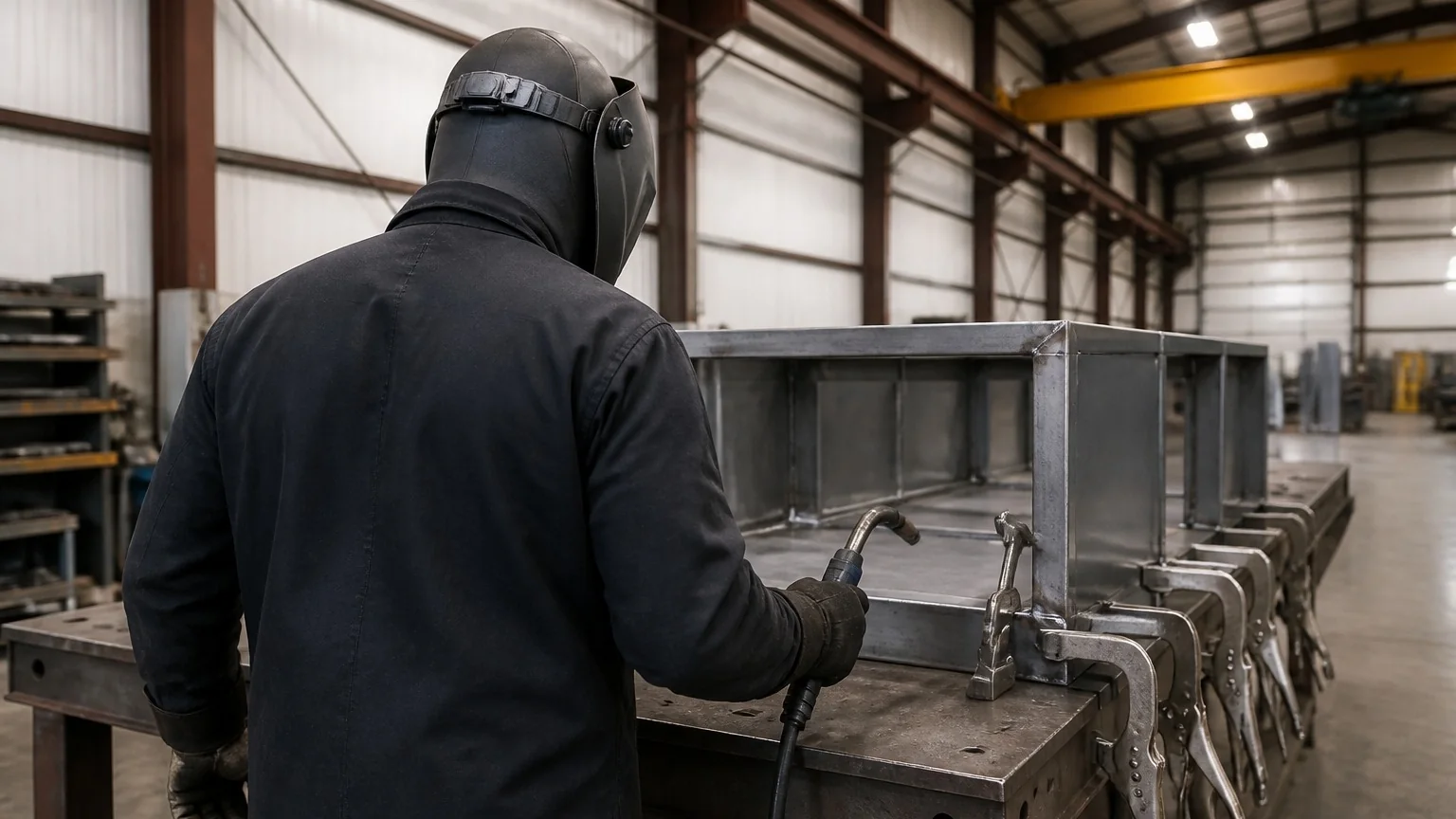
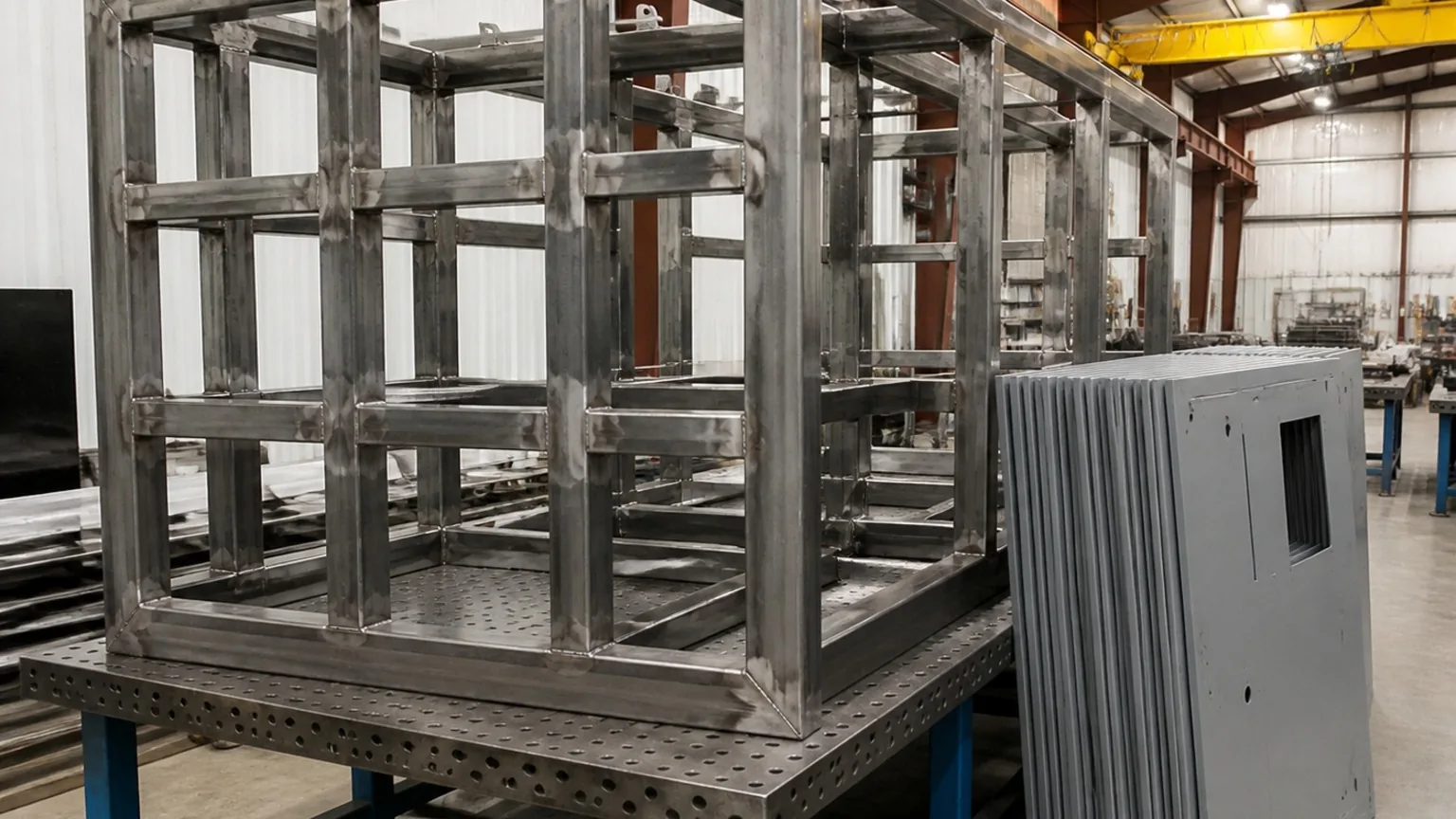
From the fabricator’s side, metal-clad adds parts and tightens tolerances. Each section has more internal barriers — formed and welded or bolted steel plates that divide the breaker, bus and cable compartments — and each barrier has cutouts for bus and bushings that must land within a tight tolerance of the OEM’s stab positions. The breaker compartment needs rails and racking provisions mounted to the frame flat and parallel, so the frame is usually a welded structural weldment squared in a fixture rather than a bolted-up sheet-metal box. Shutter mechanisms mount to the compartment walls, so hole patterns and flatness around them are held tighter than on an ordinary enclosure wall. FabTek fabricates both: kitted panels, doors and barriers for OEM assembly, and complete welded section frames.
- Frames — welded structural or heavy-gauge formed frames, squared and checked for diagonal and flatness before skins go on.
- Barriers — grounded steel plates with bus and bushing cutouts; for metal-clad, between every major compartment.
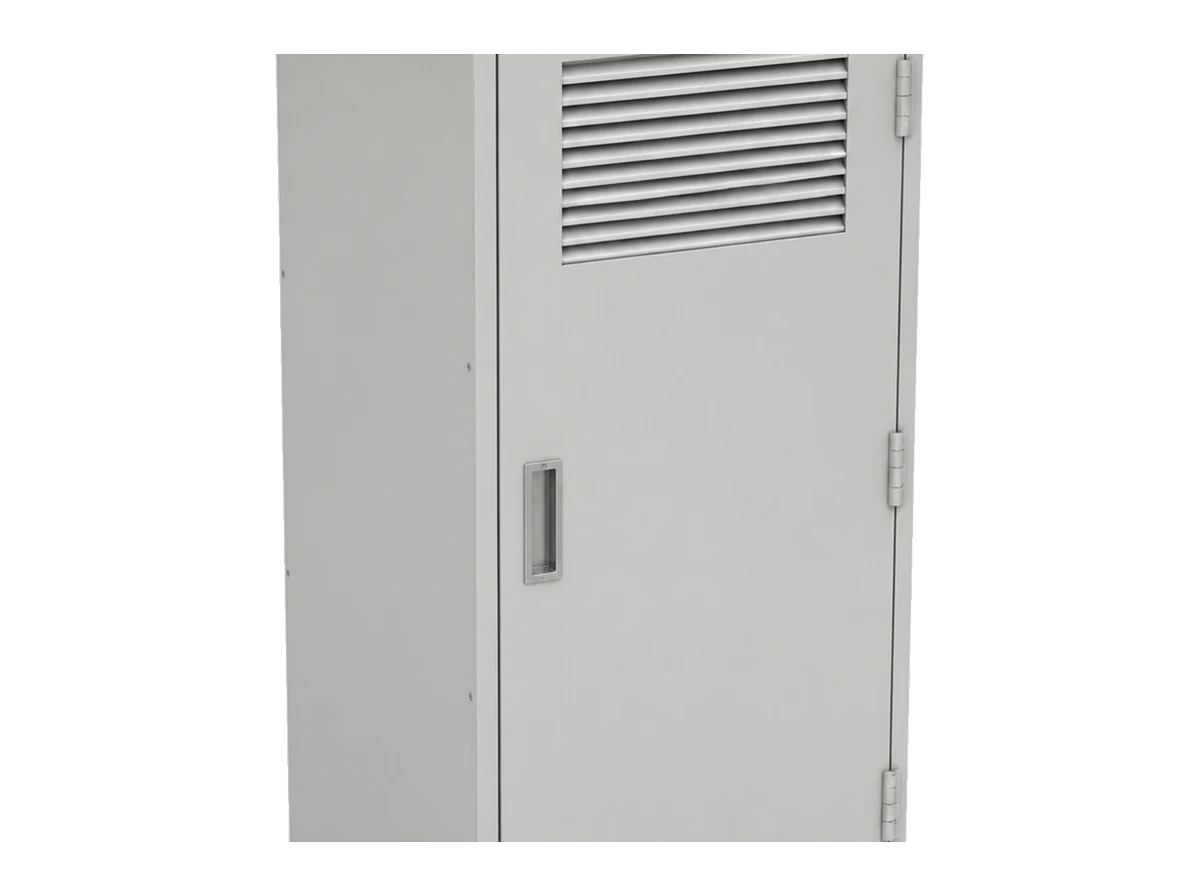
- Doors and covers — hinged doors with viewing windows and instrument cutouts on the LV compartment; bolted or hinged covers on bus and cable compartments.
- Shutter and interlock provisions — mounting holes, brackets and clearances per the OEM’s mechanism.
- Bases and sills — channel bases with anchor holes, lifting provisions and shipping-split hardware.
Tolerances and why they drive the fixtures
A drawout breaker has to rack into its stabs the same way in every section the OEM ships. That pushes the dimensional requirement onto the frame: compartment width and depth, rail position and the stab cutout location in the barrier typically carry tolerances a fraction of what an ordinary enclosure wall would. The practical answer is a welding fixture per section type and a first-article inspection on a CMM or with a checking fixture before the production run. Buyers should ask how the fabricator holds those dimensions and what the first-article report will show; we described the general approach in bolt-hole tolerances for substation steel, and the same discipline applies to switchgear frames.
Low-voltage switchgear and switchboards
Low-voltage metal-enclosed power circuit breaker switchgear (C37.20.1) and switchboards (UL 891) are built from similar sheet metal — formed frames and skins, breaker cell barriers, instrument doors — at lower voltage clearances and higher production volumes. Here the fabricator’s value is repeatability: the same cell parts, hundreds of times, kitted so the OEM’s assembly line never waits. The MCC and switchboard sheet-metal kit post covers how those programs run.
What the OEM needs to communicate
Because the type test belongs to the OEM, the print package has to carry everything the tested design depends on: barrier thickness and material, bolt patterns and torque where they affect the grounded-metal requirement, gasket and vent locations for arc-resistant designs (covered in arc-resistant enclosure fabrication), and the inspection points the OEM wants verified. A fabricator can hold what is on the drawing; it cannot hold what is only in the test report.
Metal-clad is a design the OEM tested. The fabricator’s job is to build the housing so that every section is the one that passed.
FabTek Industries fabricates switchgear enclosures, section frames, compartment barriers, doors and kitted sheet metal for medium- and low-voltage switchgear OEMs — fixture-welded, first-article inspected and powder-coated in-house — under an ISO 9001:2015 quality system with AWS-certified welding, from four production sites in Hazlehurst, Mississippi. See how we work with switchgear OEMs, or send us a print.
Working on something like this? Send a print or a scope — pricing and lead time within one business day, from four Mississippi plants.
Frequently asked questions
What is the difference between metal-enclosed and metal-clad switchgear?
Metal-clad (IEEE C37.20.2) is a stricter subset of metal-enclosed switchgear: it requires drawout breakers, grounded metal barriers between the breaker, bus and cable compartments, automatic shutters over the primary stabs, and a separate low-voltage compartment. Metal-enclosed (C37.20.3) requires a grounded metal enclosure but not that level of compartmentation.
Does metal-clad switchgear cost more to fabricate?
The enclosure typically has more barriers, a heavier fixture-welded frame and tighter tolerances for breaker racking, so the sheet metal and welding content per section is higher than for a comparable metal-enclosed section.
Who is responsible for the type test and listing?
The switchgear OEM. A contract fabricator builds frames, barriers, doors and skins to the OEM’s print, which is derived from the tested design. The fabricator does not certify the assembly.
Can a contract fabricator build metal-clad switchgear frames?
Yes. The work is welded structural frames and formed barriers held to the OEM’s tolerances with section-specific fixtures and first-article inspection, plus kitted doors and covers, finished to the OEM’s color.