Every outdoor enclosure gets one of three finishes, or a combination: a coating (powder coat is the modern default), a metallurgical layer (hot-dip galvanizing) or no finish because the metal does not need one (stainless). Utilities, OEMs and plants each have defaults, and the right choice depends on the environment, the appearance the end customer expects, the budget and who will repair it in the field. This spec sheet compares the three and gives the language to specify each.
Deciding the finish on an enclosure program? Call 601.892.5017 or email collin.t@fabtekindustries.com — send a print and a quantity and we’ll quote it.
- Powder coat is the enclosure default: color, appearance and a salt-spray-tested system; it is only as good as its pretreatment and film thickness.
- Galvanizing is for bases, frames and structures — unmatched edge protection, no color, dimensional and appearance limits.
- Stainless is the answer where chlorides, chemicals or washdown would defeat a coating; it costs more and welds differently.
- Two-finish enclosures — galvanized base, powder-coated body — and duplex systems are common and should be called out explicitly.
Side by side
| Powder coat | Electrostatic polyester or epoxy-polyester over blast or phosphate pretreatment; any color; 2–4 mil typical; salt-spray performance set by pretreatment and film; field-repairable with touch-up; in-house at FabTek with an IEEE 2000-hour rating |
|---|---|
| Hot-dip galvanizing | Zinc alloy layer to ASTM A123; protects edges and inside surfaces; gray, weathers to matte; distortion risk on thin sheet; through a partner galvanizer with transport time; see A123 vs. A153 |
| Stainless | 304/316, passivated, #4 or other finish; no coating to fail; highest material cost; AWS D1.6 welding; see 304 vs. 316 |
| Duplex | Powder coat over galvanizing; longest life of any coated system; needs sweep-blast or chemical prep of the zinc; used on bases and structures that must be colored |
| Two-finish | Galvanized base or frame, powder-coated body; common on outdoor cabinets and skids; sequence and masking on the print |
Powder coat: the enclosure default
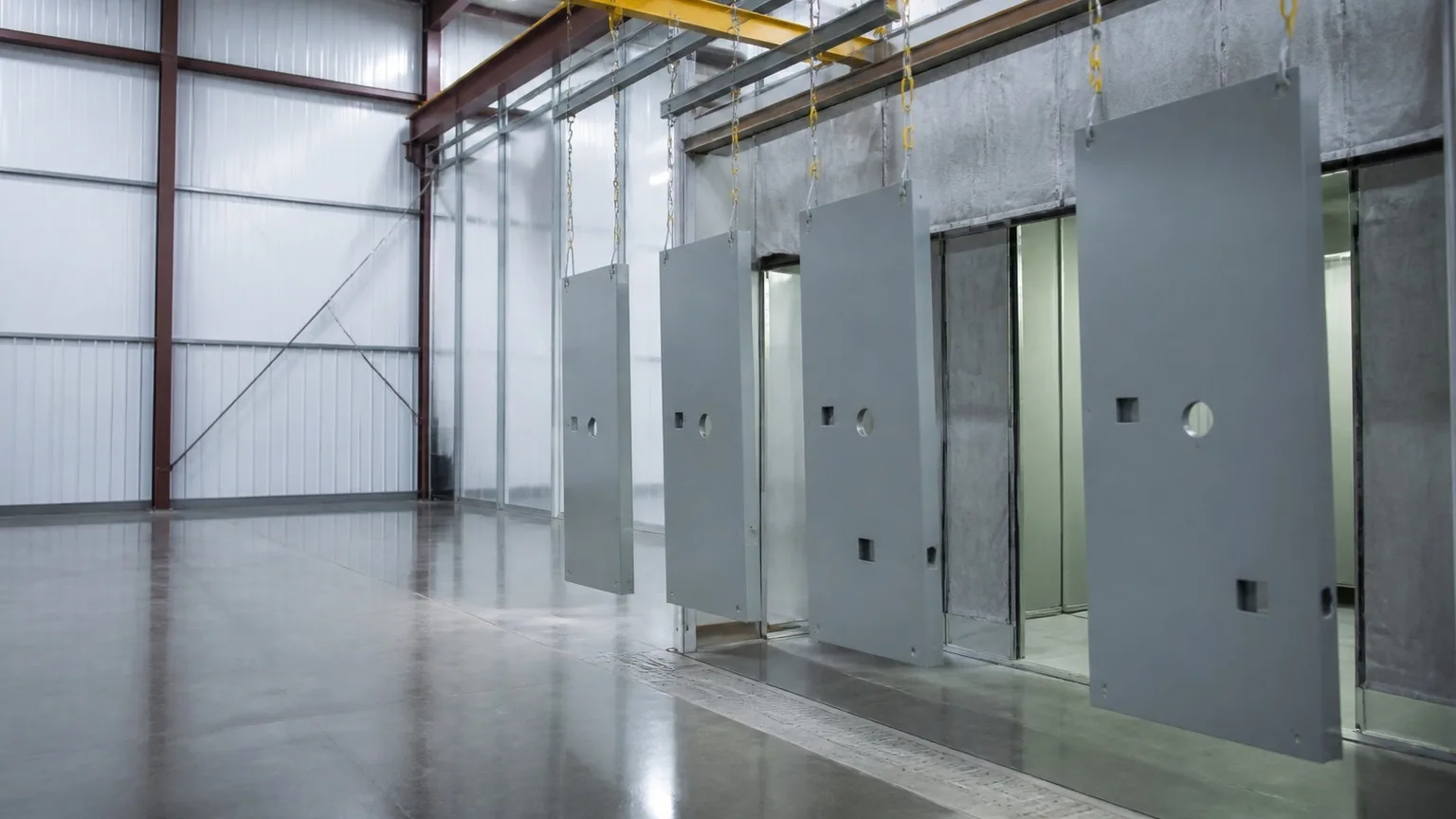
Powder coat gives color, a smooth appearance and, over proper pretreatment, outdoor performance that meets utility and OEM salt-spray requirements. The system is the pretreatment (abrasive blast or multi-stage phosphate), the powder chemistry (polyester for UV exposure outdoors, epoxy-polyester hybrids indoors), the film thickness and the cure. A spec that names only the color gets an unpredictable result; the film thickness post and salt-spray post give the parameters, and ANSI 61 and 70 gray are the utility colors. FabTek runs two in-house powder lines, which keeps finish inside the plant and off the lead time.
Galvanizing: for the steel that touches the ground
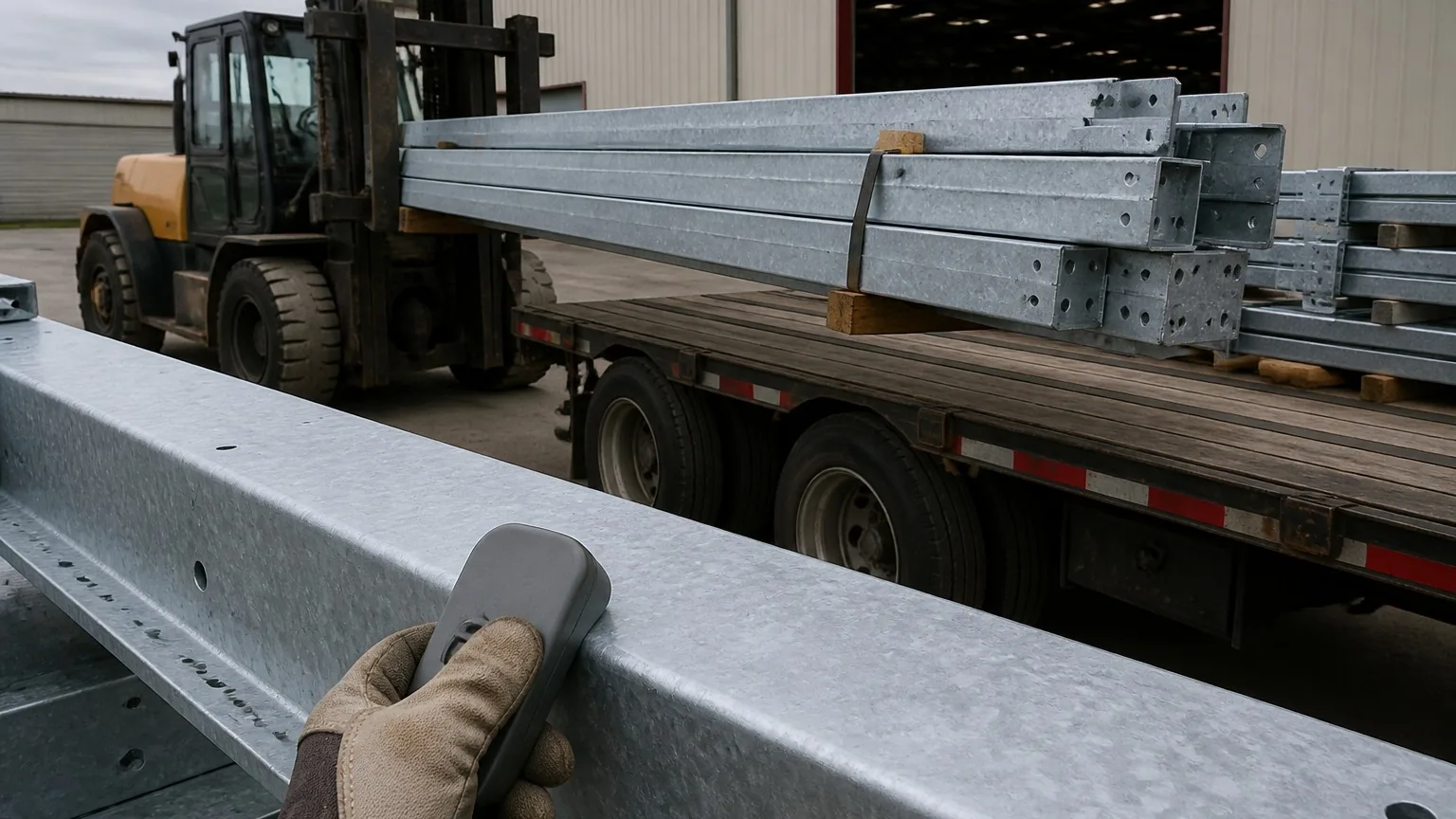
Hot-dip galvanizing protects every surface the zinc reaches, including edges, holes and the inside of tubes, which no coating does as well; it is the finish for enclosure bases, skids, frames, legs and anything set in a trench or on wet ground. Its limits are appearance (gray, no color), distortion on thin sheet, size (the kettle), surface roughness and the trip to a partner galvanizer. FabTek manages galvanizing through its partner galvanizers, stages the base through the kettle ahead of the body, and powder-coats the body in-house so the two arrive together. The general galvanize-vs-paint decision for structures is in galvanizing vs. paint for substation steel.
Stainless: when the coating would fail
Where chlorides, sulfides, chemicals or daily sanitizer would defeat any coating — coasts, wastewater, chemical plants, food washdown — the enclosure is stainless, and the finish is the metal itself: welded to AWS D1.6, ground, passivated, #4 brushed. It costs more in material and in welding, and the hardware has to match; the alloy choice and spec language are in 304 vs. 316 and the environments in water and wastewater. Aluminum is the other no-coating option for lighter duty; see aluminum vs. steel.
Choosing by environment
- Inland, outdoor, utility or industrial — powder coat to a 1,000–2,000-hour salt-spray spec; galvanized base if in a trench.
- Coastal — stainless for cabinets with electronics; duplex or enhanced powder systems with extended salt-spray on steel; galvanized structures.
- Wastewater, chemical — 316 stainless; no coated steel in the wet zone.
- Food washdown — 304/316 stainless with sanitary design.
- Indoor plant — powder coat; galvanized (G90) sheet for junction and pull boxes.
- Appearance-critical OEM product — powder coat in the brand color with a signed match panel.
Specification language
Powder: “Powder coat, polyester TGIC-free, color ANSI 61, over [abrasive blast to SSPC-SP 6 / five-stage iron phosphate], 2.5–4.0 mil DFT, [1,000/2,000] hours ASTM B117 with ≤ 1/8 inch scribe creep, interior surfaces coated, ground pads masked.” Galvanizing: “Hot-dip galvanize after fabrication per ASTM A123, [Grade/class], vent and drain holes per fabricator, straighten after dip.” Stainless: “316L, #4 finish, AWS D1.6 continuous exterior welds ground smooth, passivate per ASTM A967, 316 hardware.” Two-finish: “Base galvanized per A123; body powder-coated per above; base and body shipped assembled.” With that language the RFQ part four is done.
Powder coat is a system, galvanizing is a reaction, stainless is a material. Each fails in its own way, and the spec is where you choose which failure you are willing to wait for.
FabTek Industries finishes enclosures and their bases in-house on two powder coat lines (IEEE 2000-hour salt-spray rating), through partner galvanizers to ASTM A123, and in 304/316 stainless welded to AWS D1.6 and passivated — on switchgear enclosures, control cabinets, transformer cabinets, NEMA 4X enclosures and skids and bases — under an ISO 9001:2015 quality system, from four production sites in Hazlehurst, Mississippi. See powder coating, galvanizing, or send us a print and the environment.
Working on something like this? Send a print or a scope — pricing and lead time within one business day, from four Mississippi plants.
Frequently asked questions
Which finish is best for an outdoor electrical enclosure?
Powder coat over proper pretreatment to a salt-spray specification is the default for enclosures that need color and appearance; hot-dip galvanizing is best for bases, frames and anything set on wet ground; stainless steel is used where chlorides, chemicals or washdown would defeat a coating. Many outdoor cabinets combine a galvanized base with a powder-coated body.
What determines how long powder coat lasts outdoors?
The pretreatment (abrasive blast or multi-stage phosphate), the powder chemistry (polyester for UV exposure), the film thickness and the cure. A specification should name all four plus a salt-spray requirement, not just a color.
Can an enclosure be galvanized and powder-coated?
Yes. A duplex system — powder coat over galvanizing with sweep-blast or chemical preparation of the zinc — gives the longest life of any coated system and is used on bases and structures that must be colored. Two-finish enclosures with a galvanized base and a powder-coated body are also common.
When should an enclosure be stainless instead of coated steel?
At coastal sites, wastewater and chemical plants, and food washdown areas, where chlorides, sulfides, chemicals or sanitizers would defeat any coating. 316 is used where chlorides are present; 304 in milder service.