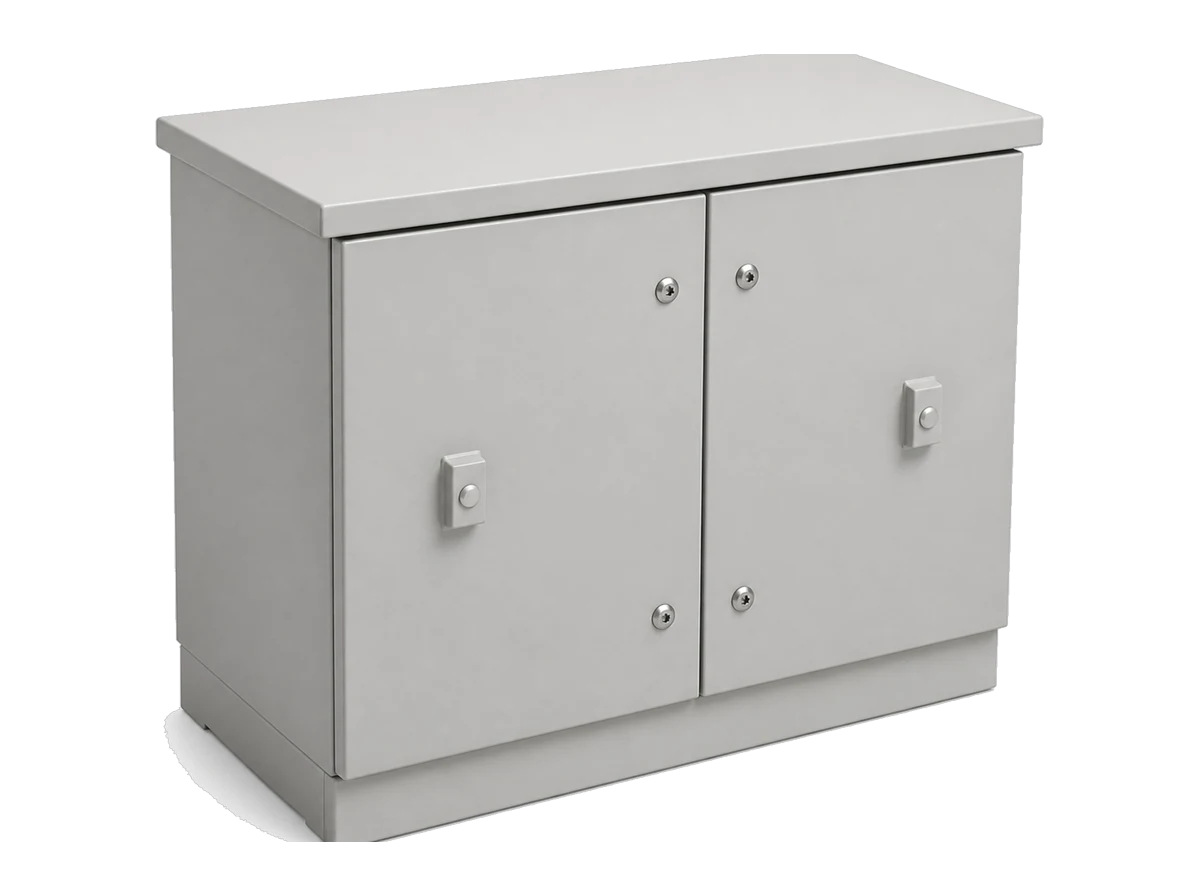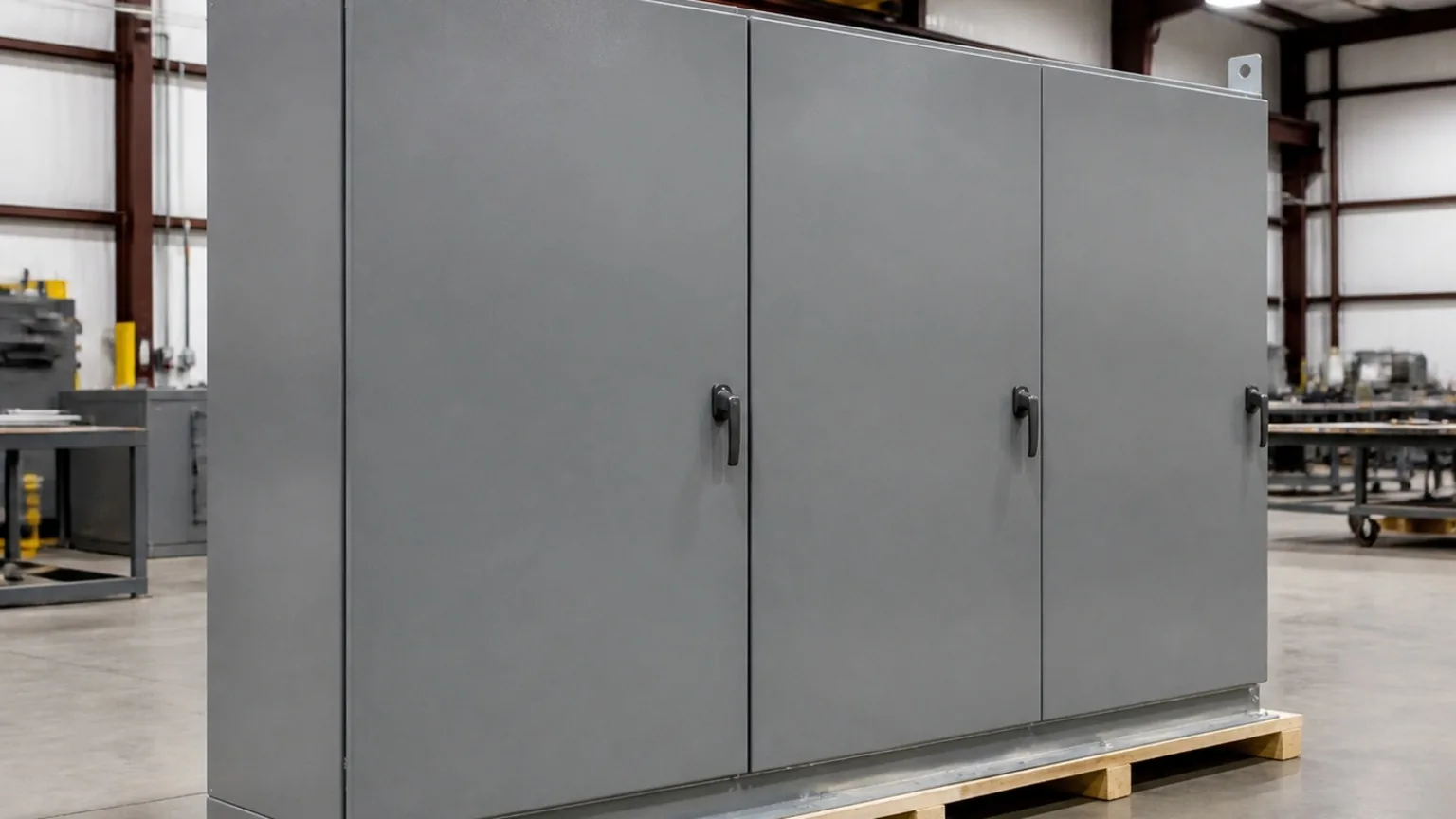
Pad-mounted transformers, switchgear and junction enclosures sit in front yards and parking lots, unattended, with medium-voltage conductors inside. ANSI/IEEE C57.12.28 is the standard that keeps the public out: a set of physical tests and construction requirements that define a tamper-resistant enclosure. OEMs design to it, utilities specify it, and the fabricator builds the features that pass it. This spec sheet explains what the standard requires and what it looks like in sheet metal.
Building pad-mounted cabinets or enclosures to C57.12.28? Call 601.892.5017 or email collin.t@fabtekindustries.com — send a print and a quantity and we’ll quote it.
- C57.12.28 is about keeping people out: no access to energized parts with simple tools, by pry, pull, probe or impact.
- It is passed by construction and hardware — recessed hinges, captive security bolts, interlocked doors, edge design — not by gauge alone.
- The standard also sets coating performance, which is why pad-mount cabinets carry salt-spray and impact requirements.
- C57.12.29 extends the requirements for coastal environments with corrosion-resistant construction.
What the standard covers
C57.12.28 applies to enclosures for pad-mounted equipment — distribution transformers, switchgear, sectionalizing cabinets, junction enclosures — that are accessible to the public. It defines enclosure integrity in two parts: security, meaning resistance to unauthorized entry, and coating, meaning the finish’s resistance to the outdoor environment. It does not define the equipment inside. OEMs apply it in their designs; utilities cite it in purchasing specifications; and a fabricator building pad-mount cabinets or pad-mounted switchgear enclosures to an OEM print is building the features that were designed to pass it.
The security tests
| Pry test | A pry bar applied at door edges, seams and the sill with a specified force; the enclosure passes if no opening large enough to admit a probe is created |
|---|---|
| Pull test | A specified force applied to hardware, hoods and doors; latches and hinges must hold |
| Wire-probe test | A wire probe applied at every seam and opening; it must not reach energized parts |
| Impact test | A specified impact on panels and hardware; no opening and no loss of security function |
| Lifting and tilting | The enclosure must stay secure when lifted or tilted from its mounting |
| Hardware | Captive, tamper-resistant fasteners (penta-head is the convention), padlockable latches, hinges not removable from outside |
Summary for fabrication purposes; the current edition of the standard and the OEM’s tested design govern.
How the construction passes
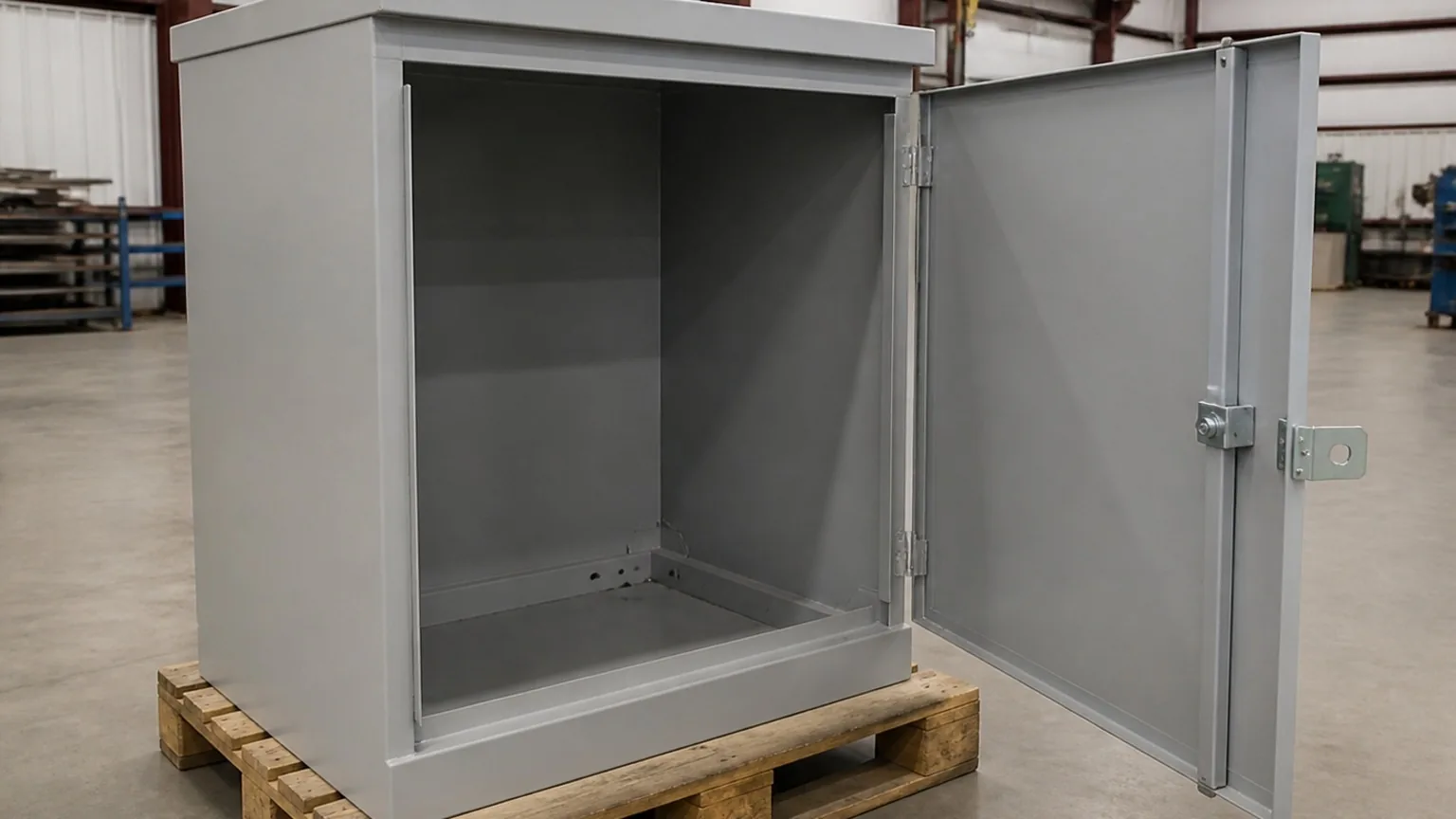
- Door and hood edges — formed returns, overlapping flanges and recessed edges that give a pry bar nothing to bite; sill and hood edges that interlock.
- Hinges — concealed or welded-pin hinges, or exterior hinges with pins that cannot be driven out; hinge leaves inside the door return.
- Latching — three-point or multi-point latching on doors, padlockable hasps dimensioned to the utility’s lock, hold-open provisions that do not defeat the latch.
- Fasteners — penta-head or equivalent security bolts, captive, on every removable panel; no exposed slotted or hex hardware on the outside.
- Interlocks — HV compartment door openable only after the LV door, by a mechanical interlock the fabricator installs to the OEM’s print.
- Gauge and stiffening — enough stiffness that panels do not deflect under the pry and impact forces; 11- and 12-gauge with formed stiffeners is typical.
The coating requirements
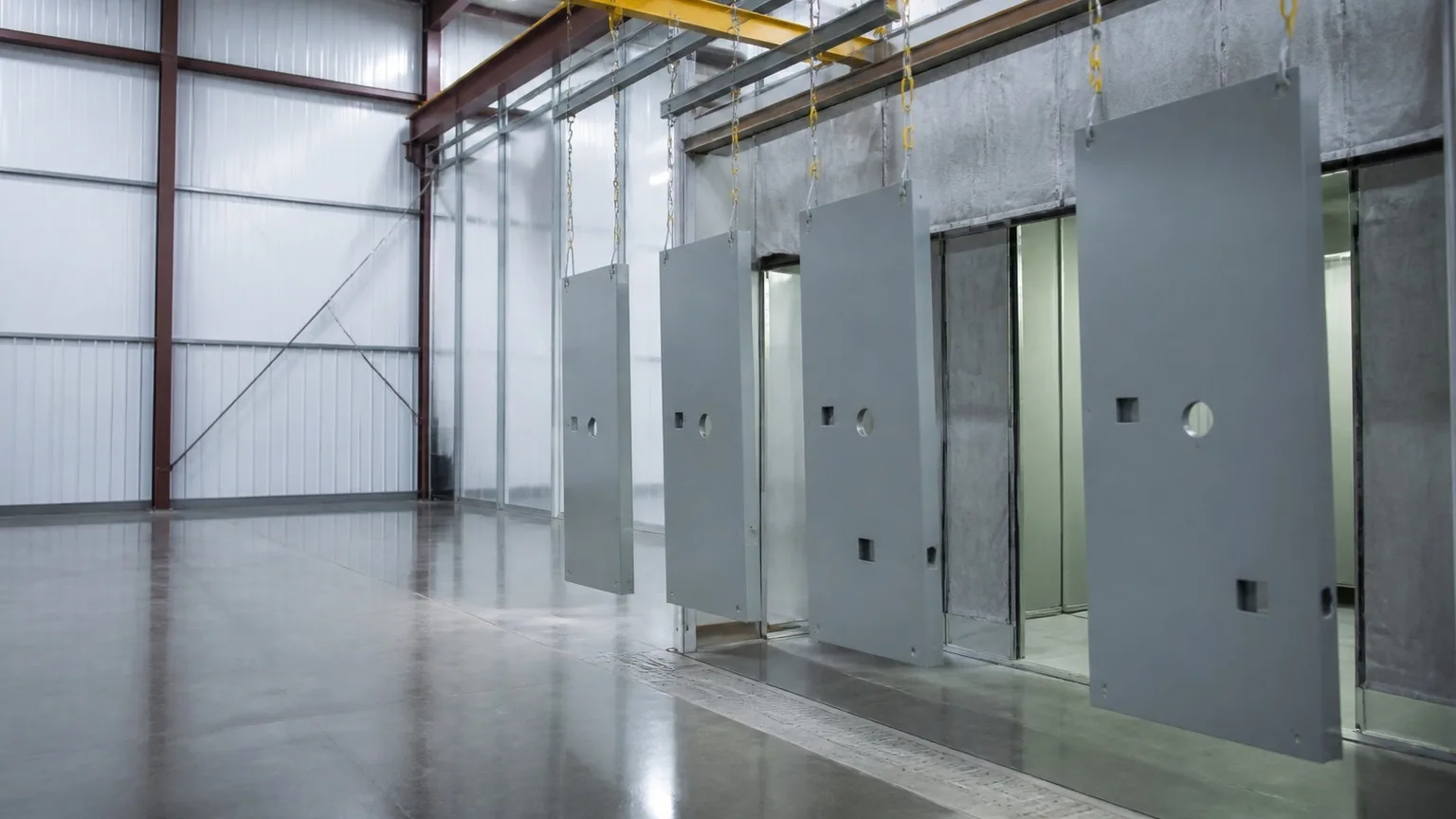
The second half of the standard is the finish. C57.12.28 specifies coating performance tests — salt spray, humidity, impact, abrasion, oil resistance, UV — and minimum durations, which is why utilities ask for salt-spray hours on pad-mount cabinets and why powder coat over proper pretreatment is the default. FabTek’s in-house powder lines carry an IEEE 2000-hour salt-spray rating; what the test means and the film thickness spec cover the details. The coating is applied inside and out, and masked only where the print requires bare metal for grounding.
C57.12.29 and coastal environments
C57.12.29 is the coastal extension: the same security requirements, with corrosion-resistant construction — stainless steel, or carbon steel with an enhanced coating system — and longer environmental test durations. Utilities on the Gulf and Atlantic coasts specify it for every pad-mounted enclosure, and it is the reason stainless pad-mount cabinets exist. The material question is covered in 304 vs. 316 stainless; the fabrication differences are AWS D1.6 welding, passivation and stainless hardware throughout.
What it means on the floor
For the fabricator, C57.12.28 shows up as a set of features on the print that cannot be simplified: every hinge, latch, bolt and edge return is there because the OEM’s enclosure passed a test with it. Substituting an exposed hinge, a standard hex bolt or a simpler edge form is not a cost saving; it is a different enclosure. The print is frozen, the hardware is the OEM’s part number, and the first article is checked against the drawing feature by feature. The same discipline applies to arc-resistant switchgear enclosures, for the same reason.
Tamper resistance is a list of things a person with a screwdriver and a pry bar cannot do. Every feature that stops them is on the print on purpose.
FabTek Industries fabricates pad-mount transformer cabinets and pad-mounted switchgear enclosures to OEM prints designed to ANSI C57.12.28 and C57.12.29 — security hardware and interlocks installed, powder-coated in-house to an IEEE 2000-hour salt-spray rating, or in 304/316 stainless — under an ISO 9001:2015 quality system with AWS-certified welding, from four production sites in Hazlehurst, Mississippi. See how we work with transformer OEMs, or send us a print.
Working on something like this? Send a print or a scope — pricing and lead time within one business day, from four Mississippi plants.
Frequently asked questions
What is ANSI C57.12.28?
The ANSI/IEEE standard for enclosure integrity of pad-mounted equipment accessible to the public. It defines security tests — pry, pull, wire-probe, impact, lifting — and coating performance requirements that a tamper-resistant pad-mounted enclosure must meet.
What hardware does C57.12.28 require?
Captive tamper-resistant fasteners (penta-head bolts by convention) on removable panels, padlockable latches, hinges that cannot be removed from outside, and door constructions that resist prying at the edges. Pad-mount transformer cabinets add a mechanical interlock so the high-voltage door opens only after the low-voltage door.
What is the difference between C57.12.28 and C57.12.29?
C57.12.29 applies the same security requirements to coastal environments and adds corrosion-resistant construction — stainless steel or an enhanced coating system — with longer environmental test durations.
Can a fabricator change hardware on a C57.12.28 enclosure to reduce cost?
Not without the OEM’s engineering approval. The hinges, latches, fasteners and edge forms are the features that passed the security tests; substituting them produces a different enclosure than the one that was tested.