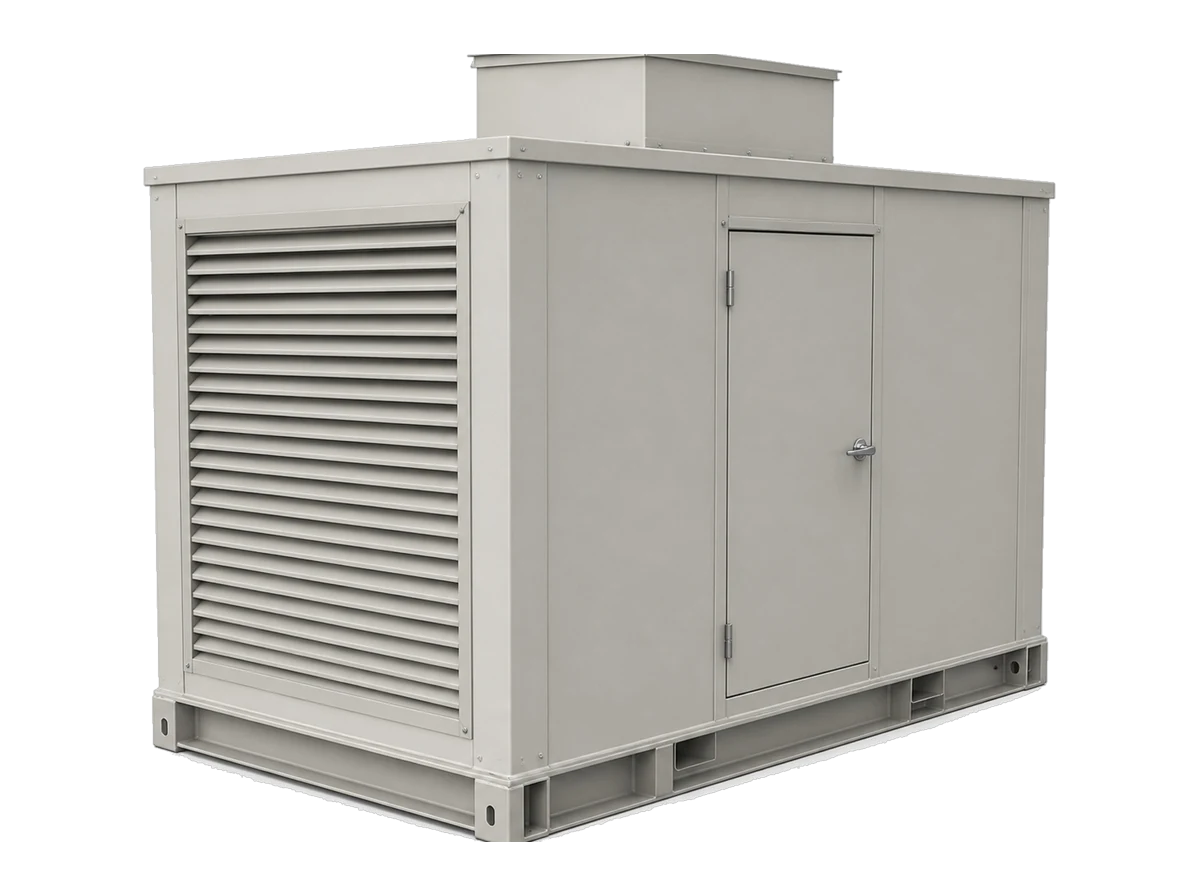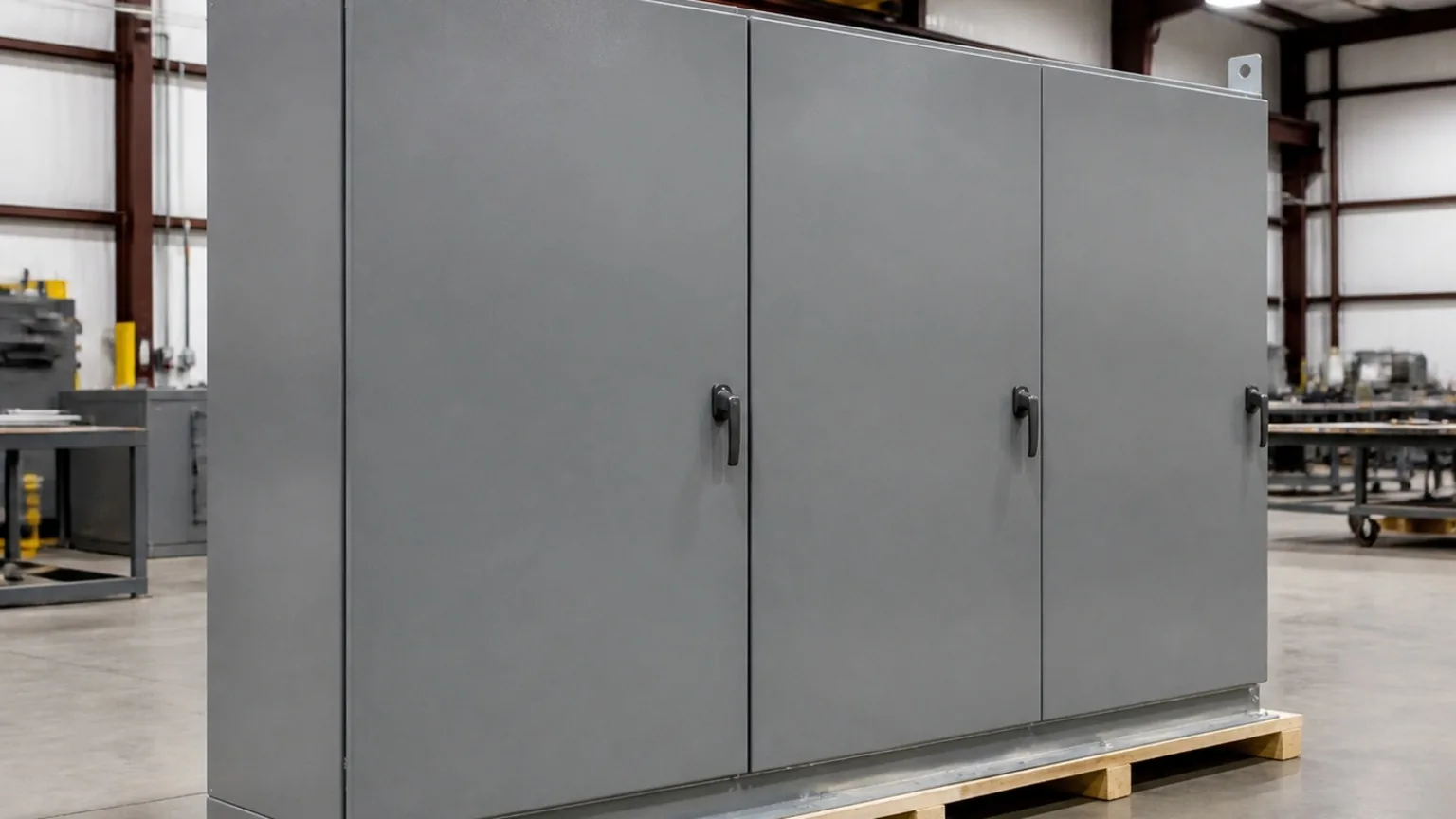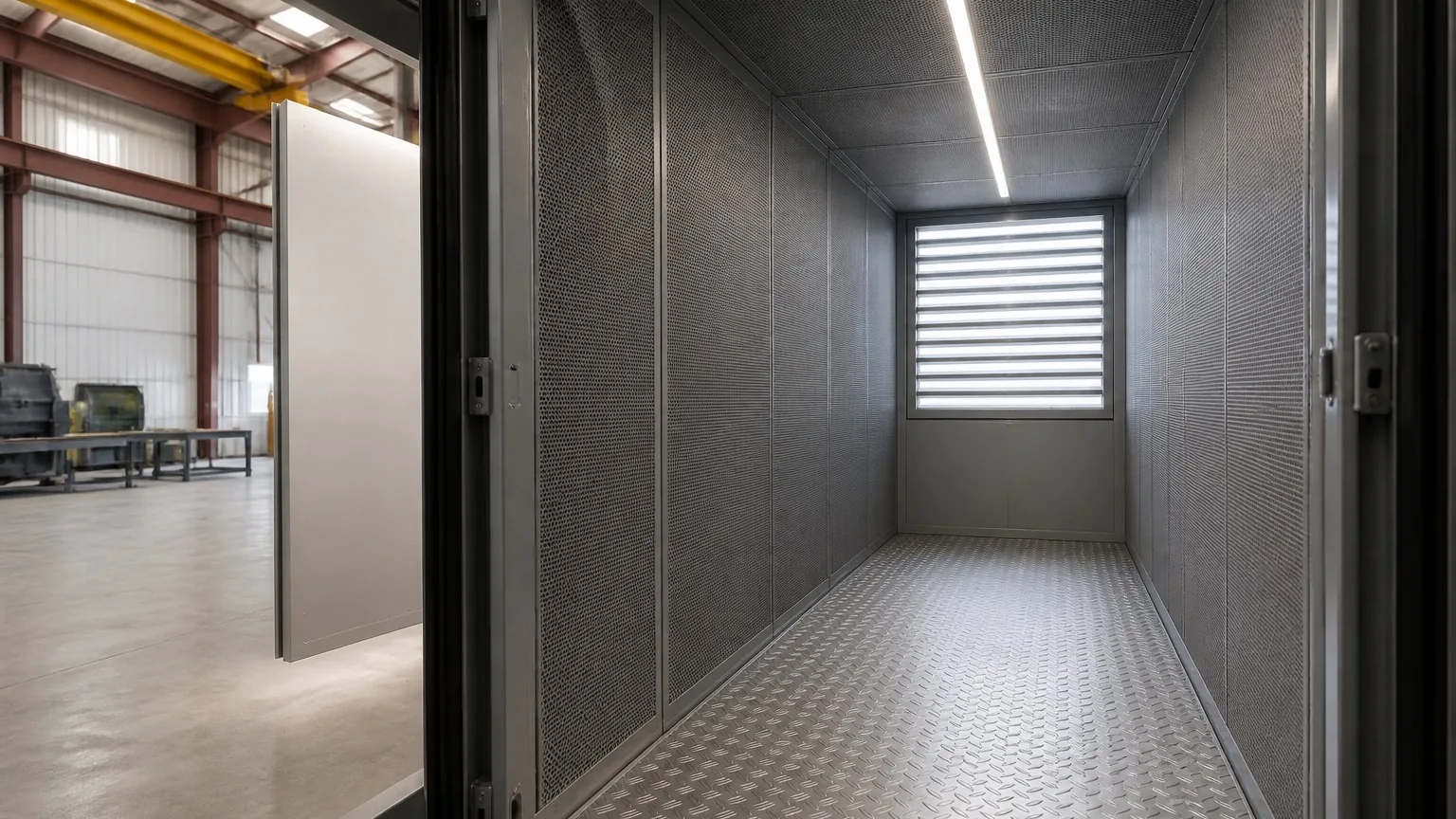
Sound-attenuated generator enclosures exist because a standby set next to a hospital, an office building or a neighborhood has to meet a noise limit at the property line. The packager designs the acoustic treatment to meet that limit; the fabricator builds the panels, hoods and seals that make the design work. The construction is more exacting than a weatherproof enclosure, and the details are where attenuation is won or lost. This spec sheet covers what the fabricator builds.
Packager sourcing sound-attenuated enclosure construction? Call 601.892.5017 or email collin.t@fabtekindustries.com — send a print and a quantity and we’ll quote it.
- Attenuation comes from mass, absorption and sealed air paths; the fabricator builds all three to the packager’s design.
- Acoustic sandwich panels — outer skin, insulation, perforated liner — are the core construction, built as repeatable sub-assemblies.
- Baffled intake and discharge hoods are where most of the attenuation and most of the fabrication complexity live.
- The packager owns the sound-level rating; the fabricator owns building exactly the tested construction.
How an enclosure attenuates sound
Engine noise leaves an enclosure three ways: through the walls, through the air openings, and through the exhaust. Walls are handled by mass and absorption — a sandwich panel with a solid outer skin, a layer of acoustic insulation, and a perforated inner liner that lets sound into the insulation. Air openings are handled by baffles — lined ducts that force the airflow through turns so the sound is absorbed on the way — on both the intake and the discharge. Exhaust is handled by a residential- or critical-grade silencer and a lined exhaust path. The packager’s acoustic engineer selects the panel construction, the baffle geometry and the silencer to hit the dB(A) at a distance; the fabricator builds them. FabTek builds sound-attenuated construction on the generator enclosure line.
Acoustic panel construction
- Outer skin — 12- to 14-gauge steel or aluminum, formed with returns that interlock with adjacent panels.
- Insulation — mineral wool or fiberglass of the density and thickness the design specifies, faced or bagged to resist oil and moisture, retained so it cannot settle.
- Inner liner — perforated steel or aluminum with the open area the design specifies, attached so the insulation stays in place under vibration.
- Framing — formed or structural members between panels, with thermal and acoustic breaks where the design calls for them.
- Joints — panel-to-panel joints sealed with gasket or acoustic sealant; a gap is a leak.
Panels are built as repeatable sub-assemblies on fixtures so every wall of every enclosure in a model matches the one that was tested.
Baffled intake and discharge hoods
The hoods are large sheet-metal assemblies — often as big as the enclosure end — containing lined splitter baffles that the air passes between. The baffle count, spacing, length and lining are set by the acoustic design against the airflow the engine needs; a baffle that is too restrictive starves the radiator, one that is too open leaks noise. The fabricator builds the hood structure, the baffle splitters with their perforated faces and insulation, the rain and weather protection, and the mounting to the enclosure, and holds the baffle spacing so free area matches the design. Discharge hoods carry the radiator duct adapter and are the heaviest single fabrication on the enclosure.
Doors, seals and penetrations
Every opening that is not a designed air path is a leak to be sealed: doors get continuous compression gaskets and multi-point latches that pull them tight; removable panels get gaskets and captive hardware; cable and exhaust penetrations get sealed thimbles and boots; the sill-to-base joint gets a continuous seal. Door design matters more here than on a weatherproof enclosure because a door that does not pull up tight to its gasket defeats the wall beside it. Hardware and gasketing covers the components.
What the packager designs, what the fabricator builds
The packager’s acoustic engineer owns the target sound level, the panel construction, the baffle geometry, the silencer selection and the test that proves the enclosure meets its rating. The fabricator owns building the panels, hoods, seals and structure exactly to the tested design, with the same no-substitution discipline described for arc-resistant switchgear: a different insulation density, a thinner liner or a smaller baffle changes the rating. The print has to carry panel layer specifications, baffle details, seal types and locations, and which dimensions are inspection points. The overall enclosure program follows the generator enclosure sourcing guide.
Attenuation is a list of gaps that are not there. The construction either closes all of them or it closes none of them that matter.
FabTek Industries fabricates sound-attenuated generator enclosures to the packager’s acoustic design — fixture-built acoustic sandwich panels, baffled intake and discharge hoods, sealed doors and penetrations, silencer supports — powder-coated in-house, under an ISO 9001:2015 quality system with AWS-certified welding, from four production sites in Hazlehurst, Mississippi. See how we work with electrical OEMs, or send us a print.
Working on something like this? Send a print or a scope — pricing and lead time within one business day, from four Mississippi plants.
Frequently asked questions
How does a sound-attenuated generator enclosure reduce noise?
Through mass and absorption in acoustic sandwich walls — a solid outer skin, insulation and a perforated inner liner — baffled intake and discharge hoods that absorb sound along the air path, a silencer on the exhaust, and sealed doors and penetrations that eliminate leaks.
Who is responsible for the sound-level rating of the enclosure?
The genset packager or OEM, whose acoustic engineer designs the panel construction, baffle geometry and silencer and tests the enclosure. The contract fabricator builds that design exactly and does not certify the rating.
What is an acoustic sandwich panel?
A wall or roof panel made of a formed outer skin, a layer of acoustic insulation of specified density and thickness retained so it cannot settle, and a perforated inner liner with a specified open area, assembled on a fixture so every panel matches the tested construction.
Why do doors matter so much on a sound-attenuated enclosure?
A door that does not pull tight to a continuous gasket is a leak that defeats the attenuation of the wall beside it. Compression gaskets, multi-point latches and sealed penetrations are part of the acoustic design.