New plants, re-tooled lines and automation upgrades all end in a row of control panel enclosures: one per machine, one per line, one per process cell. Machine builders ship them with every machine; system integrators build them for every project; plants replace them when the gear inside is upgraded. Most start as catalog boxes and many graduate to custom enclosures when the size, cutouts or volume justify it. This guide covers how industrial control enclosures are specified and when a custom program pays.
Machine builder or integrator sourcing control panel enclosures? Call 601.892.5017 or email collin.t@fabtekindustries.com — send a print and a quantity and we’ll quote it.
- Industrial control enclosures are NEMA 12 indoors, 4 or 4X where washed or outdoors, in wall-mount, free-standing and modular configurations.
- Depth and sub-panel size are set by the drives, PLC and wire duct inside — specify from the panel layout.
- Pre-cut cutouts for HMIs, disconnects, pushbuttons and cooling units are where a custom enclosure saves the panel shop hours.
- A custom program pays when volume, size, cutouts or appearance exceed what a catalog box offers.
Types and configurations
| NEMA 12 | Dust-tight, drip-tight indoor industrial enclosure with oil-resistant gasket and no knockouts; the default for machine and line panels |
|---|---|
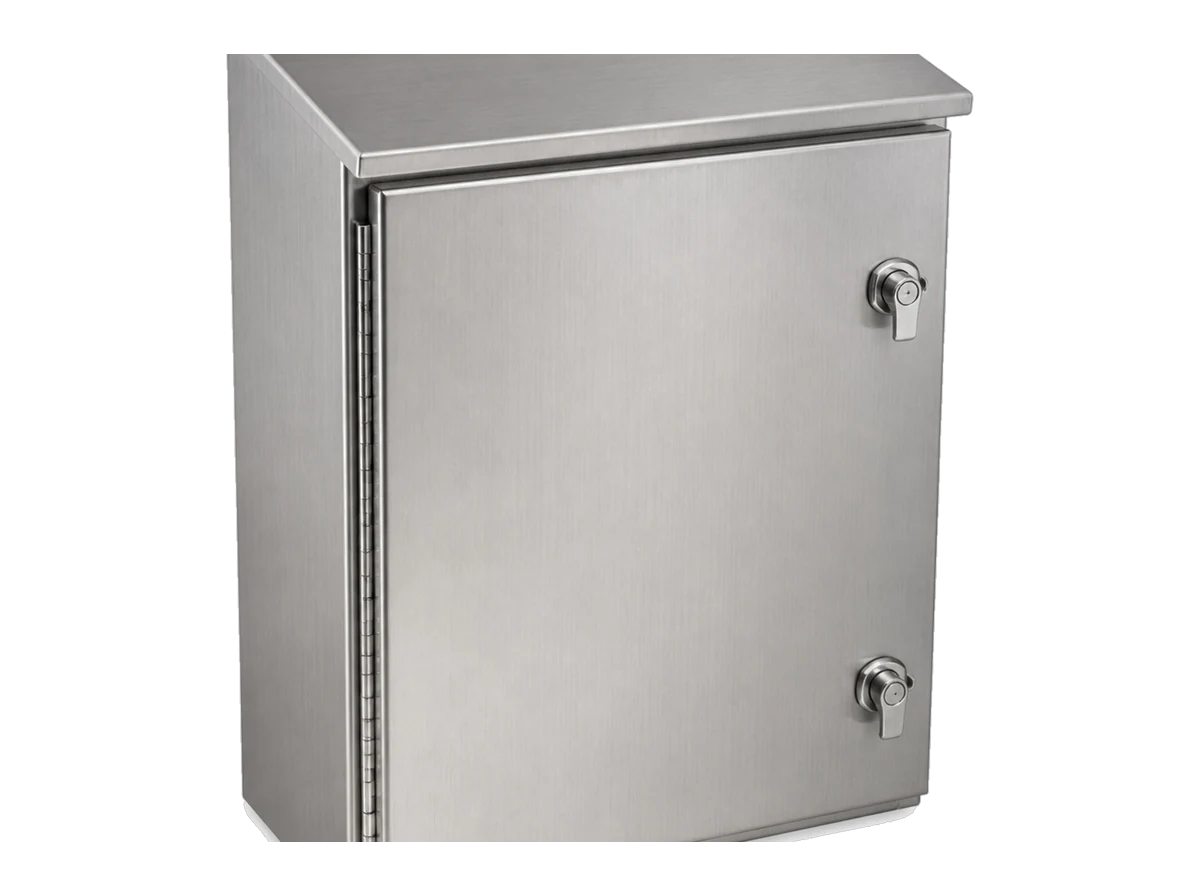
| NEMA 4 / 4X | Hose-tight; 4X corrosion-resistant in stainless for washdown, outdoor and chemical areas; see washdown enclosures |
| Wall-mount | Single-door boxes to roughly 60 by 36 inches with a sub-panel; the machine-side standard |
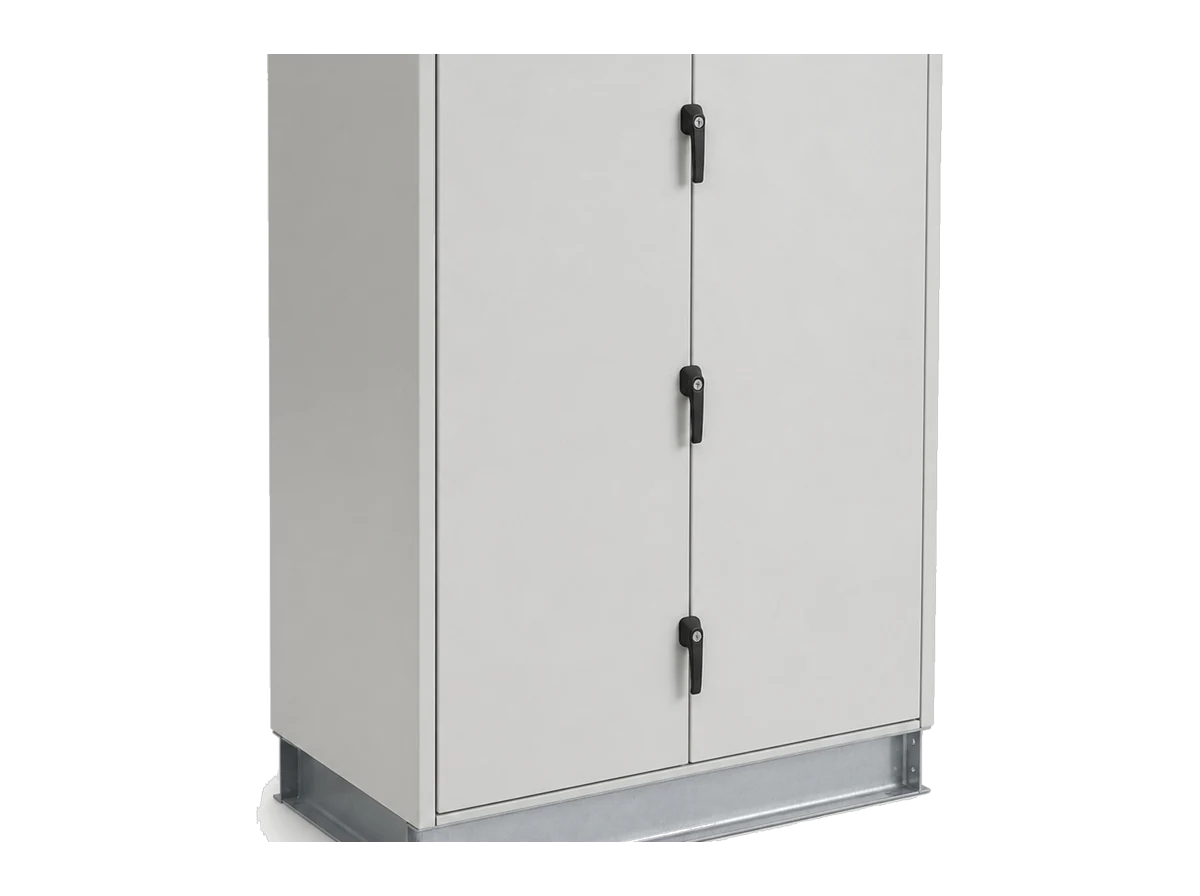
| Free-standing | Single-, double- and multi-door floor-standing cabinets on a base or legs for line and cell panels |
| Modular and bayed | Multiple free-standing sections joined on a common base with barriers removed between bays; MCC-like line-ups for large cells |
| Consoles and pedestals | Operator stations, HMI pedestals and pushbutton stations; see consoles and pedestals |
FabTek builds all of these as control cabinets and NEMA 4X enclosures to print.
Depth, sub-panel and layout
The panel designer lays out the sub-panel — drives, PLC, power supplies, terminal blocks, wire duct — and the enclosure follows: sub-panel size plus clearance to the walls, depth to clear the deepest component and the door-mounted devices, and room for the cooling unit’s intrusion. Drives are the usual depth driver; HMIs and disconnect handles are the usual door drivers. Specify the sub-panel size and mounting studs, the interior depth, the door-mounted device envelope and the heat load, and the fabricator sizes the enclosure or confirms the one on the drawing. Ventilation, fans, filters or an air conditioner follow the heat load; the fabricated side is covered in thermal provisions.
Cutouts, disconnects and hardware
- Device cutouts — HMI, pushbuttons, pilot lights, meters, switches, to manufacturer templates, laser-cut in the flat so the door stays flat.
- Disconnect — flange-mounted or door-mounted disconnect handle with the interlock the panel’s listing requires; cutout and mounting to the switch manufacturer’s template.
- Cooling — air conditioner, heat exchanger or fan-and-filter cutouts with reinforcement for the unit’s weight.
- Entries — gland plates or conduit plates sized to the cable schedule; no knockouts on 12 or 4X.
- Hardware — quarter-turn or three-point latches, lift-off hinges for panel work, door stops, print pockets, interior lights; see hardware spec.
- Finish — powder coat in the OEM’s color, often with a logo or nameplate provision; stainless #4 for 4X.
Catalog box or custom?
Catalog enclosures are right for one-offs and standard sizes. A custom enclosure is right when the panel needs a size or depth the catalog lacks; when the panel shop is spending hours cutting holes in catalog doors; when a machine builder ships the same panel every week and wants a kitted enclosure with cutouts and hardware at a lower installed cost; when the plant standard requires a material, gauge or rating the catalog does not offer; or when the enclosure is part of the machine’s appearance. The decision and the relationship with the panel shop are described in UL 508A panel shops vs. enclosure fabricators.
Running a custom enclosure program
A machine builder or integrator with repeat panels standardizes a few enclosure families — a wall-mount with the HMI and disconnect cutouts, a free-standing cell cabinet, a console — and the fabricator holds the drawings, stages material and ships kitted enclosures against a forecast. Lead time per release drops to days, the panel shop’s labor goes to wiring, and the enclosure arrives with the hardware already installed. The mechanics are those in running an OEM–fabricator program and lead times and capacity. Reshored and expanded plants are the current driver of this demand; the broader picture is in reshoring plant fit-out.
A panel shop’s technicians should wire. Every hole they cut in a catalog door is a reason the enclosure should have come with the hole in it.
FabTek Industries fabricates industrial control panel enclosures — NEMA 12 and 4/4X, wall-mount, free-standing and modular — to machine builder and integrator prints, with device, disconnect and cooling cutouts pre-cut, sub-panels and hardware installed, powder-coated in-house or in stainless, in programs against a forecast, under an ISO 9001:2015 quality system, from four production sites in Hazlehurst, Mississippi. See control cabinets, industrial processing, or send us a panel layout.
Working on something like this? Send a print or a scope — pricing and lead time within one business day, from four Mississippi plants.
Frequently asked questions
What NEMA type is used for industrial control panels?
NEMA 12 — dust-tight, drip-tight, oil-resistant gasket, no knockouts — is the indoor industrial default for machine and line panels. NEMA 4 or 4X is used where panels are washed down, outdoors or in corrosive areas, with 4X in stainless steel.
How is the size of a control panel enclosure determined?
From the panel layout: the sub-panel size plus wall clearance sets the height and width, the deepest component plus door-mounted devices and the cooling unit’s intrusion sets the depth, and the heat load sets the ventilation or cooling cutout.
When does a custom control enclosure make sense over a catalog box?
When the size or depth is not in the catalog, when the panel shop spends hours cutting holes in catalog doors, when repeat volume makes a kitted enclosure with cutouts and hardware cheaper installed, when the plant standard requires a material or rating the catalog lacks, or when appearance matters.
What does a custom enclosure program look like for a machine builder?
A few standardized enclosure families with drawings held by the fabricator, material staged against a forecast, and kitted enclosures with cutouts and hardware shipped against releases in days, so the panel shop’s labor goes to wiring.