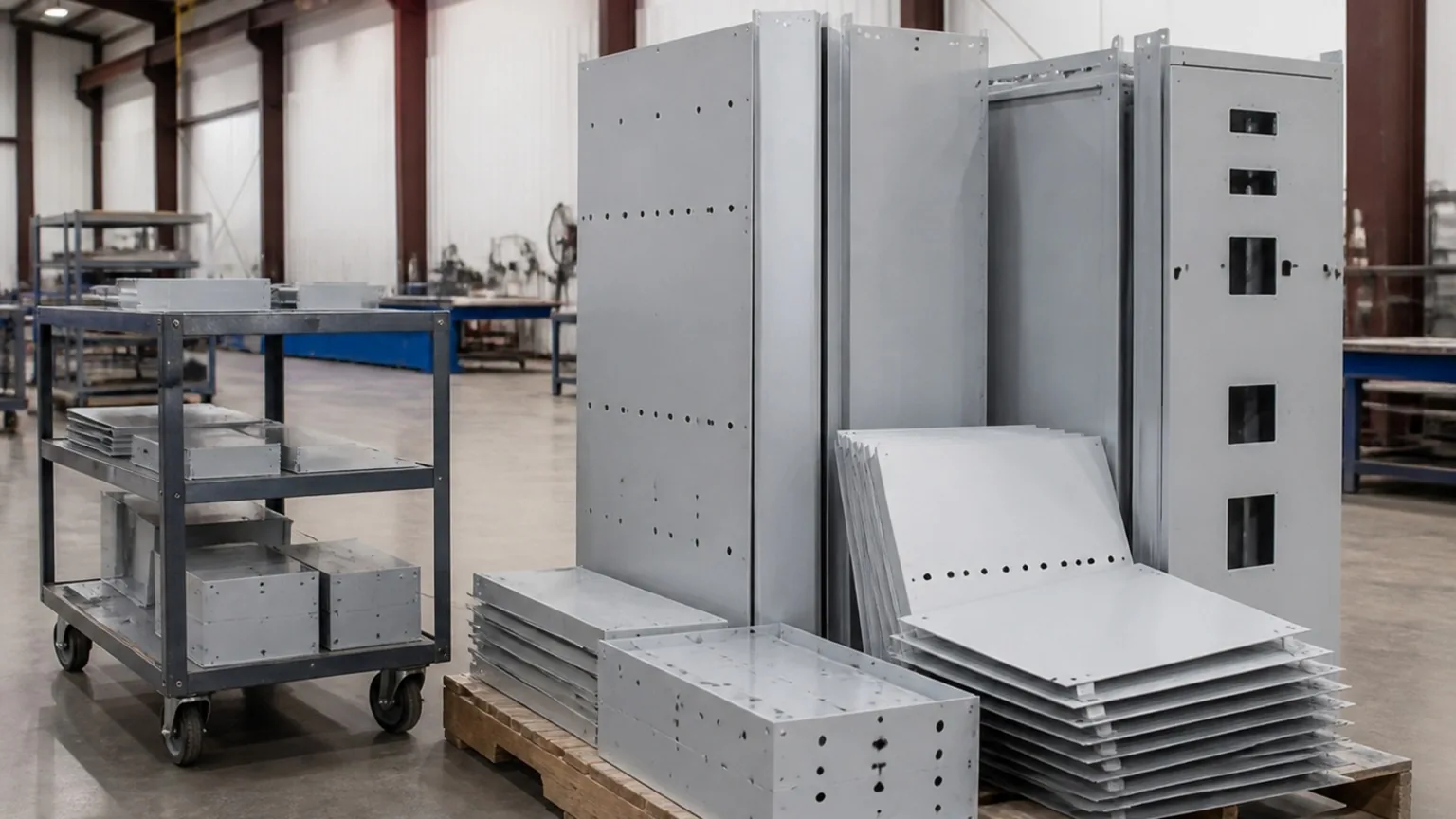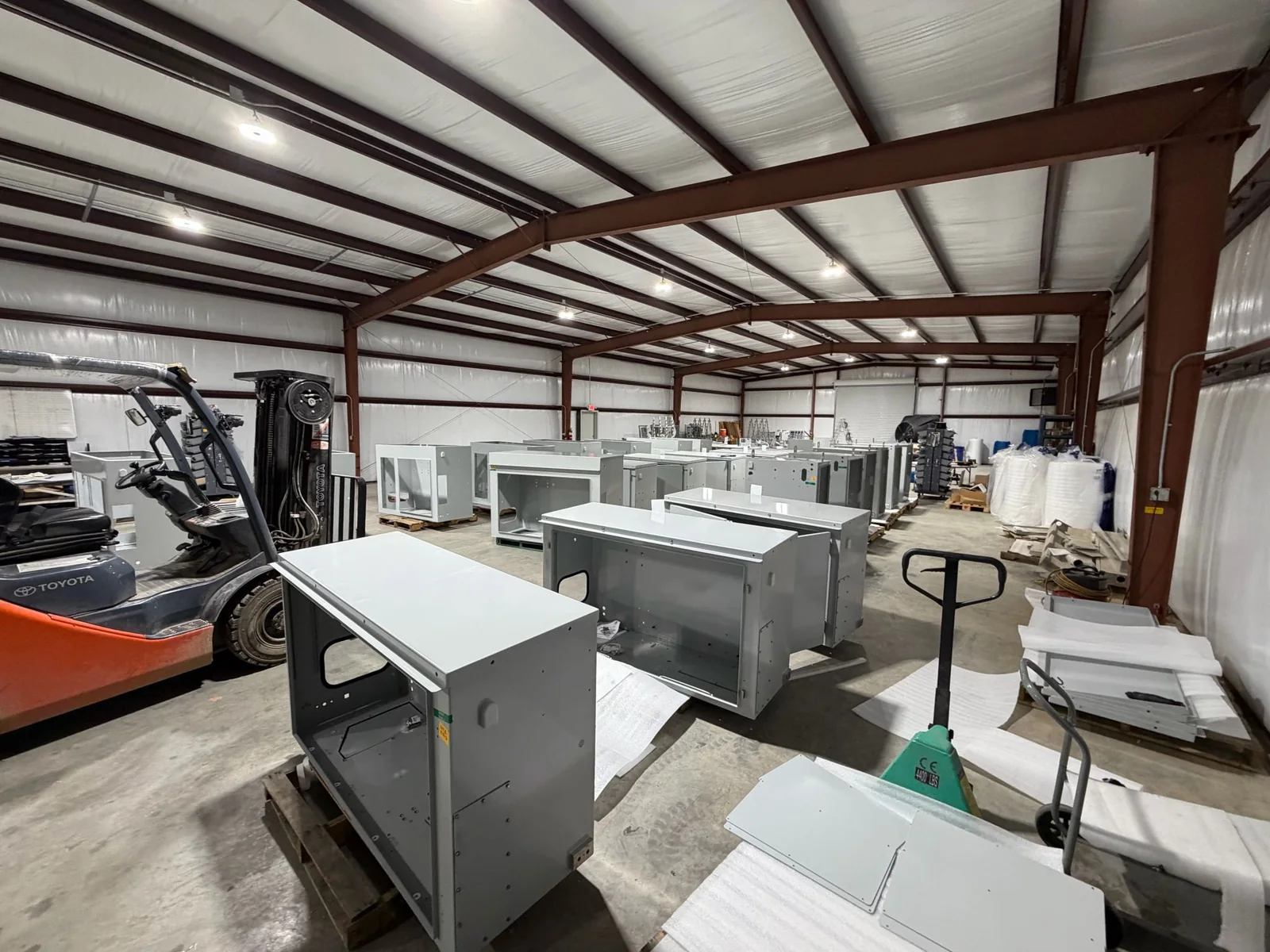
Dry-type transformers are everywhere a liquid-filled unit is not wanted: inside buildings, on mezzanines, in electrical rooms, in unit substations and increasingly at sites where fire and environmental rules push liquid units outdoors. Each one lives in a ventilated enclosure that is its own sheet-metal product, built in families by the OEM’s print. This guide covers how those enclosures are specified and sourced.
Dry-type transformer OEM sourcing ventilated enclosures? Call 601.892.5017 or email collin.t@fabtekindustries.com — send a print and a quantity and we’ll quote it.
- Dry-type enclosures are ventilated housings: the louver area and airflow path are the design, and the sheet metal exists to create them.
- Indoor units are NEMA 1 or 2; outdoor units are NEMA 3R with weather hoods over the louvers and drip-shielded covers.
- The enclosure carries the core-and-coil mounting, vibration isolation and terminal compartment; the OEM’s print sets all three.
- OEMs buy them in families by kVA and voltage class, as kits or assembled, on a forecast.
What the enclosure does
A dry-type transformer cools itself by convection: air enters low, passes over the core and coils and exits high. The enclosure’s job is to make that path work while keeping fingers, tools and falling objects out and, outdoors, keeping rain out. So the enclosure is defined by its ventilation openings — louvers or screened openings sized to the OEM’s thermal design — its interior clearances to the coils, the mounting of the core-and-coil assembly on the base, and the terminal compartment where the installer lands cables. FabTek fabricates these as part of its transformer cabinets and enclosures line, alongside coil assemblies for OEMs that outsource windings.
NEMA 1, 2 and 3R constructions
| NEMA 1 (indoor) | Ventilated housing with louvers or screened openings, removable panels, no weather protection; the standard indoor distribution dry-type enclosure |
|---|---|
| NEMA 2 (indoor, drip-proof) | NEMA 1 plus drip shields over openings for locations with dripping water or condensation |
| NEMA 3R (outdoor) | Weather hoods over louvers, drip-shielded and gasketed covers, sloped top, drained base; louver free area maintained under the hoods |
| Totally enclosed, non-ventilated | Sealed housing for dusty or corrosive locations; the transformer is derated or designed for it; often NEMA 12 or 4X construction |
The ratings are explained in NEMA 3R vs. 4 vs. 4X and the transformer-specific spec in how to spec a NEMA-rated transformer enclosure.
Louvers and airflow
The OEM’s thermal design sets the required free area for inlet and outlet, the height difference between them and the maximum pressure drop. The fabricator produces that free area with formed louvers punched and formed in the panel, stamped louver inserts, or expanded-metal or perforated screens behind an opening, to the OEM’s pattern. Outdoor units add weather hoods that shield the openings without reducing free area below the design value — a hood that is too tight is a transformer that runs hot. The panels are laser-cut and formed on the panel folder and press brakes; the louver geometry is the print’s, and a first article is checked for free area, not just dimension.
Core mounting, vibration and terminal compartments
- Base and core mounting — a formed or structural base with the OEM’s core-clamp bolt pattern, lifting provisions and forklift pockets where the size warrants them.
- Vibration isolation — provisions for the OEM’s isolation pads or mounts between the core and the base, which also reduce transmitted sound.
- Terminal compartment — a separate compartment or panel area with cable entry knockouts or gland plates, terminal board mounting and a removable cover; on larger units a side-mounted cable box, covered in transformer cable boxes.
- Ground — ground pad or lug provision bonded to the base.
- Nameplate and labels — mounting for the OEM’s nameplate and the warning labels the listing requires.
Sound and the enclosure
Dry-type transformers hum, and the enclosure can make it better or worse. Panels that resonate at the transformer’s frequency amplify the sound; stiffening ribs, panel damping and isolation between the core and the enclosure reduce it. Where a sound-level specification applies, the OEM’s design specifies the stiffener pattern and damping, and the fabricator builds it. Sound is an OEM design responsibility; what the fabricator controls is building the stiffeners and isolation provisions exactly as drawn.
How OEMs source them
Dry-type enclosures are bought in families: a given kVA range and voltage class shares a frame and panel set, with variants for NEMA 1, 2 and 3R and for terminal compartment options. OEMs buy them as kits for assembly on their own line or assembled and finished, in both cases on a forecast with material staged. The powder coat is the OEM’s standard color, usually ANSI 61 gray, applied in-house. The program mechanics are those in why transformer OEMs outsource and running an OEM–fabricator program.
A dry-type enclosure is an air path with a finish on it. If the louvers are right and the hoods are right, the transformer runs at the temperature the OEM designed.
FabTek Industries fabricates ventilated dry-type transformer enclosures — NEMA 1, 2 and 3R housings, louvered and hooded panels, bases with core mounting, terminal compartments and cable boxes — to OEM prints in families, as kits or assembled, powder-coated in-house, under an ISO 9001:2015 quality system, from four production sites in Hazlehurst, Mississippi. See transformer cabinets and enclosures, how we work with transformer OEMs, or send us a print.
Working on something like this? Send a print or a scope — pricing and lead time within one business day, from four Mississippi plants.
Frequently asked questions
What NEMA type is a dry-type transformer enclosure?
Indoor dry-type transformers use ventilated NEMA 1 enclosures, or NEMA 2 where drip protection is needed. Outdoor units use NEMA 3R enclosures with weather hoods over the ventilation openings and drip-shielded covers. Dusty or corrosive locations use totally enclosed non-ventilated designs.
Why does louver free area matter on a dry-type enclosure?
The transformer cools by convection through the louvers. The OEM’s thermal design sets the inlet and outlet free area; if the fabricated louvers or weather hoods reduce it, the transformer runs hotter than designed.
What does the fabricator provide on a dry-type transformer enclosure?
The ventilated panels, frame and base with the core-clamp bolt pattern and lifting provisions, vibration isolation mounts, the terminal compartment or cable box, ground provisions, nameplate mounting and the finish, all to the OEM’s print.
How are dry-type transformer enclosures bought?
In families by kVA range and voltage class sharing a frame and panel set, as kits for OEM assembly or as assembled and finished units, on a forecast with material staged at the fabricator.