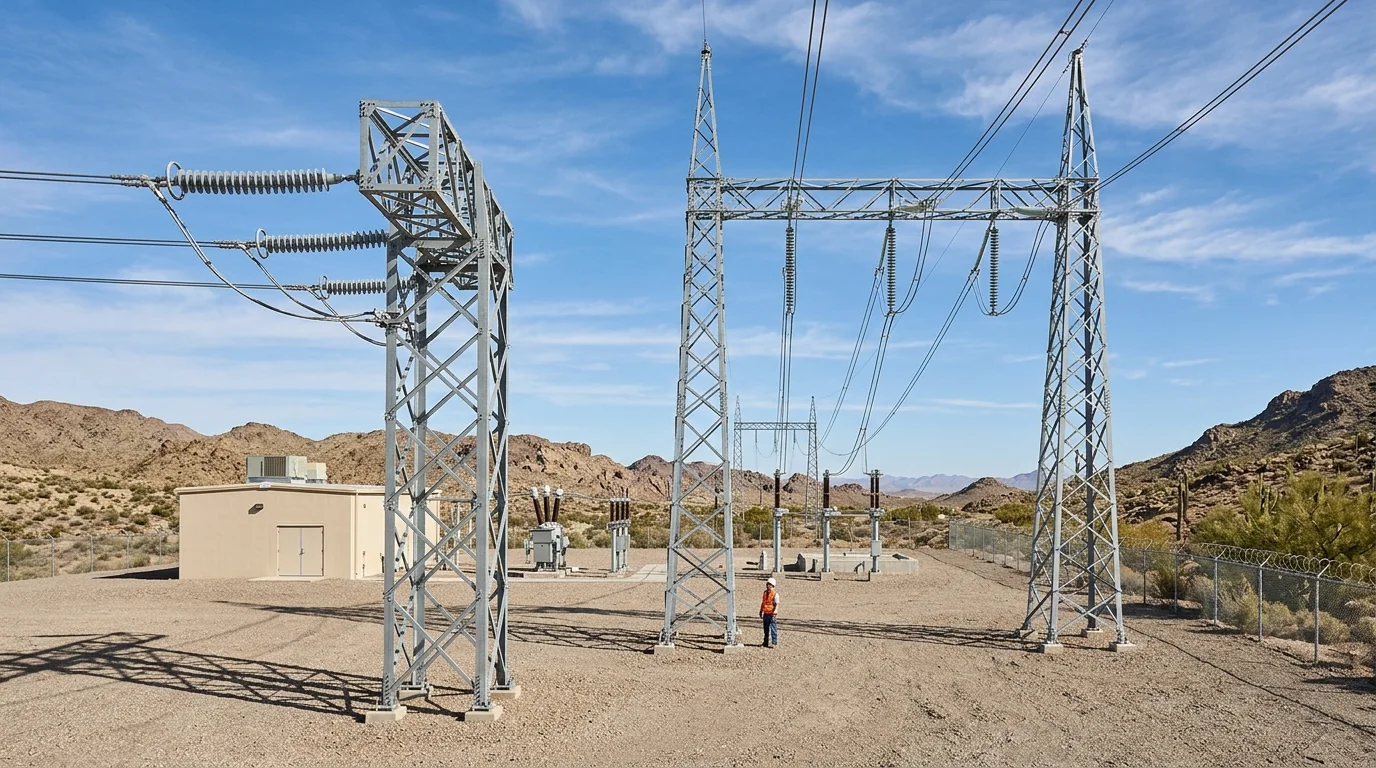
A substation looks like a fenced maze of steel and wires, but its job is simple to state: change voltage and route power. Here's what's happening inside that yard, and why it's one of the most equipment-dense places on the entire grid.
- A substation does two core jobs: change voltage (with transformers) and switch and protect circuits.
- It's the interchange between transmission and distribution — where bulk power is handed down to local feeders.
- The yard is organized around dead-end structures, A-frames, bus supports, and equipment stands.
- Nearly everything in the yard is bolted to fabricated, galvanized steel built to last decades outdoors.
What a substation is for
If the grid is a highway system, substations are the interchanges — the places where power moves between the high-voltage "interstates" and the lower-voltage "local roads," and where it can be routed, measured, and switched. Every substation exists to do some combination of two things: change the voltage of the power passing through it, and control which circuits are connected to which.
A transmission substation ties big high-voltage lines together and steps voltage down to a subtransmission level. A distribution substation steps it down further and splits it onto the feeders that serve a town or neighborhood. Large industrial customers and data centers often have their own dedicated substations for exactly the same reasons.
The main types of substation
Not every substation does the same job. A transmission substation ties together several high-voltage lines and steps voltage down to a subtransmission level; these are the big yards near generating regions and load centers. A distribution substation takes subtransmission power, steps it down again, and splits it onto the feeders that serve a town or district — this is the type most people live near. A switching station changes no voltage at all; it exists purely to connect, disconnect, and reroute circuits. And collector substations gather the output of wind or solar farms and hand it up to the transmission grid.
They differ in size and voltage, but the underlying toolkit is the same everywhere: transformers to change voltage, breakers and switches to control circuits, a bus to tie it together, and steel to hold all of it in place.
Changing voltage: the transformer at the center
The single most important machine in a substation is the power transformer, and much of the yard is arranged around it. It's the piece that actually raises or lowers the voltage; everything else — the switches, the protection, the bus — exists to feed it, protect it, and route its output. Because these transformers are so large, so expensive, and so hard to replace on short notice, the rest of the substation is built to protect them.
A substation's transformer rarely works alone. It's paired with cooling, monitoring, and its own dedicated protection, and it's often one of several so the station can keep operating if a unit is taken out of service. That redundancy is a big reason a substation yard holds so much equipment for what sounds, on paper, like a single job.
Switching and protection: routing power safely
The other half of a substation's job is control. Disconnect switches let crews physically isolate equipment for maintenance. Circuit breakers interrupt current automatically when protective relays detect a fault, the same reflex that prevents a small problem from becoming a large outage. The bus — a set of heavy conductors — is the common junction that ties incoming and outgoing circuits together, and it's held up by insulators mounted on steel bus supports.
Put together, this equipment lets operators reroute power around problems, take equipment out of service safely, and clear faults before they spread — all from a single fenced yard.
The steel that holds a substation together
Before a substation carries a single volt, it's an assembly of steel. The families of structure each do a specific job:
- Dead-end structures anchor the tension of incoming transmission lines — heavy members engineered for high horizontal pull.
- A-frame structures carry the bus, switches, and equipment within the yard, lighter but alignment-critical.
- Bus supports hold the conductors and insulators that tie the circuits together.
- Equipment stands position transformers, breakers, and switches at the right height and spacing.
Because this steel lives outdoors for decades, it's almost always hot-dip galvanized for corrosion protection. We covered the specifics in a buyer's guide to substation steel. FabTek fabricates substation and support structures domestically and coordinates finish as part of the build, shipping a complete package to the yard. If you have a drawing set, send it over.