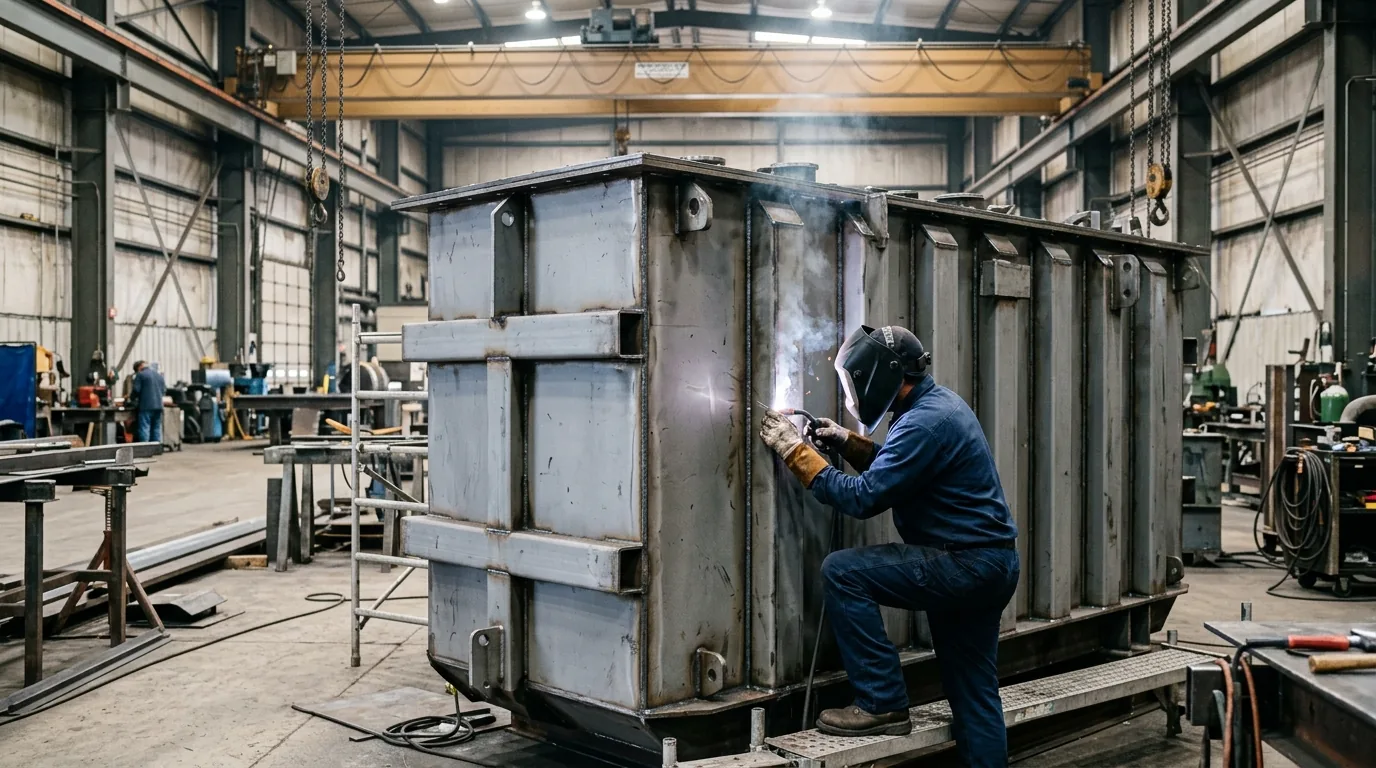
Welded or bolted? It's one of the first decisions on a transformer tank, and it ripples through sealing, lead time, repair, and cost. Here's how to weigh the trade-offs for your application.
- Welded tanks give the most reliable long-term seal; bolted tanks trade some sealing for serviceability.
- Bolted designs are easier to open for field repair and internal access; welded designs are sealed for life.
- Welding can shorten fabrication on simpler geometries; complex bolted designs add gasket and hardware steps.
- Match the choice to the duty cycle and service expectations, not habit.
How each approach seals
A welded transformer tank uses continuous seam welds for a permanent, gasket-free seal — the most reliable barrier against leaks over a long service life. A bolted tank seals across gasketed flanges, which is robust but introduces more potential leak paths and depends on gasket condition over time. For sealed-for-life units, welded is the default; where access matters, bolted earns its place.
Lead time and fabrication
On simpler geometries, welding can be the faster path — fewer machined flanges, gaskets, and fasteners to source and fit. Complex bolted designs add hardware and sealing steps. Either way, lead time tracks with how the shop runs fabrication and welding in-house versus juggling outsourced steps.
The seam you weld is the seam you never reopen. That's a feature for some tanks and a constraint for others.
Field service and repairability
This is where bolted designs shine: a bolted tank can be opened in the field for internal access, repair, or component replacement without cutting and re-welding. A welded tank is sealed for life — excellent for reliability, less forgiving if you anticipate field intervention.
Where the cost lands
Welded construction often carries lower hardware cost but demands certified welding and inspection. Bolted construction adds machined flanges, gaskets, and fasteners. The right comparison is total cost over the asset's life — including the cost (or impossibility) of field repair — not just the fabricated price.
Choosing for your application
- Sealed-for-life reliability is the priority → lean welded.
- Field access and repairability matter → consider bolted.
- Confirm AWS-certified welding and inspection records either way.
- Evaluate total cost over the service life, not just fabricated price.
FabTek fabricates transformer tanks in-house under an ISO 9001:2015 system, welded to spec with documented inspection. For transformer OEMs and utilities, send a drawing and we'll talk through the trade-offs.
Frequently asked questions
Are welded transformer tanks better than bolted?
Welded tanks give the most reliable long-term seal and are ideal for sealed-for-life units. Bolted tanks trade some sealing margin for field serviceability, so the better choice depends on your service expectations.
Can a bolted transformer tank be repaired in the field?
Yes — a bolted tank can be opened for internal access and repair without cutting and re-welding, which is its main advantage over a welded design.
Which has a shorter lead time, welded or bolted?
On simpler geometries, welded construction is often faster because there are fewer machined flanges, gaskets, and fasteners to source and fit.
What standards govern transformer tank fabrication?
Welds should be AWS-certified with documented inspection, produced under an ISO 9001:2015 quality system with full material traceability.