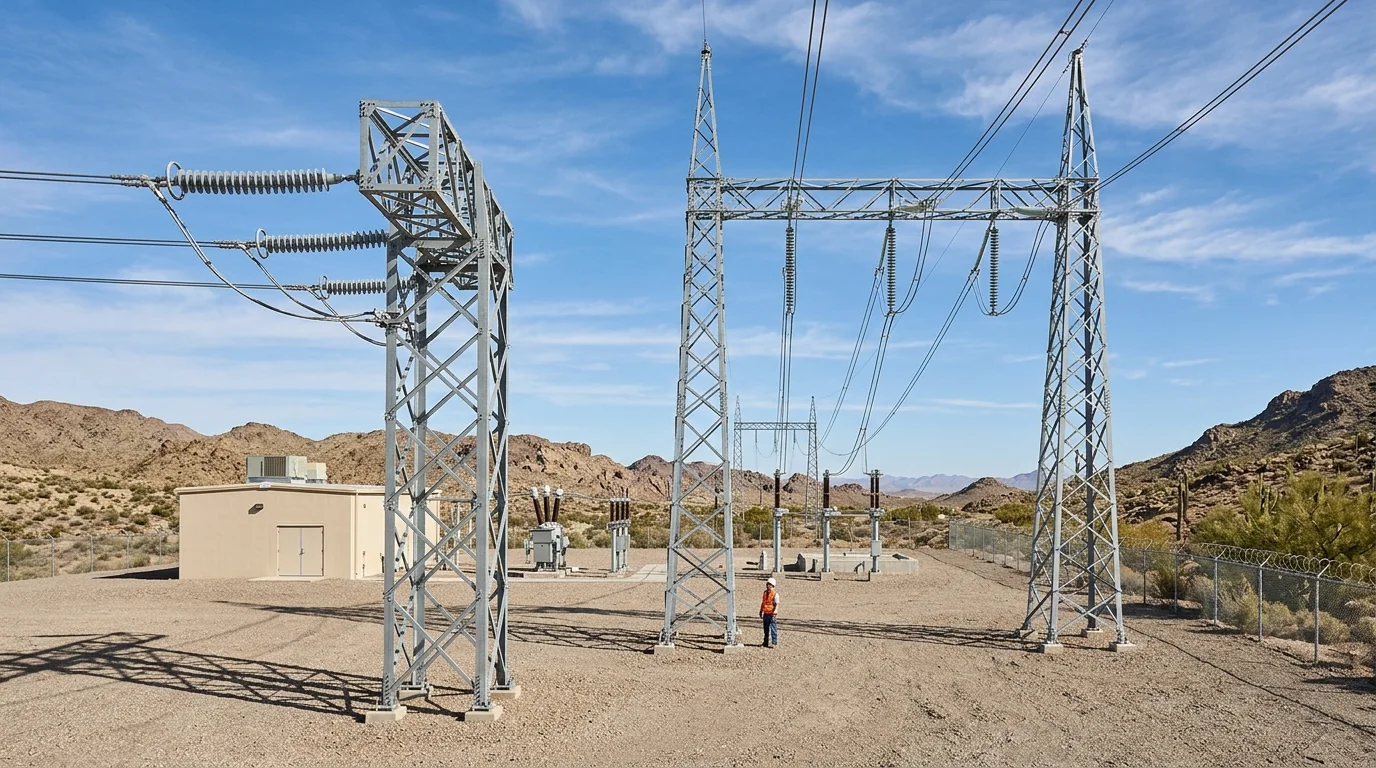
If you're speccing a substation, the support structures are where schedule and cost quietly compound. Here's how to think through dead-end versus A-frame structures, galvanizing, and what to confirm before you award the package.
- Dead-end structures anchor incoming line tension; A-frames carry bus and equipment inside the yard.
- Specify hot-dip galvanizing (ASTM A123) and coordinate it with fabrication — the handoff is where schedules slip.
- Single-source fabrication removes vendor handoffs that routinely add weeks to a substation package.
- Confirm AWS-certified welding and ISO 9001 documentation up front; it protects the multi-decade life of the asset.
What substation support structures actually do
A substation is held together by steel long before it carries a single volt. Substation support structures position and restrain the energized equipment — disconnect switches, bus, insulators, and the incoming line — and they have to hold alignment and tension for the multi-decade life of the yard. Get the steel wrong and everything downstream, from clearances to commissioning, inherits the problem.
For utilities and EPC contractors, the structures fall into a few families: dead-end (anchor) structures, A-frames, bus supports, and equipment stands. The two that drive most of the spec decisions are dead-ends and A-frames.
Dead-end vs. A-frame: when to use which
The short version: dead-end structures take the pull of the transmission line entering the yard; A-frames carry the bus and equipment within it. They're engineered to very different load cases, and conflating them is a common source of rework.
Anchor the tension of incoming transmission conductors. Heavy, deep-foundation members designed for high horizontal pull. Tolerances here protect line sag and clearances across the whole yard.
Carry bus, switches, and equipment within the substation. Lighter than dead-ends but precision-critical for alignment of the energized hardware they support.
Why galvanizing and finish coordination matter
Substation steel lives outdoors for decades, so corrosion protection isn't cosmetic. Most utility specs call for hot-dip galvanizing to ASTM A123. The trap isn't the galvanizing itself — it's the coordination. When fabrication and galvanizing sit at two vendors, parts wait, ship twice, and the schedule absorbs the gap. Coordinating finish as part of the build is how you keep a package moving.
On a substation build, the steel is rarely the long pole — coordination is. Single-source fabrication is how you take weeks out of the schedule.
Lead time: where substation steel schedules slip
Schedules rarely slip on the cutting and welding. They slip in the seams — drawings to fabrication, fabrication to galvanizing, galvanizing to the yard. Every handoff is a queue. A single source that runs cutting, forming, welding, and finish coordination under one roof collapses those queues, which is usually worth more to a project than a marginally lower per-pound price.
What to confirm before you award the package
Before the PO goes out, confirm the things that quietly decide whether the package lands on time:
- Welding is AWS-certified with inspection records you can audit.
- The shop runs an ISO 9001:2015 quality system with full traceability.
- Galvanizing (ASTM A123) is coordinated as part of the build, not subcontracted out separately.
- The fabricator can carry the complete package — dead-ends, A-frames, bus supports, and equipment stands — so it ships as one coordinated lot.
FabTek fabricates substation steel domestically in Hazlehurst, Mississippi — built to print, galvanizing coordinated, and shipped complete to the yard. If you have a drawing set or a scope to price, send it over.
Frequently asked questions
What's the difference between dead-end and A-frame substation structures?
Dead-end structures anchor the tension of incoming transmission lines entering the substation; they're heavy and engineered for high horizontal pull. A-frame structures carry the bus, switches, and equipment within the yard and are lighter but alignment-critical.
Should substation steel be galvanized or painted?
Most utility specifications call for hot-dip galvanizing to ASTM A123 for decades of outdoor corrosion protection. Paint or powder coat is sometimes added over galvanizing for color or additional protection, but galvanizing is the baseline.
How long does substation structure fabrication take?
It varies with scope and finish, but most delay comes from handoffs between fabrication and galvanizing rather than the fabrication itself. A single source that coordinates finish in-house typically shortens overall lead time.
What certifications should a substation steel fabricator have?
Look for AWS-certified welding with documented inspection records and an ISO 9001:2015 quality management system with full material traceability.
Can one supplier handle both the steel and the galvanizing coordination?
Yes. A single-source fabricator that coordinates galvanizing as part of the build removes a vendor handoff and the schedule gap that comes with it, shipping a complete package to the yard.