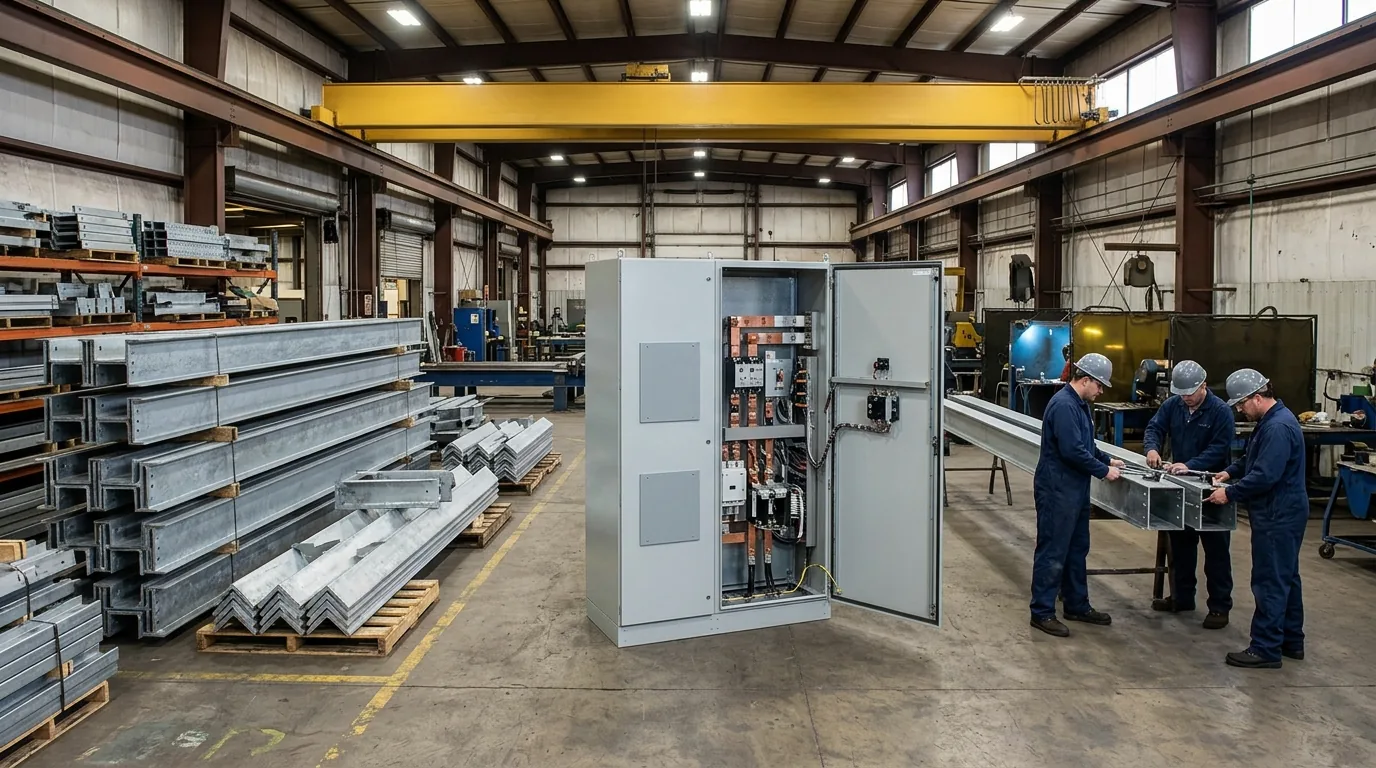
On power-equipment builds, the time lost is rarely in the cutting or the welding — it's in the handoffs between vendors. Here's why a single source for the metal and the electrical work consistently shortens lead times.
- Most schedule slippage happens at vendor handoffs, not at the machines.
- One source for metal and electrical removes drawing, scheduling, and accountability gaps.
- Single-source also tightens quality — one quality system, one traceability chain.
- The result is fewer queues and a date you can actually plan around.
The hidden cost of handoffs
Every time a job crosses a vendor boundary, it joins a new queue, waits on a new schedule, and risks a new miscommunication. On a build that splits the metal enclosure from the electrical work, those boundaries multiply — and the calendar absorbs every one of them. The machines are rarely the constraint; the seams between vendors are.
What single-source removes
A single source for the metal and the electrical build removes those seams. Drawings, scheduling, and accountability sit in one place; there's no waiting for one vendor to finish before another can start, and no finger-pointing when something's off. For transformer OEMs, that's the difference between coordinating two suppliers and managing one deliverable.
Every vendor boundary is a queue. Single-source fabrication is, at heart, the removal of queues.
One quality system, one chain
Single-source also tightens quality. One ISO 9001 system governs the whole build, one traceability chain runs end to end, and there's no gap where a spec gets lost between vendors. Fewer handoffs mean fewer places for quality to drift.
When single-source matters most
It matters most on complex builds and tight timelines — exactly the conditions datacenter and EPC work create. As capacity tightens industry-wide, the buyers who consolidate vendors are the ones holding their dates.
Frequently asked questions
What is single-source fabrication?
Single-source fabrication means one shop performs all core work — including both the metal and the electrical build — rather than splitting it across multiple vendors.
Why does single-source shorten lead times?
It removes the vendor handoffs where jobs join new queues and wait on new schedules. Fewer boundaries mean fewer delays.
Does single-source affect quality?
Yes, positively — one quality system and one traceability chain govern the whole build, with no gaps where a spec can get lost between vendors.
When is single-source most valuable?
On complex builds and tight timelines, such as datacenter and EPC work, where handoffs are most likely to cost schedule.