The power grid is the largest machine ever built, yet most people never think about it until it stops. Here's how electricity actually travels from a distant power plant to the outlet on your wall — and the three-layer system that makes it possible.
- The grid works in three layers: generation (making power), transmission (moving it long distances at high voltage), and distribution (delivering it locally).
- Voltage is stepped up for long-haul transport and stepped down near you — transformers are the machines that do both.
- The contiguous U.S. isn't one grid but three largely separate interconnections: Eastern, Western, and Texas.
- Nearly every piece of that system is bolted to fabricated steel — enclosures, tanks, frames, and support structures.
The grid in three layers: generation, transmission, distribution
It helps to picture the grid as a highway system for electrons. Power is produced in bulk at big plants, carried long distances on high-voltage "interstates," and then handed off to smaller and smaller "local roads" until it reaches a single building. Engineers split that journey into three stages.
Generation is where electricity is made — natural gas, nuclear, hydro, wind, solar, and coal plants all spin generators (or, in the case of solar, convert sunlight directly) to produce electric power. Transmission is the long-haul network of tall towers and heavy conductors that moves that power hundreds of miles from where it's generated to the regions that need it. Distribution is the last stretch — the poles, pad-mounted equipment, and lines that fan power out through neighborhoods and industrial parks to individual meters.
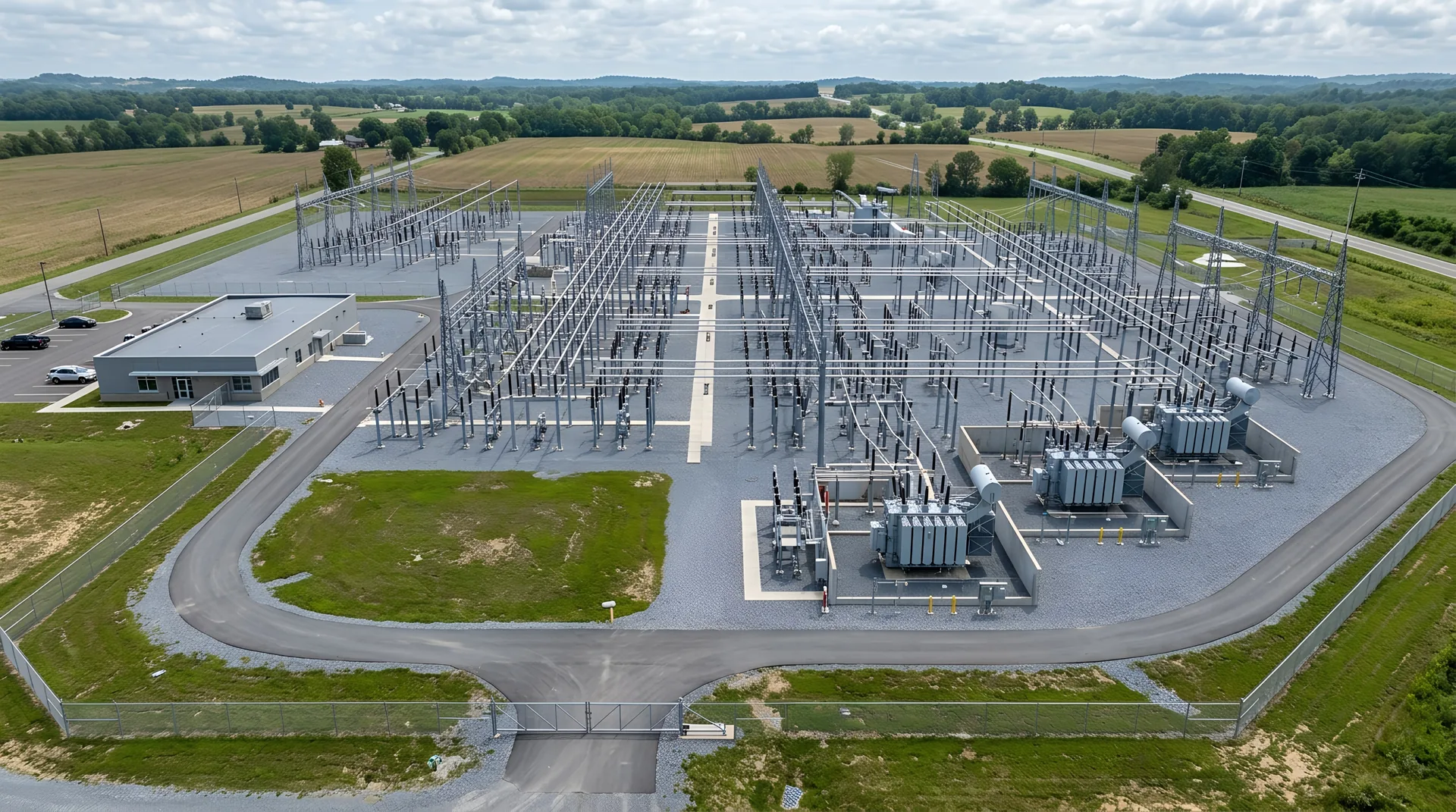
Between each stage sits a substation, the place where voltage is changed and power is routed. Substations are the interchanges of the grid, and they're where a huge amount of fabricated equipment lives.
Why the grid runs at hundreds of thousands of volts
Here's the counterintuitive part: to move power efficiently over long distances, the grid pushes it to extraordinarily high voltages — often 115,000 to 765,000 volts on the transmission network. The reason is loss. When current flows through a wire, some energy is wasted as heat, and that waste rises sharply with current. By raising the voltage, you can carry the same amount of power with far less current, which means far less loss over hundreds of miles.
That's the entire job of a power transformer: step the voltage up for the long trip, then step it down — in stages — as the power gets closer to where it's used. By the time electricity reaches a home, it has been transformed several times, ending at the familiar 120/240 volts at the outlet.
Transformers don't generate a single watt of power. They just change its voltage — and without them, a long-distance grid simply wouldn't be practical.
The U.S. isn't one grid — it's three
People say "the grid" as if it's a single national network, but the contiguous United States actually runs on three largely independent systems, called interconnections. The Eastern Interconnection covers everything from the Great Plains to the Atlantic. The Western Interconnection covers the Rockies to the Pacific. And Texas runs its own grid, managed by ERCOT, deliberately kept mostly separate from the other two.
Within each interconnection, every generator spins in near-perfect synchronization, all locked to the same rhythm. That shared rhythm — the grid's frequency — is how supply and demand stay balanced across thousands of power plants at once. It's a remarkable feat of coordination, and it's why an event in one corner of an interconnection can ripple across the whole thing.
Why the grid runs on alternating current
The grid runs on alternating current (AC), where the flow of electricity reverses direction 60 times per second in North America — that's the "60 Hz" you'll see stamped on appliances. AC won out over direct current more than a century ago for one practical reason: it's easy to change AC voltage with a transformer. Since efficient long-distance transport depends on stepping voltage up and down, AC made a continent-spanning grid feasible.
High-voltage direct current (HVDC) has made a comeback for specific long, point-to-point links, but the backbone of the grid — and virtually all of the equipment fabricated to support it — is built around AC at 60 Hz.
The fabricated steel behind every mile of grid
Strip away the electricity and the grid is, physically, an enormous amount of steel and metal enclosure. Transmission structures hold the conductors in the air. Substation support frames position and restrain the energized equipment in the yard. Transformers sit inside welded steel tanks. Switchgear and controls live inside weatherproof enclosures. Bus ducts carry current between major components.
That's the part of the grid FabTek builds. We fabricate transformer cabinets and tanks, coils and windings, bus ducts, switchgear enclosures, and substation and transmission structures — the metal that everything else bolts to — from our sites in Hazlehurst, Mississippi. If you're specifying equipment for a grid project and want it built domestically to print, send us the drawings.