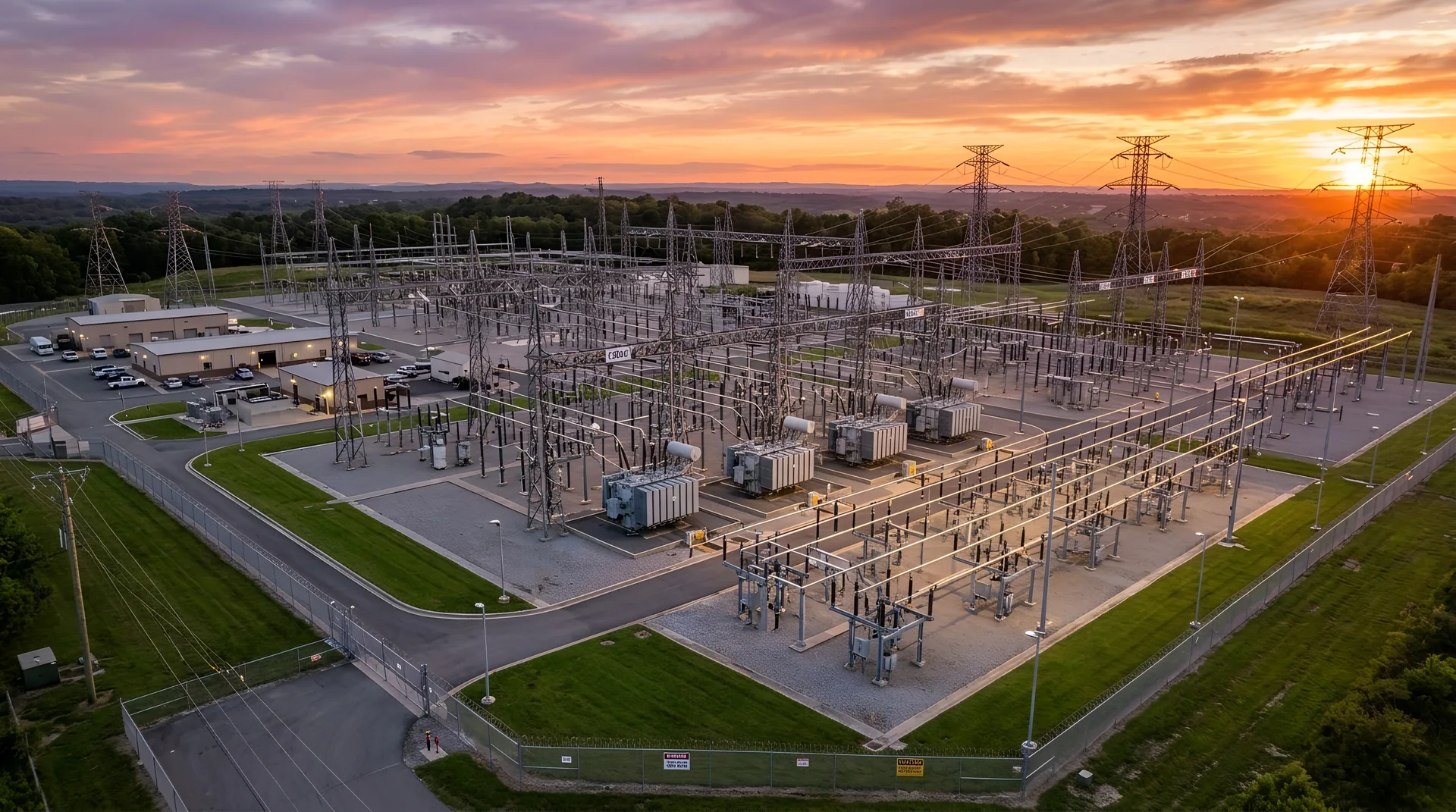
Electricity can't be stored in bulk the way water sits in a reservoir — for the most part, it's made and used in the same instant. Keeping the entire grid's supply matched to its demand, second by second, is one of the hardest balancing acts in engineering. Here's how it's done.
- Generation must match demand instantaneously — electricity is largely produced and consumed at the same moment.
- Frequency (60 Hz in North America) is the real-time signal of that balance: it dips when demand outruns supply and rises when supply outruns demand.
- Grid operators — ISOs and RTOs — continuously dispatch generation to hold the balance, under reliability rules set by NERC.
- When balance slips too far, the grid protects itself by shedding load — controlled outages beat an uncontrolled blackout.
Electricity is made and used in the same instant
The defining challenge of the grid is that, at scale, electricity isn't stored — it's generated at the exact moment it's consumed. When you turn on an air conditioner, a generator somewhere has to produce a little more power essentially right then. Multiply that by hundreds of millions of devices switching on and off unpredictably, and you have a system where total supply has to track total demand continuously, all day, every day.
Batteries are starting to change this at the margins, providing short bursts of storage, but the vast majority of grid power still has to be produced on demand. There's no buffer tank to draw down.
Frequency: the grid's balance signal
How do operators know, instant to instant, whether supply and demand are matched? They watch frequency. Across an interconnection, every generator spins in sync, and together they hold the grid's alternating current at 60 cycles per second. That frequency is a direct readout of balance: when demand exceeds supply, the generators are dragged down slightly and frequency dips below 60 Hz; when supply exceeds demand, frequency edges up. Operators use that tiny deviation — fractions of a hertz — to add or back off generation and pull the system back to 60 Hz.
Frequency is the whole grid's heartbeat. Hold it at 60 Hz and supply and demand are balanced; let it drift and something has to give.
Who actually runs the balancing act
In much of the country, independent grid operators — ISOs and RTOs, with names like PJM, MISO, ERCOT, and CAISO — run this second-by-second dispatch across their regions, deciding which plants ramp up or down to keep the balance and the frequency steady. Above them, the North American Electric Reliability Corporation (NERC) sets and enforces the reliability standards the whole system operates to. It's a layered system of markets, control rooms, and rules, all aimed at the same goal: keep the lights on by keeping supply and demand matched.
What happens when the balance slips
When the balance breaks faster than operators can correct it, the grid protects itself. If frequency falls too far, automatic systems shed load — deliberately cutting power to some areas to save the whole — because a controlled, localized outage is far better than an uncontrolled cascade that blacks out a region. The same logic explains sudden events on the demand side: in mid-2024, a voltage disturbance in northern Virginia caused around 60 data centers to disconnect from the grid almost at once, dumping roughly 1,500 megawatts of unexpected surplus onto the system and forcing operators to react quickly to keep frequency in check.
Events like that show how tight the tolerances really are — and why a large, concentrated load switching on or off is something operators have to plan around.
Why the balancing act is getting harder
Two trends are making balance harder to hold. On the supply side, variable resources like wind and solar produce power when the weather cooperates, not necessarily when demand peaks, so operators need more flexible generation and storage to fill the gaps. On the demand side, large new loads — data centers above all — are growing fast and clustering in regions that then need major grid reinforcement.
Both trends lead back to the same place: more substations, more transformers, more switchgear, and more of the fabricated steel that houses it all. FabTek builds that equipment domestically in Hazlehurst, Mississippi, and has been adding capacity ahead of the demand curve. If you're building for a grid that's getting bigger and busier, we'd like to help.