Flip a switch and the light comes on instantly — but the electricity behind it has traveled a remarkable path. Here's the whole journey, from a power plant that might be a hundred miles away all the way to the outlet in your wall.
- Power is stepped up to high voltage for transport, then stepped down in stages as it nears you.
- The distribution transformer on the pole or pad near you makes the final drop to household voltage.
- U.S. homes get split-phase 120/240 V — 120 for outlets, 240 for big appliances.
- The "last mile" of distribution is where most of the equipment — and most of the outages — actually are.
The journey, stage by stage
It starts at a generator, where electricity is produced at a medium voltage. Right away, a step-up transformer boosts it to transmission voltage — often over 100,000 volts — so it can travel long distances with minimal loss. From there it rides the transmission network, the tall lattice and tubular towers you see marching across open country.
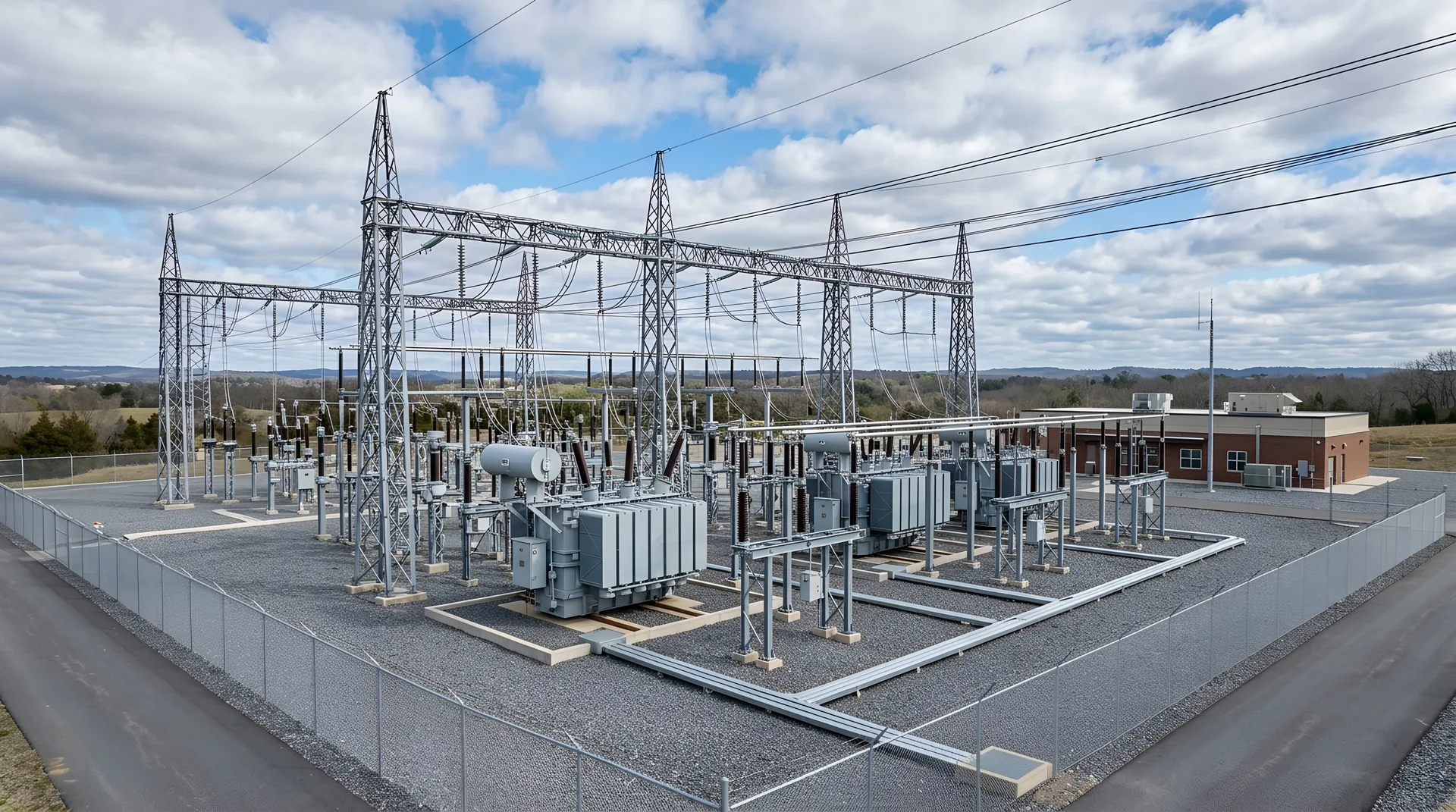
When it reaches the region that needs it, the power enters a transmission substation, where a large transformer knocks the voltage down to a subtransmission or distribution level. It may pass through a second, distribution substation that steps it down again and splits it onto the local feeders that run through your area. By the time power is traveling down your street, it's at a "primary" distribution voltage — commonly somewhere in the range of a few thousand to a few tens of thousands of volts.
The transformer near you does the final step-down
The last transformer in the chain is the one closest to you — the cylinder on the utility pole or the green box on the pad outside. This distribution transformer takes that primary voltage and drops it to the level your home or business actually uses. It's small compared to the giants at a substation, but there are millions of them, and collectively they represent an enormous amount of installed equipment.
By the time electricity reaches your outlet, it has been transformed multiple times — each step trading voltage for the practical, safe levels equipment can use.
Why your outlets are 120 volts and your dryer is 240
In North American homes, the distribution transformer delivers what's called split-phase power. Two 120-volt lines come in, and depending on how a circuit is wired, an appliance sees either 120 volts (standard outlets, lights) or 240 volts (electric dryers, ranges, HVAC, EV chargers) by connecting across both. That's why some plugs and receptacles look different from the rest — they're the 240-volt circuits.
From the transformer, the power runs to your meter (which measures what you use), then into the service panel, where breakers divide it into the individual circuits that feed each room. Commercial and industrial buildings work on the same principle but often at higher voltages and three-phase power, with their own transformers, switchgear, and distribution equipment on site.
Homes get single-phase; businesses get three-phase
The split-phase supply that feeds a house is a form of single-phase power, and it's fine for lights, outlets, and household appliances. Larger buildings — factories, hospitals, data centers, big commercial sites — are fed three-phase power instead. Three-phase delivers power more smoothly and efficiently, and it's what large motors, HVAC systems, and industrial equipment are built to run on.
The path is the same in principle: high voltage steps down through the site's own transformers and switchgear to the utilization voltage the equipment needs. There's just more of it, at higher power levels, which is why commercial and industrial sites carry so much of their own distribution equipment on the property.
Why the last mile is where things happen
The transmission grid gets the attention, but most of what customers experience happens on the distribution system — the poles, transformers, and lines in the last mile. It's the densest part of the grid, the most exposed to weather and trees, and the part most likely to be the reason your lights flicker. It's also where a huge share of grid equipment is installed and, eventually, replaced.
All of that equipment lives inside fabricated metal: pad-mount enclosures, cabinets, switchgear housings, and mounting hardware. FabTek builds that kind of equipment domestically in Hazlehurst, Mississippi — enclosures and assemblies engineered for the field. If you're sourcing distribution-class equipment and want it built to spec, reach out.