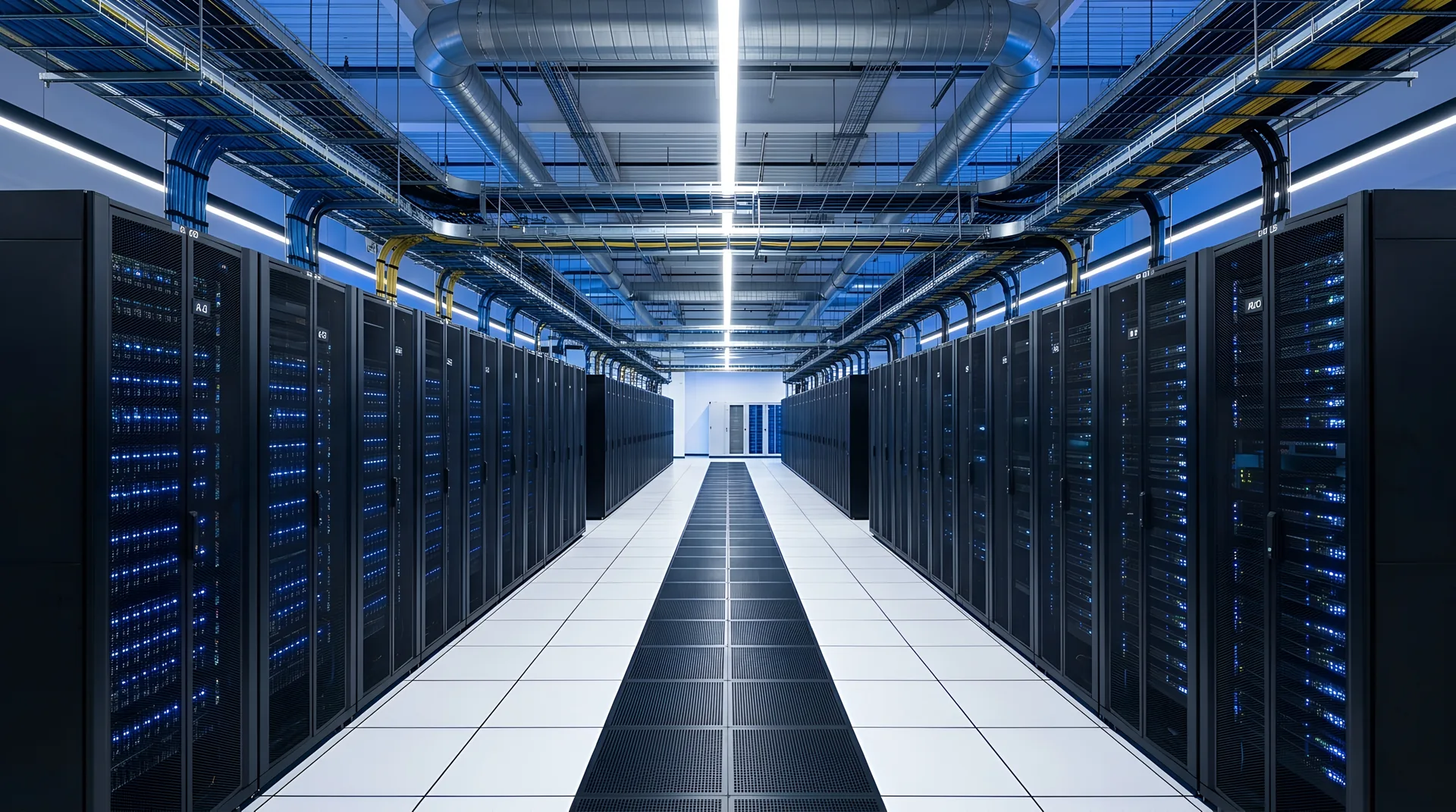
A single large data center can draw as much power as a small city — continuously, around the clock. Here's how that power travels from the grid all the way to a server rack, and why this new class of load is reshaping how the entire grid gets planned.
- U.S. data centers used about 4.4% of national electricity in 2023, with federal analysis projecting roughly 6.7–12% by 2028.
- Power flows from the grid → on-site substation → switchgear → bus duct → PDU → server rack.
- Everything is redundant — UPS systems and backup generators are sized so a single failure never drops the load.
- This dense, always-on demand is pulling grid planning, and a lot of fabrication, toward the campuses.
The scale of the load
Data centers are unusual customers. They run flat-out 24/7, they cluster together, and the largest hyperscale campuses can each demand power on the order of a small city. Federal analysis found U.S. data centers consumed roughly 4.4% of the nation's electricity in 2023 and projected that share could climb to somewhere between 6.7% and 12% by 2028 — driven largely by AI computing. In absolute terms, that's a jump from around 176 terawatt-hours in 2023 to a projected 325–580 terawatt-hours by 2028.
For the grid, a load like that doesn't just mean "more electricity." It means new substations, new transmission, and a lot of new equipment, concentrated in specific regions — which is exactly why the transformer supply chain is under so much strain.
The path: from the grid to the rack
Follow the power in from the property line and you'll see a clear chain, each stage stepping voltage down and dividing it up:
- Utility feed & on-site substation — high-voltage power arrives and is stepped down for the campus.
- Medium-voltage distribution — power moves around the site and into each building.
- Switchgear — switchgear distributes and protects the circuits feeding the power halls.
- Transformers — step the voltage down again to what the IT equipment uses.
- Bus duct / busway — heavy bus ducts carry large currents efficiently overhead to rows of racks.
- PDUs & rack — power distribution units make the final split to individual servers.
Bus duct matters more here than in most buildings: at data-center current levels, running that much power in cable becomes impractical, so a rigid bus duct system is the efficient way to move it and tap off it as the layout changes.
Why everything is doubled up
Data centers are engineered so that no single failure takes the load down. That's the meaning of designations like N+1 (one spare beyond what's needed) or 2N (a full duplicate path). Between the grid and the servers sit uninterruptible power supplies (UPS) that carry the load for the seconds it takes backup generators to start, and generators sized to run the whole facility through an extended grid outage.
All of that redundancy multiplies the equipment count. Every redundant path needs its own switchgear, its own enclosures, its own bus — which is why a data center campus is one of the most fabrication-heavy structures you can build.
Why this reshapes grid planning
A load this large and this concentrated changes the math for utilities. A single campus can require its own transmission connection and dedicated substations, and a cluster of them can shift a whole region's demand curve. That's led to multi-billion-dollar grid upgrades in the areas where data centers are landing — including, as we've written, right here in central Mississippi.
The fabrication behind the power hall
Behind every megawatt is metal: bus ducts, switchgear enclosures, transformer tanks and cabinets, and structural steel. It has to be built accurately, finished for the environment, and delivered on a schedule that keeps a fast-moving construction project on track. FabTek fabricates datacenter-grade bus ducts, switchgear enclosures, and related equipment domestically in Hazlehurst, Mississippi — metal and electrical under one roof. If you're building for this kind of load, send us your scope.