Transformers are the quiet workhorses of the grid — you pass dozens of them every day without noticing. Here's how a device with no moving parts changes voltage, why the whole grid depends on it, and what's inside that steel tank.
- A transformer changes voltage using electromagnetic induction — two coils sharing a magnetic core, with no moving parts.
- Step-up transformers raise voltage for long-distance transport; step-down units lower it for use.
- Transformers only work on alternating current — the changing current is what makes induction happen.
- Inside the tank: a grain-oriented electrical steel core, copper or aluminum windings, insulating oil, and bushings — housed in fabricated steel.
The core idea: two coils and a magnetic field
A transformer has no engine, no gears, and no moving parts, yet it can turn 20,000 volts into 240 with startling efficiency. The trick is a principle called electromagnetic induction. Wrap a coil of wire around an iron core and run alternating current through it, and the constantly changing current creates a constantly changing magnetic field in the core. Wrap a second coil around that same core, and the changing field induces a voltage in it — even though the two coils never touch.
The voltage that appears in the second coil depends on a simple ratio: how many turns of wire it has compared to the first. More turns on the output side and the voltage goes up; fewer turns and it goes down. That turns ratio is the entire secret. A transformer isn't amplifying anything — it's trading voltage for current, keeping the power roughly constant, minus small losses.
Step-up vs. step-down: same device, opposite jobs
At a power plant, a step-up transformer takes the generator's output and raises it to transmission voltage so it can travel long distances efficiently. Near the destination, a series of step-down transformers bring it back down — first at a transmission substation, then at a distribution substation, and finally at the transformer on the pole or pad near your building.
Mechanically they're the same machine; which coil you feed power into decides whether it steps up or down. That's why the grid needs so many of them: every change in voltage, in either direction, is a transformer doing its job.
Raises voltage after generation — for example, from a generator's output up to transmission levels — so power can travel hundreds of miles with minimal loss.
Lowers voltage in stages as power nears its destination, ending at the utilization voltage that equipment and appliances actually use.
Why transformers are everywhere
Once you know what to look for, transformers are impossible to miss. The gray cylinder on a utility pole is a distribution transformer. The green metal box on a concrete pad in a subdivision is a pad-mounted transformer. The large equipment humming inside a fenced substation yard includes power transformers the size of a small house. Inside a factory or data center, more transformers step the incoming power down again for the equipment on the floor.
That hum, by the way, is real — it's the core physically expanding and contracting 120 times a second as the magnetic field reverses. A healthy transformer is a boring transformer.
What's actually inside the tank
A power transformer is more than a box of wire. The heart of it is a core made of grain-oriented electrical steel (GOES) — a specialized steel rolled so its magnetic properties line up in one direction, cutting the energy lost each time the field reverses. Around that core are the windings, usually copper or aluminum, precisely wound and insulated. The whole assembly sits in a sealed steel tank filled with insulating oil that both cools the unit and prevents electrical arcing. Bushings let the high-voltage connections pass safely through the tank wall, and radiators shed heat.
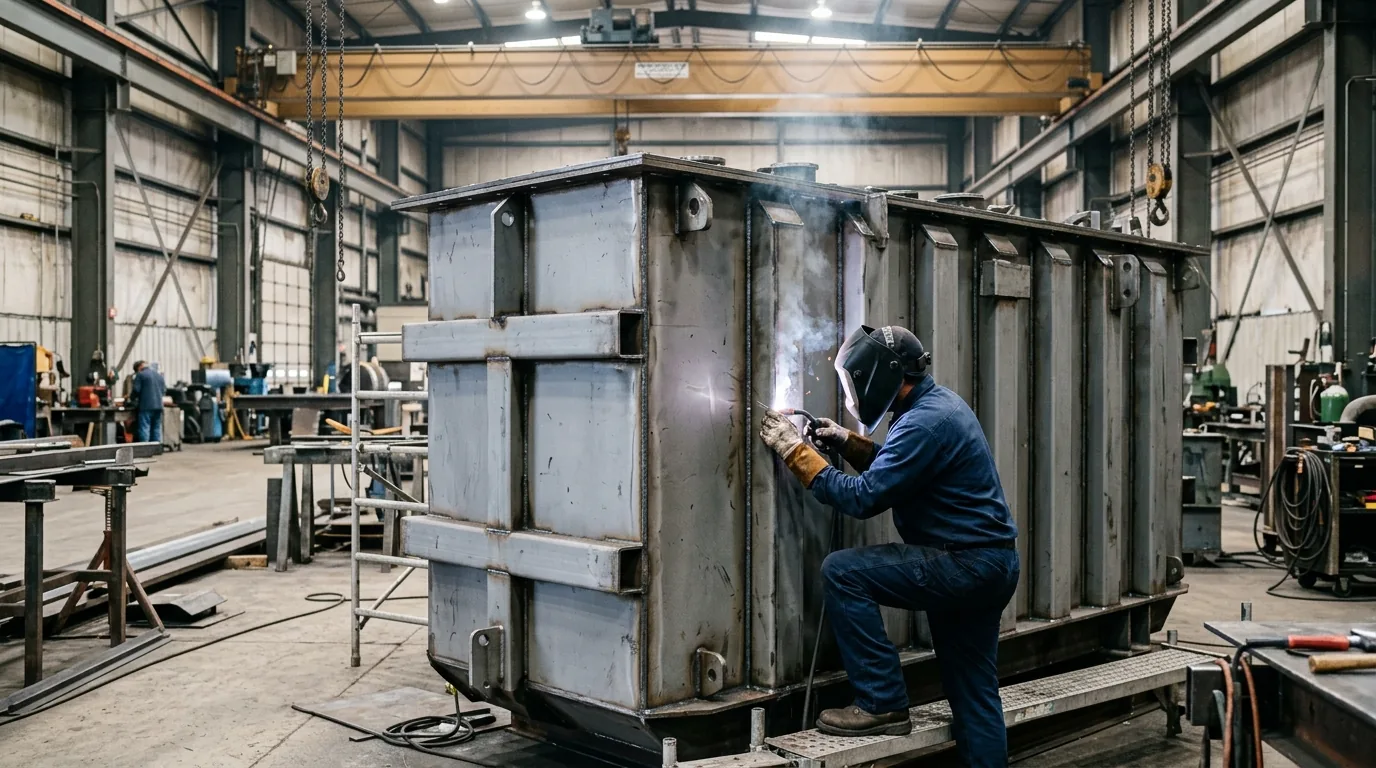
Every one of those elements is exacting work. The coils and windings have to be wound and assembled to tight tolerances; the tank has to be welded to hold oil for decades without a leak. FabTek fabricates both the metal and the electrical side of this equipment under one roof — a rare single source for the components that go into transformers.
Why new transformers take so long to get
Because transformers are highly customized and built from specialized materials, they've become one of the hardest pieces of grid equipment to buy. Large power transformers are often engineered to a specific project's requirements, use materials with their own supply constraints, and are built by a limited number of manufacturers. The result: lead times that now routinely stretch past two years, with the most specialized units taking longer still.
That bottleneck is reshaping how utilities and developers plan projects — and it's a big part of why domestic fabrication capacity matters more than ever. We dug into the causes in a companion piece on how the transformer supply chain works.