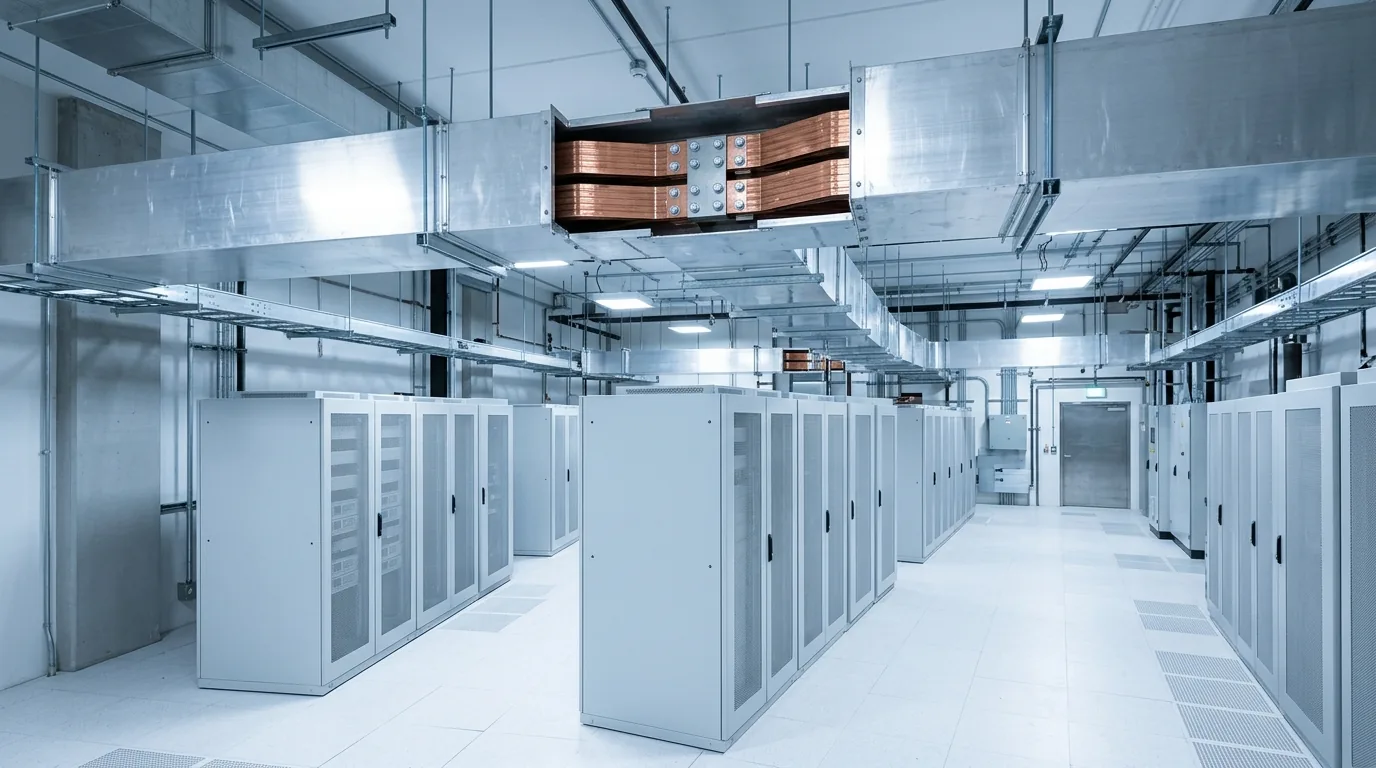
Datacenter power timelines keep compressing, and bus duct is often on the critical path. Here's what to confirm when you source it — ampacity and spec, realistic lead time, and whether a shop can absorb your surge.
- Confirm ampacity, conductor, and configuration against the actual one-line — not a generic spec.
- Lead time is a capacity question; ask how the shop scales, not just its quote.
- Surge capacity matters — hyperscale schedules move, so the fabricator has to flex.
- Single-source (steel + electrical) removes coordination drag on tight timelines.
Start with the one-line, not a generic spec
Bus duct decisions should come off the actual one-line diagram: ampacity, conductor material, configuration, and routing. A bus duct quoted against a generic spec tends to need revision once real loads and layout land — and revisions on the critical path are expensive.
Lead time is a capacity question
A lead-time number is only as good as the capacity behind it. Ask how the shop runs fabrication and how it scales output — dual shifts, backup machines, overflow capacity. For datacenter work, throughput and the ability to hold a date matter more than a marginally lower unit price.
On a datacenter build, the question isn't just ‘what's your price’ — it's ‘can you absorb my surge without slipping the date.’
Surge capacity for hyperscale schedules
Hyperscale timelines move, and demand spikes. The fabricators worth shortlisting can flex — absorb a surge through rush-order support and overflow capacity without compromising quality.
Why single-source matters on tight timelines
When the metal and the electrical build sit at one shop, you remove the coordination drag between vendors. For EPC contractors on a compressed schedule, single-source fabrication is often the difference between hitting and missing the energization date.
What to confirm before you award
- Ampacity, conductor, and configuration are pinned to the one-line.
- The shop's capacity and scaling approach (shifts, backup, overflow) are clear.
- Surge capacity is demonstrated, not just claimed.
- Steel and electrical scope can be single-sourced.
- Lead time is tied to a realistic delivery and energization date.
FabTek builds datacenter-grade bus ducts in-house and has stood up dedicated lines on short notice. If you have a one-line or a scope, send it over.
Frequently asked questions
What determines bus duct lead time?
Primarily the fabricator's capacity and how many handoffs are in the process. A shop with in-house fabrication, dual-shift capability, and backup equipment can hold tighter dates.
How do I size bus duct for a datacenter?
Size from the actual one-line diagram — ampacity, conductor material, and configuration — rather than a generic specification.
Can a fabricator handle rush datacenter orders?
Some can. Look for demonstrated surge capacity: dual shifts, overflow facilities, backup machines, and a track record of standing up dedicated lines quickly.
What's the advantage of single-source bus duct fabrication?
A single source for the metal and the electrical build removes vendor coordination drag, which is often where weeks are lost on compressed datacenter schedules.