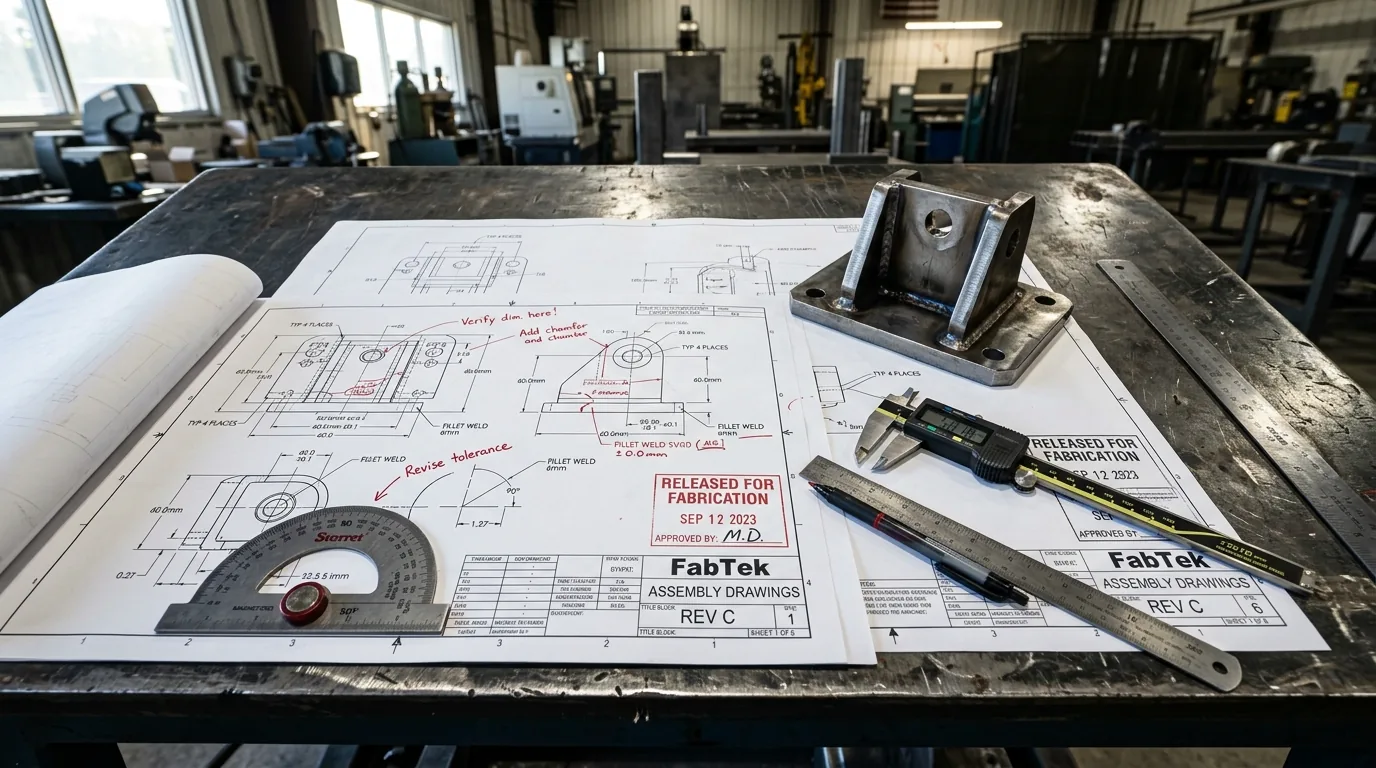
Build-to-print only works if the print is complete. Here's how to write a spec package a fabricator can quote accurately and build right the first time — and where ambiguity quietly turns into rework.
- Freeze the drawing set and revision; ambiguity becomes rework and change orders.
- Specify tolerances, materials, and finish explicitly rather than leaving them to assumption.
- Define acceptance criteria and the documentation you expect up front.
- A complete package gets you accurate quotes and fewer surprises.
Start with a frozen drawing set
Build-to-print puts the burden of completeness on the print. Freeze the drawing set and revision before you send it out for quote. Every ambiguity left in the drawings is one the shop has to fill with an assumption — and you find out which way at first article, when changing it is expensive.
Specify tolerances and materials
State the controlling tolerances, the material grade, and gauge explicitly. "Standard" means different things to different shops; a tolerance you assumed and didn't write is a tolerance you didn't buy. For custom and build-to-print work, this is where most rework originates.
Every assumption you leave in a print, the shop fills in for you — and you find out which way at first article.
Call out the finish
Specify the finish system — powder coat, galvanizing, or duplex — and the standard it meets. Our galvanizing vs. paint guide covers the trade-offs; the point here is simply to say it on the print rather than leave it open.
Define acceptance and documentation
Agree on acceptance criteria, inspection points, and the records you'll receive before the first lot runs. Acceptance criteria written after the fact are arguments waiting to happen.
A complete spec package
- Frozen drawing set and revision.
- Controlling tolerances, material grade, and gauge stated.
- Finish system and standard specified.
- Acceptance criteria, inspection points, and required records defined.
FabTek builds to print for OEMs and utilities under an ISO 9001:2015 system. Send your package and we'll flag anything that needs pinning down before we quote.
Frequently asked questions
What is build-to-print fabrication?
Fabrication to a customer's complete drawings and specifications, where the shop builds exactly what the print defines rather than designing it.
What should a build-to-print spec package include?
A frozen drawing set with revision, controlling tolerances, material grade and gauge, finish system and standard, and acceptance criteria with required documentation.
How do I avoid rework on a fabrication order?
Remove ambiguity from the print up front — specify tolerances, materials, finish, and acceptance criteria so the shop isn't filling gaps with assumptions.
Why do incomplete drawings raise costs?
Because the shop prices in risk for the unknowns and any wrong assumption surfaces at first article, when changes are most expensive.